AI Recommendations
AI Product Recommendations for Shopify — Increase AOV by 20-35%
AI-powered product recommendations for Shopify use machine learning to analyze shopper behavior, cart contents, and purchase history in real time — delivering personalized product suggestions that increase average order value by 20-35%.

Quick Summary
- Algoshop's AI-powered Product Recommendation Card analyzes real-time shopper behavior — pages viewed, time spent, cart contents, and past purchases — to suggest products that are contextually relevant and personalized.
- Merchants using Algoshop's recommendation engine report AOV increases of 20-35%. For a store with $100 AOV and 1,000 monthly orders, this equals $20,000-35,000 in incremental monthly revenue.
- Unlike basic "Frequently Bought Together" widgets, Algoshop's AI recommendations are conversational and proactive — appearing within the chat widget with personalized messaging that explains why each product is recommended.
How AI Product Recommendations Work
Algoshop's recommendation engine operates in real time through the Shopify Admin API. When a shopper browses your store, the AI reads their session data: which products they viewed, how long they spent on each page, what they added to their cart, and their purchase history from previous visits. This data is processed through the multi-model AI architecture — GPT-5.5 for complex recommendation logic, Gemini 3 for multilingual product descriptions, and DeepSeek V4 for high-volume catalog matching.
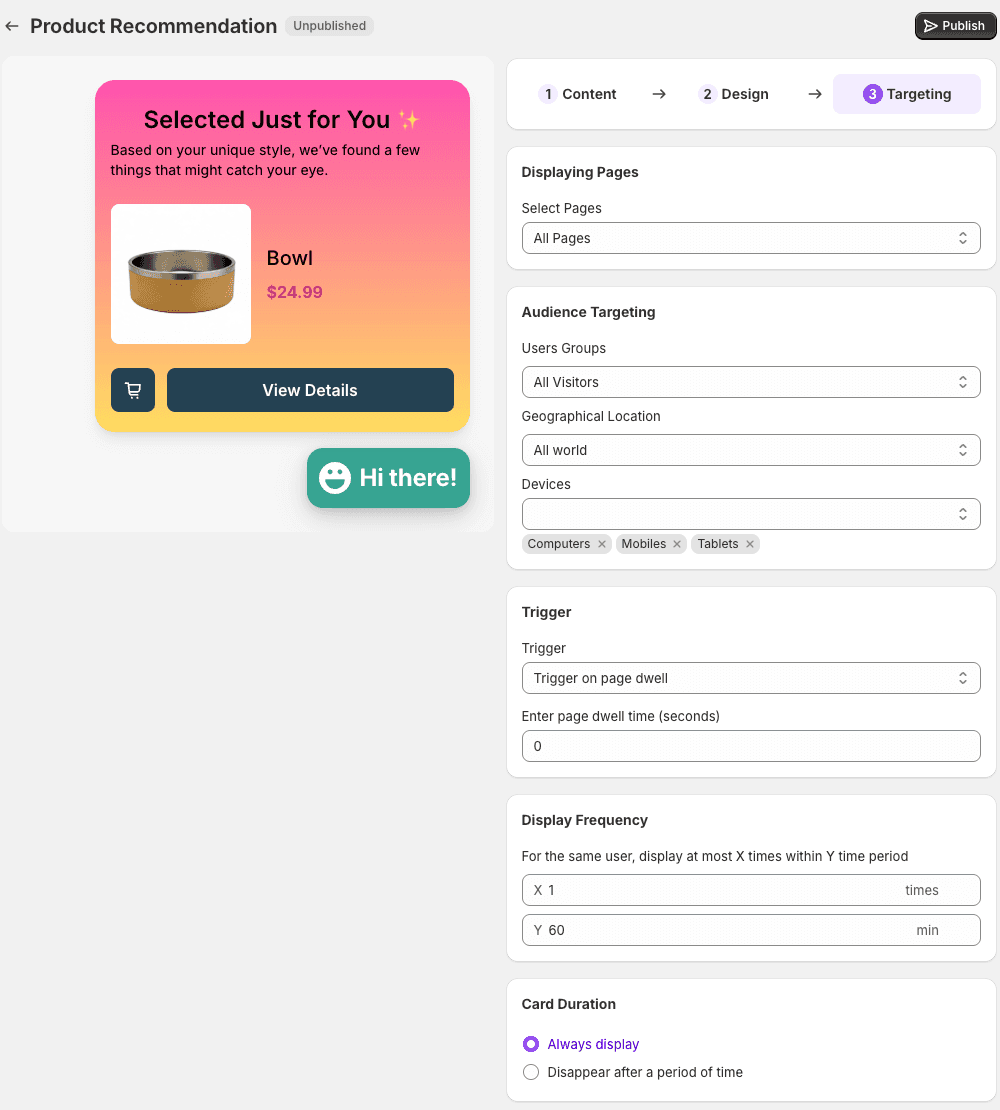
The result is a Product Recommendation Card that appears at the right moment with the right product suggestion. Unlike static recommendation widgets that show the same suggestions to every shopper, Algoshop tailors each recommendation to the individual shopper's context. A first-time visitor browsing winter jackets sees different suggestions than a returning customer who previously purchased a matching accessory.
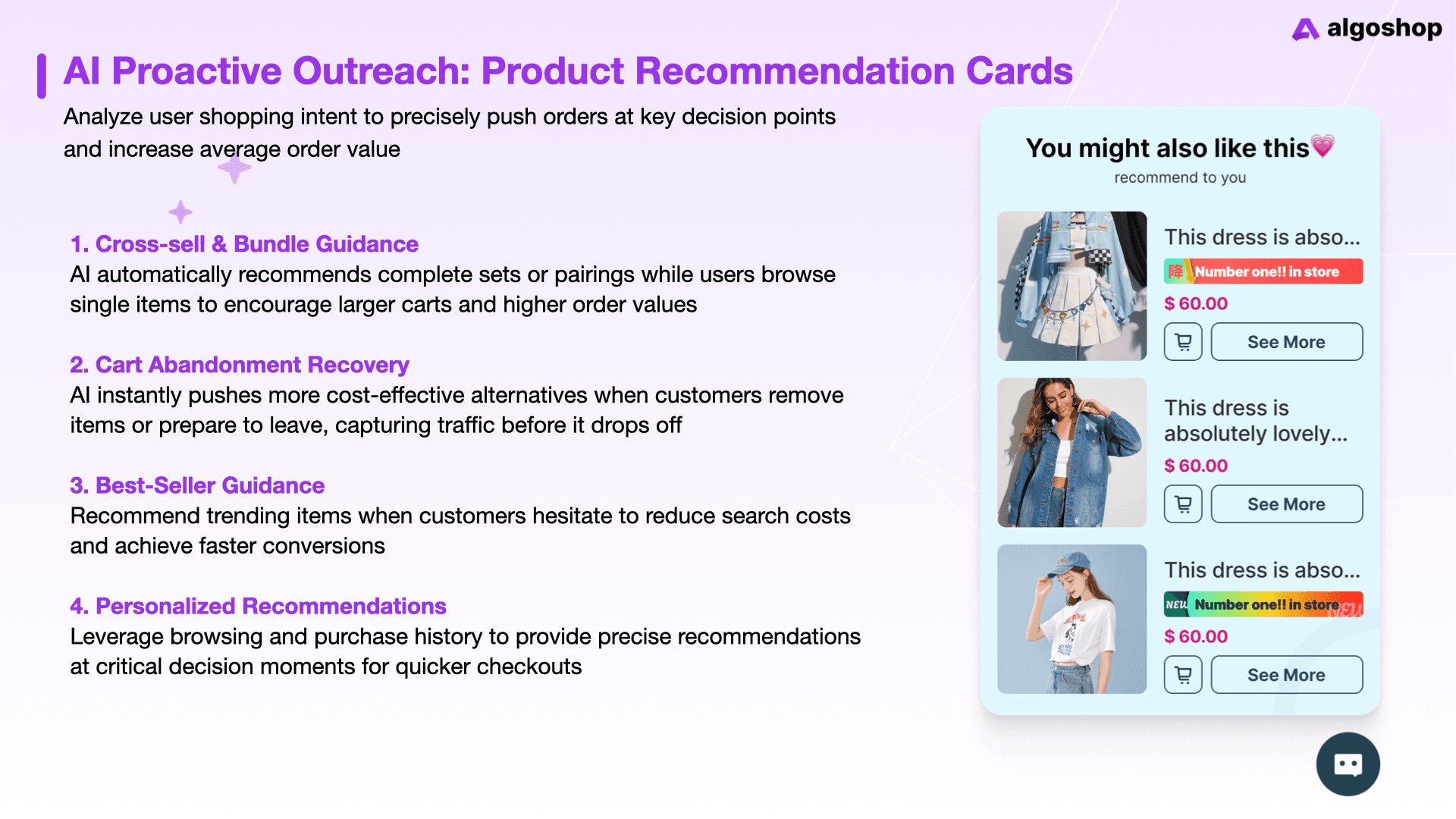
The recommendation card appears conversationally within the chat widget — not as a distracting pop-up or a generic sidebar widget. The AI explains why the product is recommended, referencing the shopper's specific behavior (e.g., "Since you were looking at the Merino Wool Sweater, you might also like these matching accessories"). This contextual framing dramatically increases click-through and conversion rates compared to unlabeled product suggestions.
The Technology Behind AI Product Recommendations
Algoshop uses a multi-model AI architecture that routes recommendation tasks to the most appropriate language model for each job. GPT-5.5 handles the most complex recommendation logic — understanding nuanced shopper intent, cross-category relationships, and seasonal buying patterns. Gemini 3 powers multilingual product descriptions, ensuring recommendations feel natural in all 15 supported languages. DeepSeek V4 manages high-volume catalog matching, scanning thousands of SKUs in milliseconds to find the most relevant complementary products.
The system processes three data streams simultaneously. Behavioral data captures real-time browsing patterns — product views, dwell time, scroll depth, and navigation paths. Cart data monitors contents, quantities, and total value to identify upsell and cross-sell opportunities. Historical data draws on past purchases, order frequency, and category affinity to build a long-term shopper profile that improves with each visit.
All processing happens within the Shopify ecosystem through the Admin API. Store data never leaves Shopify's infrastructure for recommendation processing. The AI generates recommendations on-the-fly — there is no batch processing, no periodic model retraining, and no need to export product data to a third-party platform.
Types of AI Recommendations Algoshop Delivers
Algoshop generates four distinct recommendation types, each designed for a specific conversion goal. Cross-sell recommendations suggest complementary products to items already in the cart — batteries for electronics, cases for phones, belts for pants. Upsell recommendations suggest higher-value alternatives or premium versions of the product being viewed. Accessory recommendations pair add-on items with the primary product a shopper is considering. Bundle recommendations group related products into a discounted package to increase total order value.
Each recommendation type is triggered by specific shopper behaviors. Cross-sells activate when a product is added to the cart. Upsells trigger when a shopper dwells on a product page for more than 15 seconds. Accessory recommendations appear when the AI detects the shopper is in a research phase — viewing multiple product pages in a category. Bundle recommendations fire when the cart contains two or more products that belong to a known product grouping.
The AI also learns from outcomes. When a recommendation is shown but ignored, the system notes the context and refines future suggestions for that shopper. When a recommendation leads to a purchase, the system reinforces that recommendation pattern for similar shoppers. Over time, each store's recommendation engine becomes more precise and more profitable.
Revenue Impact: From $100 AOV to $135 AOV
Merchants using Algoshop's AI Product Recommendation Card consistently report AOV increases of 20-35%. For a store processing 1,000 orders per month with a $100 average order value, this translates to $20,000 to $35,000 in incremental monthly revenue — without spending a dollar on additional traffic. The ROI calculation is straightforward: if the recommendation engine increases AOV by 25%, every $100 in existing revenue becomes $125 with no incremental ad spend.
The revenue impact compounds across multiple purchases. A shopper who receives a personalized recommendation on their first order is more likely to return, and on subsequent visits the AI has more data to work with. Returning customers who engage with recommendations spend 30-45% more per order than those who don't, according to aggregated Algoshop merchant data.
The most significant gains come from the conversational presentation format. Unlike sidebar widgets or email recommendations that shoppers ignore, the chat-based recommendation card captures attention because it feels like a personal shopping assistant. The AI explains the rationale behind each suggestion, which builds trust and drives higher conversion rates on recommended products.

AI Recommendations vs. Static Recommendation Widgets
Most Shopify stores use basic recommendation widgets — "Frequently Bought Together" or "You Might Also Like" sections on product pages. These widgets use simple rule-based logic: if product A and product B are frequently purchased together, show B when A is viewed. The system cannot distinguish between a shopper buying a gift for someone else, a repeat customer restocking supplies, or a first-time visitor researching a category.
Algoshop's AI recommendations are fundamentally different. The system understands shopper intent, not just purchase correlations. It can distinguish between a shopper who is price-sensitive vs. quality-focused and adjust recommendations accordingly. It knows when a shopper has already purchased a product and avoids duplicative suggestions. It adapts in real time as the shopper's behavior changes during a single session.
The result is a recommendation engine that feels intelligent rather than mechanical. Shoppers who receive AI-powered recommendations are 3-4x more likely to click through than shoppers shown static widgets, and 2-3x more likely to add the recommended product to their cart. The gap widens on mobile devices, where sidebar widgets are invisible but the chat widget remains prominently accessible.
| Feature | Algoshop | Competitor |
|---|---|---|
| Recommendation Engine | Multi-model AI (GPT-5.5, Gemini 3, DeepSeek V4) | Rule-based or single-model |
| Real-Time Shopper Analysis | Behavior, cart, purchase history — all real time | Periodic batch sync or none |
| Presentation Format | Conversational card with explanation | Static sidebar widget or popup |
| AOV Impact | 20-35% documented increase | 5-15% typical |
| Recommendation Types | Cross-sell, upsell, accessory, bundle | Usually 1-2 types |
| Shopify API Integration | Real-time (live inventory, catalog, pricing) | None or periodic import |
| Proactive Triggers | Dwell time, cart event, exit intent, scroll depth | Cart event only or manual placement |
| Multilingual Support | 15 auto-detected languages | English only or manual translation |
What Merchants Say
"We installed Algoshop for the support automation, but the product recommendations turned out to be the real game-changer. Our AOV went from $85 to $112 in the first 6 weeks — a 32% increase. The AI keeps suggesting products we wouldn't have thought to cross-sell."
Elena Voss
Shopify App Store
"I was skeptical about AI recommendations after bad experiences with bulk email suggestions, but Algoshop's conversational format works differently. Customers actually read the recommendation and ask follow-up questions before buying. Our conversion rate on recommendations is over 18%."
David Park
G2 Review
"What surprised me most is how little maintenance it needs. The AI learns from our catalog automatically — we added 200 new SKUs last month and the recommendations adjusted immediately. No manual tagging, no category mapping, no rules to write."
Amara Osei
Shopify App Store
Sources & References
FAQ
What are AI product recommendations for Shopify?
AI product recommendations use machine learning and large language models to analyze shopper behavior and purchase history in real time, then suggest products that are personalized to each individual shopper. Unlike basic rule-based recommendations ("Frequently Bought Together"), AI recommendations understand context and intent — they can distinguish between a first-time browser, a repeat customer restocking, and someone shopping for a gift, and adjust suggestions accordingly.
How much can AI product recommendations increase AOV?
Merchants using Algoshop's AI-powered product recommendation cards report AOV increases of 20-35%. The recommendations are conversational and personalized, making them significantly more effective than static recommendation widgets. For a store with $100 AOV and 1,000 monthly orders, a 25% increase represents $25,000 in incremental monthly revenue.
How are Algoshop's recommendations different from "Frequently Bought Together" widgets?
"Frequently Bought Together" uses simple correlation rules — if products are often purchased together, they are shown together to everyone. Algoshop's AI analyzes each shopper's unique behavior, cart contents, and purchase history to generate personalized recommendations. It can cross-sell, upsell, suggest accessories, or create bundles based on the individual shopper's context, not aggregate purchase patterns.
Does Algoshop use real-time Shopify inventory data for recommendations?
Yes. Algoshop connects to your store through the Shopify Admin API and reads live inventory levels, pricing, discounts, and catalog data in real time. Recommendations never suggest out-of-stock products, and pricing is always current. If inventory changes mid-session, the AI adjusts its recommendations immediately.
How long does it take to set up AI product recommendations?
Algoshop's Product Recommendation Card requires no coding or manual setup. After installing the app from the Shopify App Store, the AI automatically reads your product catalog and begins generating recommendations within minutes. The system improves over time as it collects more shopper behavior data, but it starts delivering value from the first conversation.
Which AI models power Algoshop's recommendation engine?
Algoshop uses a multi-model architecture: GPT-5.5 for complex recommendation logic and intent understanding, Gemini 3 for multilingual product descriptions, and DeepSeek V4 for high-speed catalog matching across large inventories. Each model handles the task it is best suited for, routed automatically by Algoshop's orchestration layer.
Can AI recommendations work for stores with large catalogs?
Yes. Algoshop's architecture is designed for scale. DeepSeek V4 handles high-volume catalog matching, scanning thousands of SKUs in milliseconds. The system performs equally well for stores with 50 products and stores with 50,000 products. The recommendation accuracy actually improves with larger catalogs because the AI has more data to identify meaningful product relationships.
Does Algoshop support multilingual product recommendations?
Yes. Algoshop auto-detects the shopper's language and generates recommendations in their preferred language from 15 supported options: English, Spanish, French, German, Japanese, Chinese, Portuguese, Italian, Dutch, Korean, Swedish, Danish, Finnish, Indonesian, and Traditional Chinese. The recommendation explanation is written in the shopper's language, not just the product title translated.