AI Chatbot vs Live Chat for Shopify: How to Choose a Support Model
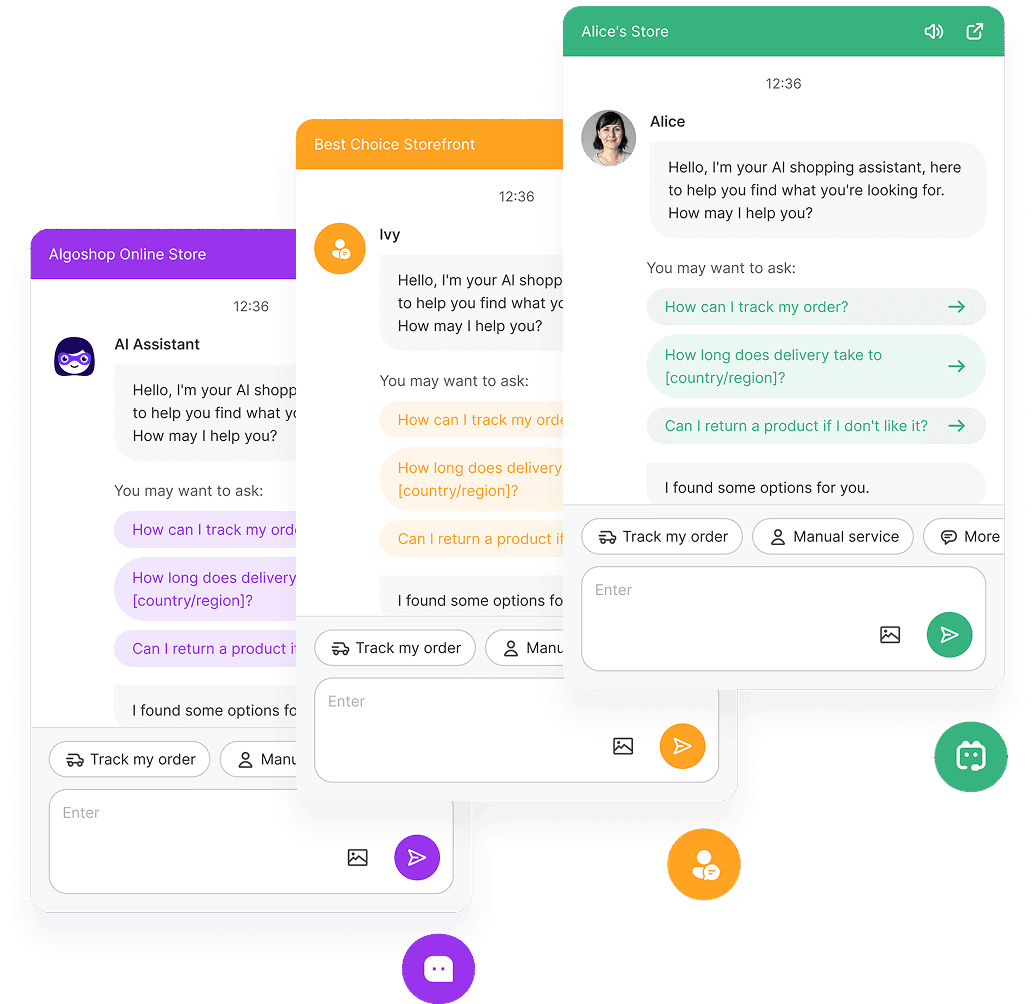
A shopper visits your Shopify store after hours with a sizing question. A staffed live-chat team may be offline; an automated assistant may be available but can only help if its answer is grounded in accurate product and policy information. The useful question is not which tool is universally better, but which workflow fits the questions your customers ask and the coverage your team can provide.
This guide compares AI-assisted chat and human live chat across availability, answer quality, handoff, channel coverage, setup, and cost inputs. It does not claim a universal conversion lift or response-time benchmark. Use the decision framework to design a test around your own conversations and orders.
The State of Ecommerce Customer Support in 2026
Start with the support work, not the technology label. Separate product questions, order-status requests, policy questions, complex exceptions, and sales guidance. For each type, note when it arrives, what information is needed, whether a correct answer can be automated, and when a person must take over.
- Product questions Sizing, compatibility, materials, and availability; answers need current catalog data.
- Order questions Status, shipping, and changes; access and actions depend on the store's connected tools.
- Policy questions Returns, delivery, and discounts; use current, approved policy language.
- Exceptions Complaints, unusual requests, or missing information; define a clear human handoff.
- Sales guidance Recommendations can help discovery, but measure engagement and orders separately.
An assistant can make approved information easier to find, while a human can use judgment and handle exceptions. Neither setup guarantees a fast or satisfactory outcome: staffing, knowledge quality, channel configuration, and escalation design all matter.
Head-to-Head: AI Chatbot vs Live Chat
| Dimension | AI Chatbot | Live Chat |
|---|---|---|
| Coverage | Depends on supported automation and setup | Depends on staffed schedule and queue |
| Answer source | Connected data and approved knowledge | Agent training and available account context |
| Cost inputs | Plan, usage, setup, and ongoing review | Staffing, coverage, software, and training |
| Languages | Check product's current supported-language list | Check team fluency and coverage |
| Peak periods | Check plan limits and escalation capacity | Check staffing and queue coverage |
| Order outcomes | Measure against a suitable baseline or control | Use the same attribution window and definition |
| Customer feedback | Survey respondents and response rate | Survey respondents and response rate |
| Exceptions | Define when a human must take over | Handoff completion and resolution quality |
There is no universal winner. Automation can respond outside staffed hours, but it may fail when knowledge is incomplete or a case needs judgment. Live chat supports nuanced conversations, but coverage depends on staffing and queue conditions. A hybrid workflow is useful only when ownership, handoff, and follow-up are clearly designed.
Dimension 1: Response Time and Availability
A timestamp can show when a message arrived and when a reply was sent, but it does not tell you whether the reply solved the question. Compare first-response time and resolution separately, and report staffed and unstaffed periods distinctly.
- Log arrival Record channel, local time, market, and whether the conversation entered during staffed coverage.
- Measure useful response Distinguish an automated acknowledgement from a reply that answers the shopper's question.
- Review outcomes Compare resolution, handoff completion, repeat contact, and order activity without assuming causation.
Automation may acknowledge or answer a supported question outside staffed hours. Human live chat can respond only when an agent is available. Build the comparison from your own transcripts: record channel, arrival time, first useful answer, handoff, resolution, and whether the customer returned to complete an order. Do not translate an after-hours contact into lost revenue without evidence.
Illustrative measurement example: compare after-hours conversations before and during a chatbot pilot. Check how many received a correct answer, how many needed a person, and what happened next. Do not label later orders as recovered by the tool unless the test design supports that conclusion.
Dimension 2: Cost and Scalability
Subscription price alone is not the cost of support. Compare the work included in each option and the resources needed to run it. For a human team, include staffed hours, training, queue coverage, and follow-up. For an AI tool, include plan limits, channels, setup, knowledge maintenance, human handoffs, and any usage-based charges.
| Cost component | Live chat (3 agents) | AI chatbot |
|---|---|---|
| Coverage time | Staffed hours and handoffs | Plan limits and human review |
| Software and usage | Current vendor quote or plan page | Current vendor quote or plan page |
| Setup and upkeep | Training and knowledge maintenance | Configuration and answer review |
| Peak support | Overtime or additional coverage | Usage limits and escalation coverage |
| Management overhead | Supervision and follow-up time | Answer review and exception handling |
| Total monthly cost | Add current labor and software costs | Add current plan, usage, and remaining labor costs |
Use a representative month of conversations rather than an assumed inquiry count. Model a normal period and a peak period, and record what the vendor's plan includes. A hybrid setup may add software cost while reducing some repetitive work; whether it is less expensive depends on your actual workload and staffing model.
Dimension 3: The Hybrid Model (AI + Human)
A hybrid model is one option: assign predictable, documented questions to automation and reserve people for cases that need judgment, empathy, or account-specific action:
Step 1: Answer approved routine questions
Use the assistant for questions whose answer is available in approved product, order, or policy information. Verify whether the app supports the required data and channel. If the answer is missing, uncertain, or involves a sensitive exception, offer a human handoff instead of guessing.
Step 2: Give agents useful context
For cases that need a person, pass along the conversation and the customer's stated question where the integration supports it. Make clear who owns the next reply and what the shopper should expect. Do not promise agent drafts, saved time, or context transfer until those behaviors are confirmed in the product you select.
Step 3: Route exceptions to a person
Define escalation cases such as billing disputes, unusual custom requests, complaints, or topics requiring specialist review. Test that a person receives the handoff, relevant context, and a way to reply. Document what happens when no agent is available.
A hybrid model assigns predictable, well-documented questions to automation and reserves people for cases that need judgment, empathy, or account-specific action. Treat this as a workflow to test, not a promise that automation will remove a fixed share of tickets or headcount.
Dimension 4: Sales Conversion and Revenue Impact
Support is no longer just a cost center. Modern AI chatbots actively drive revenue through proactive engagement:
- Cart abandonment recovery: If the tool supports a relevant, non-intrusive prompt, explain what question or obstacle it is intended to address. Measure eligible sessions, exposure, dismissal, and completed checkouts in a controlled way.
- Product recommendations: Check which product data and recommendation logic the app uses. Review suggestions for relevance and make sure shoppers can continue without accepting an add-on.
- Upsell guidance: A useful assistant can explain differences that are documented on the product pages. Keep price, availability, and feature comparisons current.
- Shipping threshold boosters: A shipping-threshold message should use the store's actual threshold and cart value. Treat any order-value change as a result to measure, not an expected lift.
Both human and automated conversations may support product discovery. The difference is how recommendations are generated, what information is available, and whether a shopper can ask follow-up questions. Measure recommendation views, clicks, add-to-cart activity, and orders separately; avoid comparing numbers with different attribution windows.
Dimension 5: Customer Satisfaction and Trust
Do not compare satisfaction scores unless the questions, response rates, timing, and customer mix are comparable. An automated reply can be quick but unhelpful; a human reply can be thoughtful but delayed. Ask customers about the outcome and inspect unresolved transcripts alongside any rating.
- Availability bias: Report the number of eligible conversations and survey responses. Make clear that satisfaction ratings describe respondents, not every visitor or shopper who did not start a chat.
- Speed premium: Compare an immediate acknowledgement with the time to a useful answer. A fast but incorrect response can create more work and reduce trust.
- First-contact resolution: Define first-contact resolution for your store and audit a sample manually. Count repeat contacts and transfers so that an automated close does not appear successful when the shopper still needs help.
A hybrid setup is not automatically better. It adds value when customers can reach a person at the right point and the team can act on the context. Measure satisfaction by issue type and channel, and include customers who did not respond to a survey in your interpretation.
Dimension 6: Multilingual and Global Support
For international stores, compare the languages your customers actually use with the languages supported by your team and tools. Translation availability does not guarantee that product names, measurements, policy terms, or culturally specific questions are handled correctly.
The [Algoshop Shopify listing](https://apps.shopify.com/algoshop-ai-sales-chatbot) currently names 23 supported languages. Before enabling a language, test representative product, shipping, and return questions with a fluent reviewer, and give customers a way to reach a person when wording is unclear.
When to Choose Live Chat Only
Live chat as the sole support channel makes sense only in specific scenarios:
- Ultra-luxury brands where customers expect a named specialist and bespoke advice throughout the purchase
- B2B wholesale where orders are large, custom, and relationship-driven
- Highly regulated industries (pharmaceuticals, financial services) where compliance requires human oversight on every interaction
- Very small catalogs where the team can reliably cover incoming questions and a chat assistant would add little value
For other stores, consider a staffed chat workflow, an automated assistant, or a hybrid pilot based on the volume and type of questions you actually receive. Do not infer ROI from category alone.
Implementation Guide: Adding AI Chatbot to Your Shopify Store
Use this staged pilot instead of assuming a fixed deployment timeline:
- Step 1: Choose one workflow to evaluate. Confirm the app's Shopify permissions, supported data, plan limits, and channel requirements before installation.
- Step 2: Prepare a small, current set of approved product and policy information. Test it against real questions and remove conflicting or outdated copies before widening the knowledge source.
- Step 3: Select only triggers documented by the app and relevant to the question you are testing. Record the trigger, audience, message, and suppression rules so that the prompt is not repeated unnecessarily.
- Step 4: Write the answer and handoff paths. If using recommendations or offers, verify product relevance, current terms, and mobile readability. Include a no-promotion path for shoppers who only need support.
- Step 5: Run a limited pilot. Track answer accuracy, response and resolution separately, successful handoffs, repeat contacts, customer feedback, and order outcomes with a defined baseline or control. Expand only when the pilot meets your own quality and cost criteria.
Start with one question type, an approved source of truth, and a clear route to a person. Compare answer quality and customer outcomes before expanding to more channels or sales prompts. For workflow design, see the [Shopify AI sales chatbot implementation framework](/blogs/shopify-ai-sales-chatbot/); for checkout follow-up, see the [cart-abandonment guide](/blogs/how-to-reduce-cart-abandonment-on-shopify-10-proven-strategies-that-actually-work-2026/).
Frequently Asked Questions
Choose the Right Support Model
If your store needs always-on answers plus revenue recovery, review the Shopify AI sales chatbot implementation path before defaulting to human-only live chat.
Back to BlogSee the Shopify AI sales chatbot path