

A product can win the first-order ROAS comparison and still be the wrong place to increase acquisition spend. Algoshop AI Sales Chatbot helps shoppers reach a purchase decision; afterwards, the merchant needs to understand which entry products bring customers who return—and whether those orders leave enough contribution.
NextCart analyzes historical Shopify orders for 90-day product LTV and reorder behavior. Its App Store listing includes paid-order filtering and CSV exports. That helps a media buyer shortlist acquisition products; it does not turn revenue automatically into profit or prove a new campaign will reproduce the past.
This guide separates historical customer value from the costs and cash timing of acquiring those customers. It explains what NextCart contributes to the decision and what a media buyer still needs to investigate. It does not present a simulated customer cohort as an App result.
Why first-order ROAS can pick the wrong product
First-order ROAS divides attributed first-purchase revenue by advertising spend. It leaves two questions open: how much revenue survives variable costs, and how much contribution the customer produces later. A high-priced item can look excellent while procurement, delivery and returns consume nearly all its revenue. A lower-priced starter item may lead to profitable repeat baskets.
Choose the economic objective before ranking products. A business that needs immediate cash payback should not adopt the same acquisition strategy as one that can finance a three-month opening loss. Use a fixed 90-day horizon here, and keep longer-term value separate. Three months of observed purchases are not the customer's entire lifetime.
Two views of the same acquisition decision
The first purchase
Advertising reports help evaluate the immediate response to a campaign. They do not, by themselves, describe purchases that happen later or the costs of fulfilling them.
The customer relationship afterward
Product-level history helps investigate whether customers associated with an entry product return. Assess the economics separately before deciding how much to spend acquiring another similar customer.
The developer's Awees website emphasizes gross margin and profit-oriented advertising analysis in its agency services. That provides useful context for the media-buyer perspective, but those services are not additional NextCart features. Do not assume that installing the app also changes Google Ads bids, imports product costs or automates campaigns.
Use NextCart to supply the historical view
Match the app's paid-order filtering to the cohort basis. Use the product LTV and reorder analysis to shortlist products, then attach actual costs and acquisition spending in a separate worksheet. The listing confirms CSV exports but does not document every field or the exact assignment of mixed first baskets.
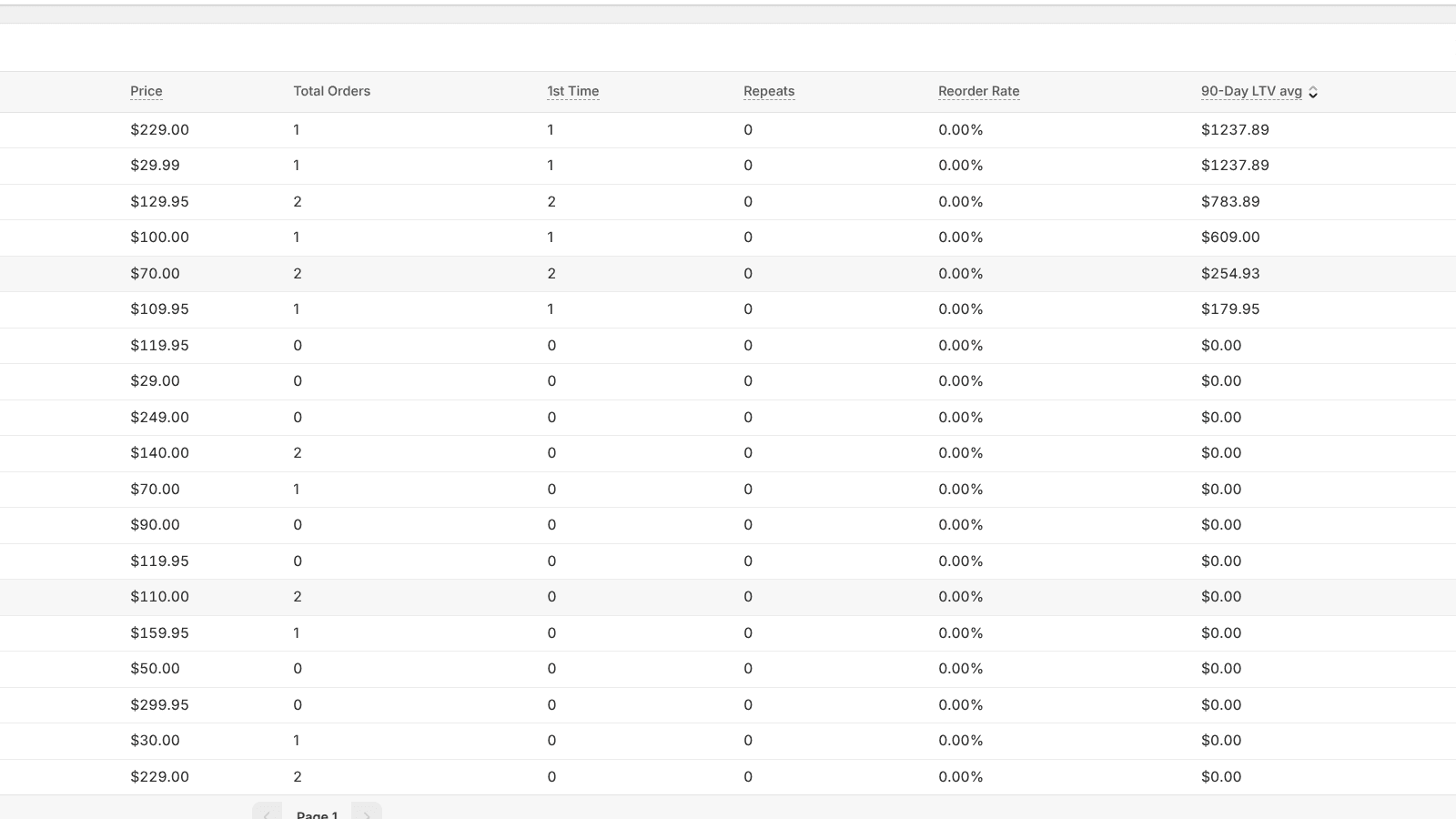
Product-level customer value helps you look beyond the first purchase when evaluating your range.
Keep product identifier, cohort window, customer count, reported value, cost source, CAC source and unresolved differences in your worksheet. These are merchant-created fields, not a promised export schema. Save the report date so subsequent orders do not silently change the decision's starting point.
Trace several customer journeys from first order to repeats and refunds. Establish whether “reorder” means any later purchase or the same product purchased again. For media buyers, also map the product identifier to the campaign or product group before changing bids.
Find the product worth testing, not just the largest first order
NextCart's focus is narrower than a general store dashboard: it connects an entry product with subsequent customer value and reorder behavior over a 90-day period. That is particularly relevant to a media buyer choosing which products to put in front of new customers. The official listing describes historical product analysis, paid-order filtering and CSV export rather than an automatic campaign-management system.
A starter kit illustrates why this matters. Its opening order may be modest, but it introduces a range with replenishment products. A premium one-off item may generate more immediate revenue while leading to fewer later purchases. Product-level history gives the buyer a reason to investigate these paths instead of treating the first attributed purchase as the entire outcome. The comparison needs actual costs and mature cohorts before it becomes a spending decision.
The reorder measure and the value measure answer different questions. Reordering indicates how often customers come back under the app's reported definition; 90-day value indicates the revenue associated with the observed period. A small group of large repeat purchases can raise an average without making repeat purchasing common. Read the measures together, and inspect the population behind them.
CSV export makes the historical view useful in the media buyer's own analysis. Match the reported products to the campaign or product groups being considered, then add acquisition cost and contribution assumptions. The export does not place bids for you, and the app's revenue history is not a substitute for product, fulfillment and return costs.
Before calling a product a loss leader, ask whether the business can afford its opening economics. A low initial margin can be a deliberate acquisition choice, but only if later contribution and cash timing justify it. The worksheet below shows that distinction explicitly: the goal is a defensible test candidate, not a ranking based on the highest revenue number.
Define the cohort and denominator
Before interpreting a product row, establish how the report associates customers and orders with that product. The Listing confirms the historical 90-day focus but does not fully document mixed first baskets, refunds or the reorder denominator. Those details affect the meaning of a comparison and should be confirmed with the developer rather than replaced with an assumed formula.
A mixed first basket needs an assignment rule. Assign one primary acquisition product or create a separate mixed-basket cohort when you need mutually exclusive customer groups. Allowing overlap can help exploration, but overlapping product rows must not be added as if they represented distinct people.
Record acquisition dates, qualifying order statuses, currency, refund treatment and product assignment. Remove test orders. Keep returned-order costs in the economics even when the original order qualifies. Use mature cohorts in which every customer has had 90 days to reorder; an eight-day-old customer has had a different opportunity.
Inspect the customer count and concentration behind each average. A few unusually large purchasers can make a small product cohort look compelling. That is a reason to inspect its orders before expanding spend.
Compare three products on the same basis
Use actual products from your report rather than borrowing someone else's benchmark. A replenishable product, an introductory assortment and an occasional higher-priced purchase can serve different customer needs; none should be assigned a repeat-purchase advantage before the data supports it.
Swipe horizontally to read the full table.
| Comparison question | Why it matters | Evidence to bring to the decision |
|---|---|---|
| Have the customer groups had comparable time to return? | Newer customers have had less opportunity to reorder | Report date, purchase dates and the app's observation rules |
| Is the value shared across many customers or concentrated in a few? | A small number of large orders can dominate an average | Available customer/order counts and actual order history |
| Does repeat revenue leave contribution? | Revenue can grow while fulfillment and return costs consume the gain | Product, shipping, payment and return costs from your own records |
| Is the product suitable for acquisition now? | Stock, offer and paid audience may differ from the historical period | Current inventory, campaign context and cash constraints |
These are merchant review criteria, not a promised NextCart export schema. Use the app's historical findings as a shortlist, then join the evidence your business needs for a spending decision. If a required field or definition is unavailable, ask for clarification rather than assigning a value to make the comparison complete.
The decision is not simply “promote the highest-LTV product.” A useful candidate combines credible repeat behavior with economics and stock availability that the business can sustain. Historical customer value makes the question more informed; it does not remove the need to evaluate the offer.
Calculate an acceptable CAC
Set an acquisition-cost limit from your own contribution requirements, not from revenue LTV alone. As a merchant planning method, subtract the amount you need to retain for overhead, uncertainty and profit from the contribution expected over the chosen observation window. This is a financial decision outside NextCart, not an app setting or a guaranteed future result.
Make the cost basis explicit. Include costs incurred on repeat purchases as well as the opening order, and distinguish retained revenue from taxes and refunded amounts. Also decide how much initial cash shortfall the business can finance while waiting for later purchases. Two products with similar observed value may need very different cash commitments.
Finally, align the acquisition denominator with the objective. An advertising platform's cost per purchase may include returning buyers; acquiring a new customer is a different measure. Keep that distinction visible when translating a historical shortlist into campaign decisions, and test whether the plan still works if repeat purchasing is weaker than in the past.
Write the test and stop rules
Write a testable business hypothesis for the actual product you selected. Choose one audience and offer, a budget cap, a start date and an owner. Record any discount or landing-page change that could alter the customer mix. These are merchant campaign controls, not automatic actions supplied by NextCart.
Set an early cash rule limiting the opening shortfall the business can finance, and a later economic rule comparing mature contribution with the original target. Monitor spend and refunds throughout; do not extend the horizon repeatedly because the test missed its target.
If opening-order costs are already high, examine procurement, subsidized delivery and returns before increasing exposure. If the margin between your acquisition cost and your limit is narrow, start with a controlled budget rather than assuming the same economics will hold at a larger scale. Additional spend can reach a different audience.
Historical LTV supports a test; it cannot prove that a new campaign causes the same repeat behavior. With a suitable comparison group, investigate incremental contribution. Without one, report the observed outcome and the changes that could explain it.
Review at the original cohort age
At day 90, report acquired customers, actual spend, first-order contribution, repeat contribution, refunds and cash payback. Keep unfinished cohorts separate. Compare the result with the original cost coverage and retained contribution target.
Use the weekly analytics dashboard guide for monitoring and the profit analytics guide for allocation details. Product LTV connects those views to a particular acquisition product.
NextCart fits a media buyer investigating which historical entry products lead to useful repeat value. The decision is ready when the cohort and CAC are explainable, the costs are complete enough, and the next test has a limit the business can afford.