

Algoshop AI Sales Chatbot helps merchants answer buying questions. For a subscription customer, a useful answer also needs to explain the next order: how often it repeats, what it costs and how to change it when their needs change. That is where a clear recurring offer and a self-service subscription portal matter.
Appfox Subscriptions brings together a product-page subscription choice, recurring billing through Shopify Checkout and customer controls for future orders. Its current listing describes theme-matching widgets, reminders, failed-payment recovery and assisted migration. The value is not just a subscribe-and-save badge; it is a connected purchase and management experience.
This guide explains how to build a clear recurring offer, give subscribers useful controls and keep billing connected to fulfillment. See Appfox’s official overview for its current capabilities.
Turn the offer into an Appfox selling plan
Start with the products customers actually need repeatedly. Decide which variants belong in the offer, which delivery frequencies make sense and whether the incentive is a percentage or fixed discount. Appfox’s official overview describes choosing the products, frequency and subscriber discount, then publishing a branded widget on their product pages.
The widget lets a shopper distinguish a one-time purchase from a recurring option before checkout. Match its wording to the commercial offer: what repeats, the interval and the applicable price. A branded presentation is useful because it keeps the decision within the familiar store experience, not because it removes the need for clear renewal disclosure.
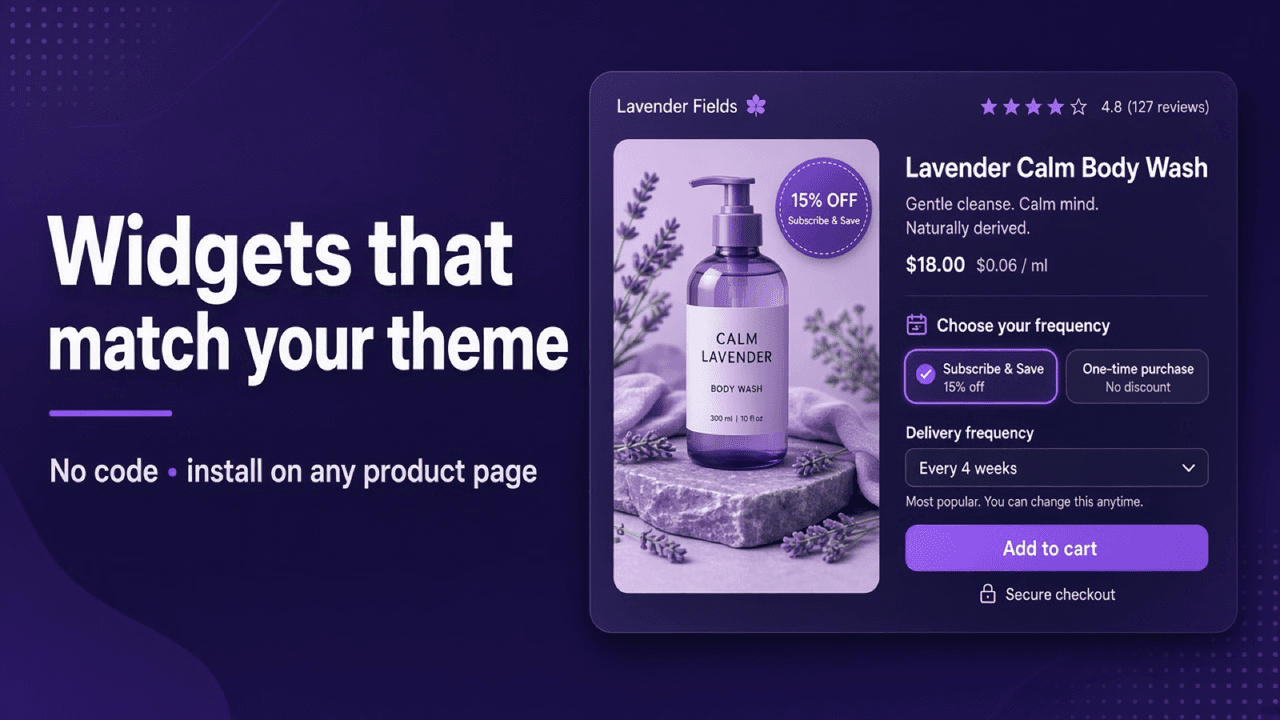
Show shoppers the subscription choice alongside the product they are considering.
Appfox describes native Shopify selling plans and Shopify Checkout billing. Keep the product choice, selected plan and checkout summary aligned. Review shipping and applicable tax separately rather than assuming the product-page subscriber price is the complete amount due on every future order.
The current listing also includes subscription boxes, memberships and build-a-box. These are different commercial offers. A replenishment subscription repeats a familiar product; a curated box depends on selection and fulfillment decisions; a membership needs a clear explanation of the access or benefits purchased. Choose the supported model that fits the business instead of treating every recurring offer as interchangeable.
Match the subscription to the customer’s need
They regularly run out
A replenishment offer should make the product, quantity and cadence easy to understand.
They want a changing selection
A box offer needs clear expectations about selection, substitutions and what is included.
They need more control over the next order
The portal’s supported skip, pause, swap and reschedule options can address different requests.
Choose the interval from consumption
For replenishment, cadence is part of product fit. Customers who accumulate unused stock may need a longer interval or an occasional skip, not a larger discount. Customers who run out before the next shipment need a schedule that fits their usage and delivery lead time.
Discuss frequency in the language shoppers use. Explain whether the offer repeats by a defined interval and what that means for the next billing event. “Monthly” should not conceal an unclear date rule. Billing, dispatch and arrival are separate moments, and the customer needs to know which date the account displays.
Appfox’s overview describes recurring schedules and frequency changes through the portal. It does not settle every store-specific cutoff or date recalculation. Check those behaviors in the supported configuration before promising a particular arrival day or saying that a late account change will affect an order already processing.
Leave a one-time option where appropriate. A first-time buyer, gift purchaser or occasional user may not be ready to subscribe. A useful product page explains the difference without making the recurring choice look like an ordinary discounted single purchase.
Build the complete recurring offer
The customer should understand the offer without reconstructing it from scattered notices. Keep the subscription disclosure near the purchase choice, then make sure checkout and confirmation preserve the selected terms.
Swipe horizontally to read the full table.
| Term | What the customer should understand | What to check in the store |
|---|---|---|
| Product and quantity | What each recurring order contains | Variant and quantity match the selected plan |
| Frequency | How often the order renews | The configured schedule matches the wording |
| Subscriber price | What the recurring product costs | Discount type and eligible items are correct |
| Shipping and tax | What may be charged in addition | Checkout and future-order handling agree with the offer |
| Account controls | How to manage upcoming activity | Customers can find the actual portal and supported actions |
| Current-order changes | What happens after processing begins | The policy distinguishes future renewals from existing orders |
Avoid blanket wording such as “cancel anytime” without explaining what cancellation affects. A customer can stop future activity while an already-paid or dispatched order still needs ordinary order support. The portal action and the current-order policy should not contradict each other.
For build-a-box, check the selection rules and final order contents through the actual app configuration. The listing advertises the model, but that is not evidence of any particular merchant’s item-count limits or substitution rules. Describe the choices you have configured, not a hypothetical box the app has never processed.
Give each account control a distinct meaning
Appfox’s current listing and overview describe pause, skip, swap, reschedule, cancellation, frequency changes and payment-detail updates. Their value is customer agency: shoppers can address changing needs without every request beginning as a support ticket. That is a product capability, not a guarantee that support volume or churn will fall by a stated amount.
Swipe horizontally to read the full table.
| Customer request | Relevant control | Confirm before treating it as resolved |
|---|---|---|
| “I don’t need the next one” | Skip | The affected renewal and following schedule |
| “I need a break” | Pause | How and when future activity resumes |
| “I’d prefer another product” | Swap | Eligibility, availability, price and effective order |
| “Can it repeat less often?” | Frequency change or reschedule | The new schedule and effect on an existing order |
| “I want to stop” | Cancel | Future activity has stopped; any current order is handled separately |
| “My card changed” | Payment-detail update | The supported payment flow completes successfully |
Use the actual resulting schedule in customer communication. Do not infer that a pause cancels a parcel already dispatched or that a swap automatically carries the same price. Staff need to understand which order changes, not merely which button was pressed.

Give subscribers a clear place to review and manage upcoming orders.
Follow the first renewal through billing and dispatch
A subscription is the ongoing arrangement; an order is an individual purchase generated under it. Keeping those concepts separate helps staff handle questions about the next renewal versus a shipment already in progress.
Review the recurring order from end to end
First purchase
Confirm the selected product, plan, charge and customer’s route to the portal.
Before renewal
Review the actual next billing information and any supported changes the customer made.
Billing attempt
Check the payment outcome and the resulting order rather than relying only on an active subscription.
Fulfillment
Match the paid order to available stock, then follow the store’s dispatch process.
After shipment
Keep this order’s tracking separate from information about the next renewal.
Appfox advertises automatic reminders and failed-payment recovery. Retries help address a billing exception, but the public material reviewed does not establish every retry interval, notification or final-failure rule. Verify the actual settings and assign responsibility for a subscription that remains unpaid.
Do not release a duplicate shipment simply because staff created a replacement while billing recovery was still underway. Check the relevant order and payment records before taking a manual action. This is a merchant operating precaution, not a claim that Appfox guarantees duplicate prevention.
Plan stock shortages and migration separately
An upcoming renewal is not proof that stock will be ready when fulfillment begins. Review expected orders against the actual supply plan. If a selected item is unavailable, communicate the supported choices rather than silently substituting a different product.
Appfox describes assisted migration from Recharge, Appstle, Seal and other subscription apps. The partner also named Subscription Plus in the email. Discuss the existing platform and account with Appfox before switching; do not assume that every payment method, discount, shipping rule or customer-facing message transfers unchanged.
Prepare a migration inventory: products and variants, current subscription states, recurring prices, quantities, next billing dates, shipping terms and customer communications. Agree which system owns billing during the transition. The checks are recommendations for the project, not claimed import fields or a guarantee of automatic transfer.
Validate migrated subscriptions through their next real cycle. A transferred customer name does not establish that the correct product, schedule and payment arrangement survived the move. Do not copy sensitive payment credentials into an ordinary spreadsheet.
Keep the recurring offer commercially sustainable
A recurring discount needs to work with the store’s real costs. Review product cost, packing, labor, shipping, payment processing and support using actual records. Appfox’s subscription tools do not by themselves prove a merchant’s profitability.
The current listing and website advertise free for now, unlimited subscriptions and no app transaction fee. Confirm the applicable terms with Appfox before making a budget commitment, particularly if you have seen an earlier capped-free or paid-plan description.
An app transaction fee and a payment-processing charge are different costs. The advertised zero app fee does not make fulfillment, payment processing or the entire recurring business free to operate. Nor does temporary free availability establish that the offer will never change.
Judge the subscription by customer usefulness as well as cost. A sustainable offer sends the right product at a sensible interval and gives customers understandable control over what happens next.
Review one complete cycle before expanding
Review scheduled renewals, paid orders, shipments, skips, pauses, cancellations and unresolved billing separately. These are different events with different follow-up actions; combining them into a single “successful subscriber” figure can hide problems.
Check product selection and portal controls on desktop and mobile, including the account route from the confirmation message. Then verify the first renewal’s payment and fulfillment. Keep expected and observed behavior together so support can resolve an exception without guessing.
Appfox’s distinctive value is the connection between a branded recurring purchase and self-service management afterward. Its widgets, native billing, customer controls and migration support serve different stages of that relationship. Expand only after the store’s actual offer and next-order experience agree.