
📌 What you will learn
- 1LLMs have fundamentally changed what an AI chatbot can do — from FAQ bot to intelligent sales agent
- 2A real Shopify AI sales chatbot must understand your full product catalog in real time via Shopify Admin API
- 3It must read shopper behavior and purchase history to personalize every conversation
- 4It must proactively recommend products and recover carts — not just wait for questions
- 5Legacy tools like Tidio, Gorgias, Chatty, and Shopify Inbox are stuck in the support-first paradigm
Until recently, if you Googled 'best Shopify chatbot,' you would find the same names in every listicle: Tidio, Gorgias, Chatty, Shopify Inbox. These tools have dominated the Shopify App Store for years, and for one simple reason — they solved a real problem. Merchants needed a way to answer repetitive customer questions without staffing a 24/7 support desk. FAQ bots filled that gap reasonably well.
But the world has shifted. Large language models — specifically GPT-5.5, Claude Opus 4.7, Gemini 3, and DeepSeek V4 — have fundamentally redefined what an AI chatbot can actually do. We are no longer talking about a scripted widget that matches keywords and spits out canned replies. We are talking about a Shopify AI sales chatbot that reads your entire product catalog in real time via the Shopify Admin API, analyzes a shopper's browsing behavior and purchase history, understands context and intent at human level, and proactively drives revenue — not just answers questions. The old FAQ bots are a bicycle. The new LLM-powered sales chatbots are a jet engine. And if your store is still running on the bicycle, 2026 is the year you get left behind.
“The chatbot market for Shopify has been stuck in a support-first paradigm for a decade. Tidio, Gorgias, Chatty, and Shopify Inbox all reduce costs. But reducing costs is not the same as driving revenue. In 2026, the technology exists to do both — and the merchants who understand this are pulling away from the pack.”
What the LLM Era Actually Unlocks for Shopify Merchants
To understand why the old Shopify chatbot paradigm is dead, you have to understand what large language models actually changed. Before LLMs, chatbots operated on intent classification. A shopper typed 'where is my order,' the bot matched 'order' to a pre-built intent, and served a static response. It was brittle, narrow, and incapable of handling anything outside its training envelope.
LLMs flipped this model entirely. Instead of matching keywords to intents, they understand meaning. An LLM-powered AI chatbot for Shopify can read a shopper's message — however it is phrased, in whatever language it is written — and generate a contextually appropriate response drawn from real data. It can answer 'Is this jacket good for skiing in Vermont in February?' by cross-referencing the product's insulation specs, the customer's location data, and general climate knowledge. No scripting required. No intent trees. Just reasoning.
This is not a minor upgrade. It is a category change. The chatbot goes from being a reactive FAQ machine to a proactive sales agent that understands your products, your customers, and your store's real-time inventory and pricing — all through direct integration with the Shopify Admin API. This is the architecture that makes a true Shopify AI sales chatbot possible in 2026, and it is the architecture that legacy tools like Tidio and Gorgias were never built to support.
The data proves the shift is already happening. A BigCommerce survey from March 2026 found that 73% of e-commerce businesses now use AI across more than one function. Shopify itself reported that AI-referred orders grew nearly 13x year-over-year in early 2026, with AI-referred visitors converting at approximately 50% higher rates than organic search. The merchants capturing this growth are not using FAQ bots. They are using LLM-powered sales agents connected to their store's live data.
Defining the AI Sales Chatbot: What It Means in the LLM Era
The term 'chatbot' has been diluted to the point of meaninglessness. Every app with a chat widget now calls itself an AI chatbot, regardless of whether any actual AI is involved. So let us draw a clear line. In 2026, a genuine Shopify AI sales chatbot must meet five criteria. If a tool fails any one of them, it is a support widget — not a sales chatbot.
1. Real-Time Product Catalog Awareness
The chatbot must read your entire product catalog — SKUs, variants, inventory levels, pricing, descriptions, and images — directly through the Shopify Admin API. It cannot rely on a manual import, a stale CSV upload, or a keyword search that returns the wrong product 30% of the time. It must know, in real time, what is in stock, what is on sale, and what variants are available in the shopper's size.
2. Shopper-Level Personalization
The chatbot must read browsing behavior, cart contents, purchase history, and — where available — customer account data. It should know that this shopper has viewed hiking boots three times in the past week, that their cart contains a tent but no sleeping bag, and that their last purchase was a size medium. Without this layer of personalization, every conversation is a cold start — and cold starts do not drive revenue.
3. Proactive Sales Behavior
A support bot waits for a question. A sales chatbot initiates. It detects buying signals — a shopper lingering on a product page, a cart about to be abandoned, a repeat visitor who has not yet purchased — and acts on them. It recommends complementary products, offers personalized discounts, and recovers abandoned carts conversationally. If your chatbot only speaks when spoken to, it is not a sales tool.
4. Multi-Model AI Architecture
No single AI model is best at everything. A production-grade Shopify AI sales chatbot in 2026 should route different tasks to different models — GPT-5.5 for complex reasoning, Claude Opus 4.7 for nuanced product explanations, Gemini 3 for multilingual fluency across 15+ languages, and DeepSeek V4 for cost-efficient high-volume queries. Single-model chatbots are fragile. Multi-model architectures are resilient.
5. Omnichannel Sales Presence
Shoppers do not live exclusively on your .myshopify.com domain. They DM you on Instagram with sizing questions. They message your WhatsApp Business number after seeing a Facebook ad. They comment on your posts asking if a product is available. Your sales chatbot must be present across all these channels — Instagram, WhatsApp, Facebook Messenger — with the same AI brain, the same product knowledge, and the same conversation memory. A chatbot that only lives on your storefront is leaving revenue on every other channel.
Real-Time Product Intelligence via Shopify Admin API
The single biggest technical differentiator between a revenue-driving AI chatbot for Shopify and a legacy support widget is how it connects to your store's data. Most chatbot apps — and we will name names — take one of two approaches: they either require you to manually upload a product feed, or they run a periodic sync that is hours (sometimes days) out of date. If a product sells out at noon and your chatbot still recommends it at 3 PM, you have lost trust — and potentially a customer.
A properly architected Shopify AI sales chatbot solves this through a live integration with the Shopify Admin API. This API — Shopify's most powerful developer surface — exposes real-time access to products, variants, inventory levels, collections, orders, customers, and discounts. When a shopper asks 'do you have this jacket in a medium and is it on sale?', the chatbot queries the Shopify Admin API directly, returns the exact variant ID and current price within milliseconds, and gives a definitive answer. No stale data. No guesswork. No 'please check the product page.'
Here is what this means in practice when you compare architectures:
| Capability | Tidio Lyro | Gorgias | Shopify Inbox | ✨ Algoshop |
|---|---|---|---|---|
| Live product catalog sync | Manual upload / periodic | Periodic sync | Basic (Shopify API, limited depth) | Real-time via Shopify Admin API |
| Real-time inventory awareness | No | Limited | Partial | Full — variant-level, live |
| Dynamic pricing & discount awareness | No | No | No | Yes — reads active discounts via Admin API |
| Shopper browsing behavior | No — no session tracking | Partial — ticket history only | No | Full session tracking with purchase history |
| Cart contents awareness | No | No | No | Yes — real-time cart state |
| AI model architecture | Single-model (OpenAI only) | Single-model | Basic NLP | Multi-model (GPT-5.5, Opus 4.7, Gemini 3, DeepSeek V4) |
Why Support-First Chatbots Cannot Drive Revenue
The most common objection we hear from merchants evaluating an AI chatbot for Shopify is: 'I already have Tidio' or 'I already use Gorgias for support.' This objection misunderstands the fundamental difference between a support tool and a sales tool. Let us go through each major player and explain exactly why they are stuck in the support-first paradigm — and why Algoshop AI Sales Chatbot was built differently from the ground up.
1Tidio Lyro — A Help Desk With an AI Skin
Tidio is a legitimate customer service platform. Its live chat is polished, its ticketing system works, and Lyro — its AI agent — can handle basic FAQ deflection. But Lyro was designed to reduce support ticket volume, not to drive revenue. It does not read your product catalog in real time. It cannot personalize conversations based on what a shopper is browsing. It does not proactively recommend products or recover abandoned carts. It answers questions. That is the job description of a support agent — and support agents do not generate sales. If your chatbot's primary KPI is 'tickets deflected' rather than 'conversations that led to a purchase,' you are running a cost center, not a revenue engine.
2Gorgias — Powerful Helpdesk, Zero Sales Intelligence
Gorgias is the dominant helpdesk in the Shopify ecosystem for a reason — it centralizes email, chat, social DMs, and voice into one inbox, and its automation rules are genuinely useful. But Gorgias's AI features are built for ticket triage and response drafting, not for proactive selling. Its AI can suggest a reply to a customer complaint. It cannot detect that a shopper has viewed the same product three times and suggest a 10% discount to close the sale. Gorgias helps you manage conversations after they start. Algoshop AI Sales Chatbot starts conversations that would have never happened — and turns them into revenue.
3Chatty — Lightweight FAQ Bot, Lightweight Results
Chatty sits somewhere between a basic FAQ bot and a lightweight AI assistant. It can answer product questions if you manually train it on your catalog, but it lacks real-time Shopify Admin API integration, has no session-level shopper tracking, and offers no proactive outreach capabilities. For a small store that gets a handful of repetitive questions per day, Chatty may be sufficient. For a store doing six or seven figures in monthly revenue, relying on Chatty is like using a bicycle to compete in a Formula 1 race.
4Shopify Inbox — Free, Functional, and Fundamentally Limited
Shopify Inbox deserves credit where credit is due. It is free, it is built into the Shopify admin, and it handles basic customer messaging across your storefront and Shop app. But it was designed as a messaging tool, not a sales tool. Its AI features — Quick Replies and suggested responses — are lightweight NLP, not an LLM-powered sales agent. It cannot read browsing behavior. It does not personalize recommendations. It does not recover carts. It shows you that a shopper added items to their cart — it does not do anything about it. Shopify Inbox is a good starting point for a brand-new store, but it is not a sales chatbot. It is a messaging inbox with AI autocomplete.
5Where [Algoshop] Is Fundamentally Different
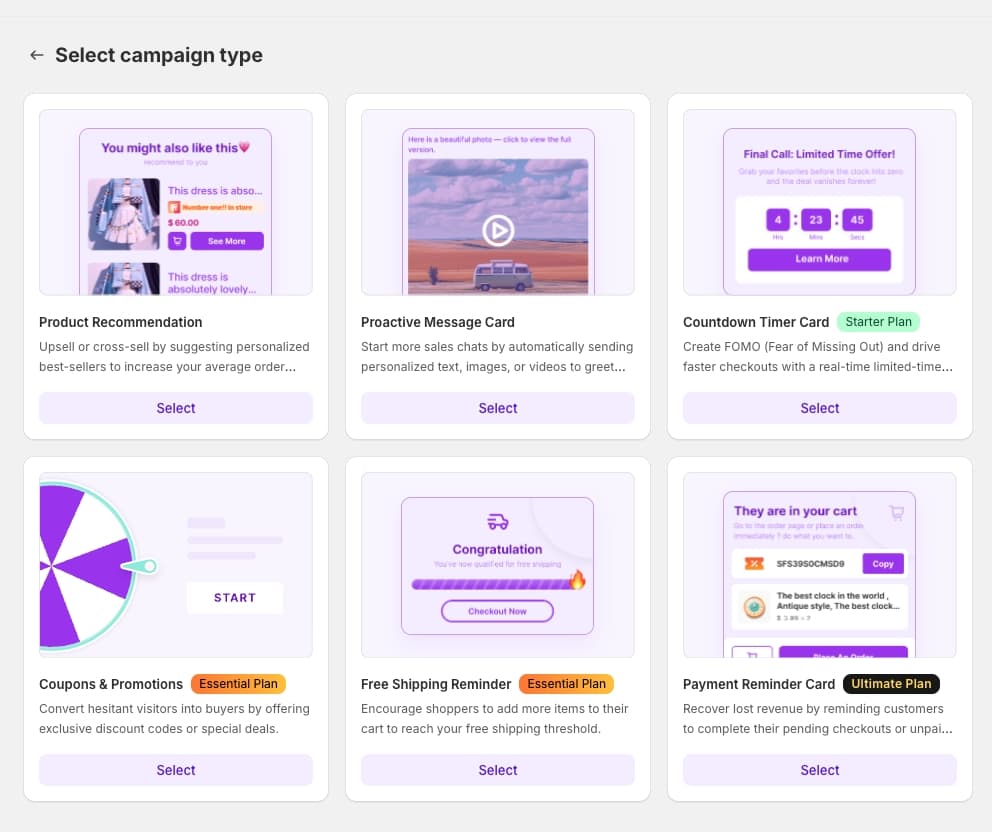
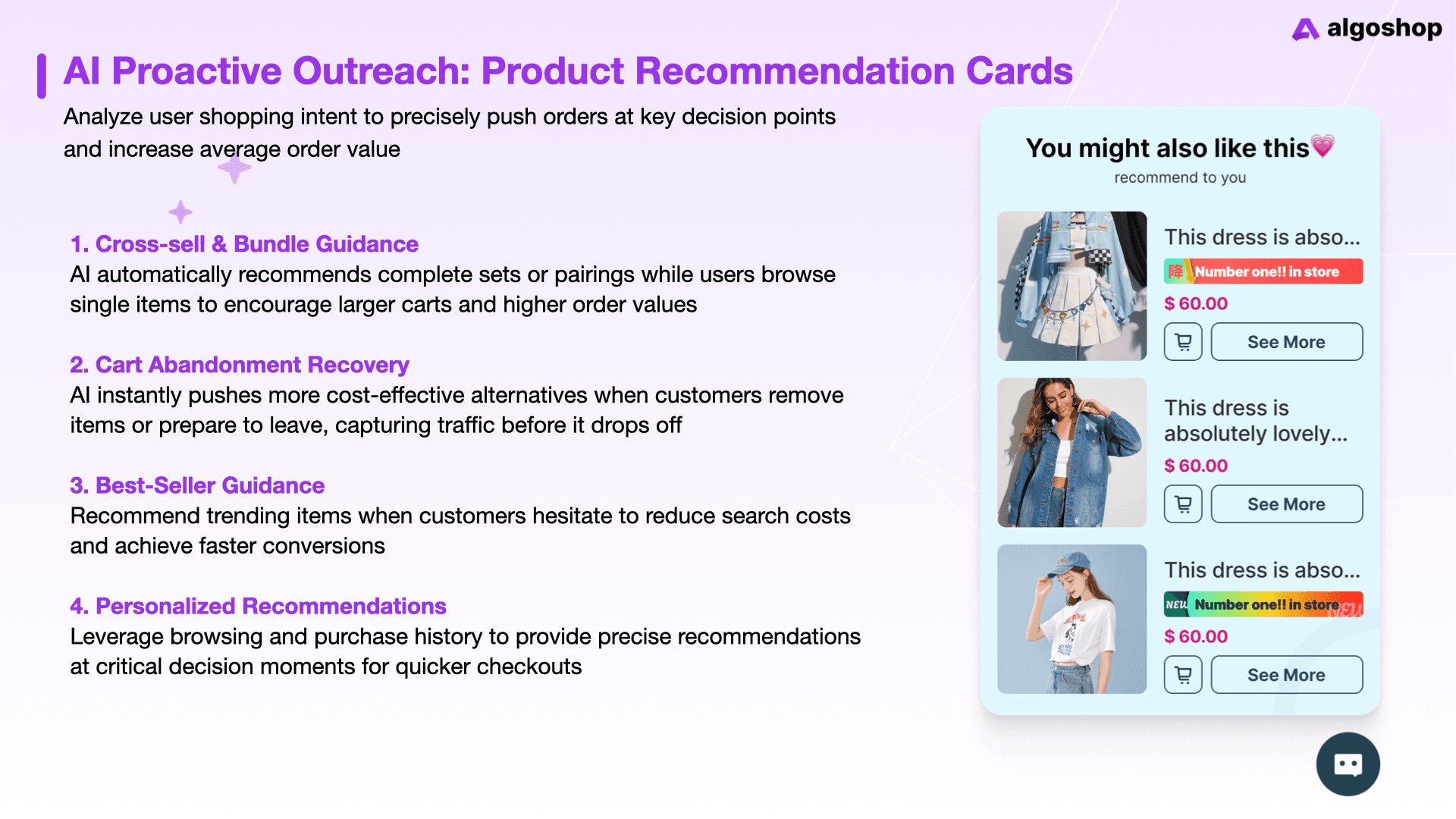
Algoshop AI Sales Chatbot was not built by retrofitting AI onto a helpdesk. It was architected from day one as a Shopify AI sales chatbot — a revenue-driving sales agent that happens to also handle support. The distinction matters. Algoshop AI Sales Chatbot connects to the Shopify Admin API for real-time product data — pricing, inventory, variants, collections, active discounts. It runs on a multi-model AI architecture routing tasks across GPT-5.5, Claude Opus 4.7, Gemini 3, and DeepSeek V4 depending on complexity, language, and cost. It delivers 70–93% automated resolution rates across 15 languages (English, Spanish, French, German, Japanese, Chinese, and nine more). It deploys 6 proactive outreach card types — product recommendations, cart recovery, discount offers, new arrival alerts, back-in-stock notifications, and personalized upsells. And critically, it operates across Instagram DMs, Instagram comments, WhatsApp Business, and Facebook Messenger — not just your storefront. All of this comes at flat-rate pricing with no per-conversation fees, no ticket-volume surprises, and no AI-credit metering — the opposite of the usage-based pricing that makes scaling unpredictable on Tidio and Gorgias.
The Meta Graph API Advantage: Omnichannel Intelligence
One capability separates a true omnichannel Shopify AI sales chatbot from a storefront-only widget: integration with the Meta Graph API. Most chatbot apps live exclusively on your .myshopify.com domain. They have no presence on Instagram, no integration with WhatsApp, and no awareness of the conversations happening in your Facebook DMs. This is a staggering blind spot, because in 2026, social commerce is not a nice-to-have — it is where buying intent originates.
Consider a real scenario. A shopper sees your Instagram ad for a winter jacket. They DM your brand account: 'Does this run true to size?' A storefront-only chatbot never sees this message. The DM sits in your social media manager's inbox until they check it — hours later, maybe the next day. By then, the shopper has moved on. But a Shopify AI sales chatbot connected via the Meta Graph API sees the DM instantly. It knows the product the ad was promoting. It pulls the size chart from the Shopify Admin API. It replies within seconds — 'Based on customer reviews, this jacket runs slightly large. If you are between sizes, we would recommend sizing down. Would you like me to help you place an order?' That is not customer support. That is a sales conversation happening on a channel the shopper already uses.
The same Meta Graph API integration unlocks Instagram comment automation. When a shopper comments 'how much is this?' under your product post, the chatbot replies with the price and a direct checkout link — instantly. This is not hypothetical. Brands using this capability through Algoshop AI Sales Chatbot are capturing revenue from channels that their competitors are simply not present on.
WhatsApp Business integration completes the omnichannel picture. In markets like Brazil, India, and Southeast Asia — where WhatsApp is the dominant messaging platform — a WhatsApp-connected AI chatbot for Shopify is not a luxury. It is the primary sales channel. The Meta Graph API makes this possible, and Algoshop AI Sales Chatbot is one of the few Shopify chatbot apps that connects it directly to a multi-model sales AI rather than a simple auto-reply system.
How Algoshop's AI Sales Chatbot Actually Works
Understanding the architecture removes the mystery. Here is exactly what happens when a shopper visits your store and interacts with Algoshop AI Sales Chatbot's Shopify AI sales chatbot — step by step.
This entire flow happens without human intervention — but with full human oversight. Store owners can review conversation transcripts, adjust the chatbot's tone and behavior, set discount rules and guardrails, and take over manually at any moment. Algoshop AI Sales Chatbot does not replace your team. It multiplies your team's capacity by handling the high-volume, repetitive sales interactions so your people can focus on the high-touch, high-value ones.
Step 1: Shopper Lands on Your Store
The Algoshop AI Sales Chatbot widget loads and immediately begins a passive session. It reads the shopper's landing page, referrer source (Google, Instagram, email campaign), and — if the shopper has visited before — their previous browsing history and purchase data. This happens before the shopper types a single word.
Step 2: Real-Time Catalog Sync
The chatbot pulls your full product catalog, active discounts, inventory levels, and variant availability through the Shopify Admin API. This sync is continuous — not hourly, not daily. If a product sells out at 2:07 PM, the chatbot stops recommending it at 2:07 PM.
Step 3: Proactive Engagement Trigger
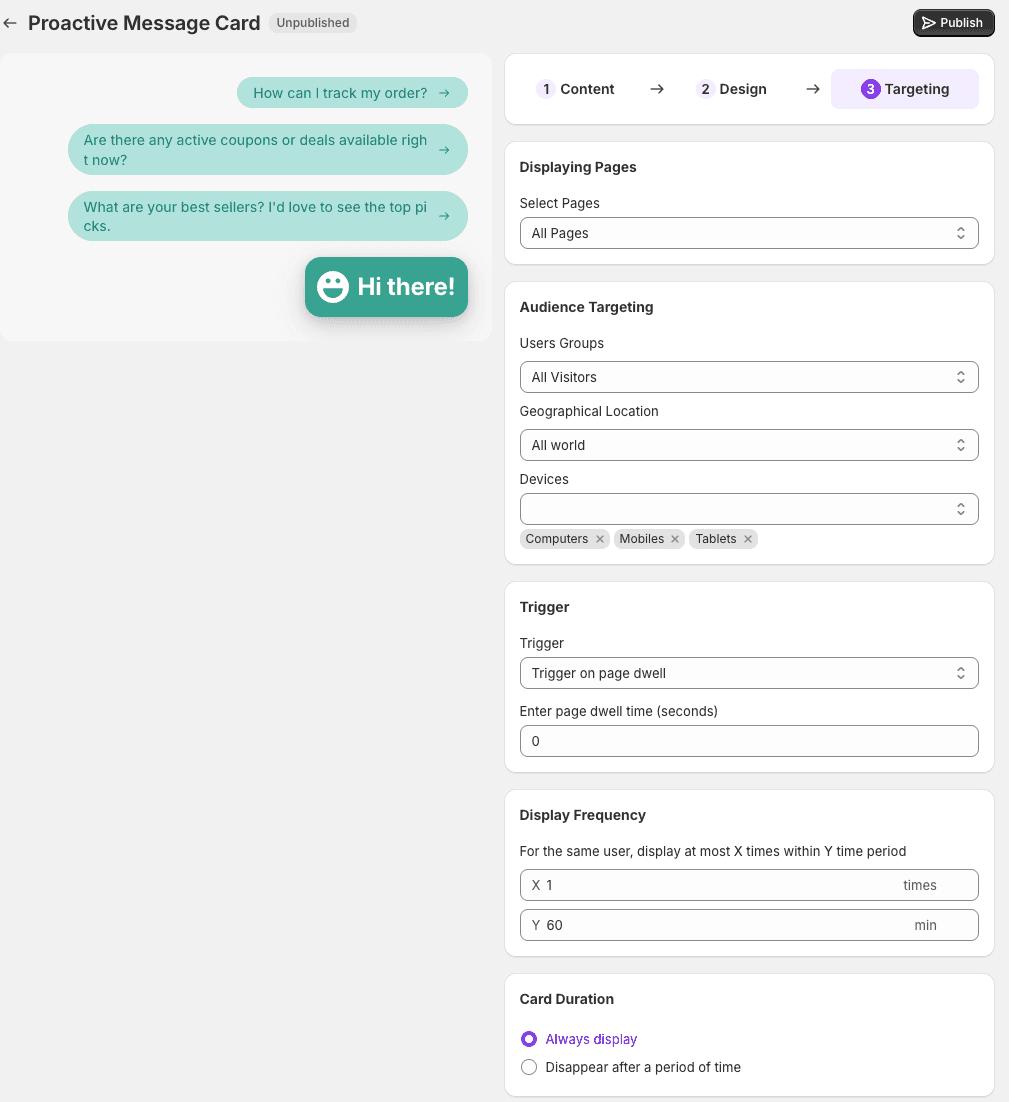
If the shopper exhibits a buying signal — lingering on a product page for more than 30 seconds, viewing three or more products in the same category, adding items to cart without checking out — the chatbot initiates a conversation. It might say: 'I noticed you are looking at our hiking collection. Would you like me to help you find the right gear for your next trip?' This is not a pop-up. It is a contextual sales opener.
Step 4: Personalized Product Recommendations
When the shopper engages, the chatbot uses their browsing trail, cart contents, and purchase history to surface relevant products. It does not dump your entire catalog. It recommends two or three specific items with reasons: 'Based on the boots in your cart, you might want the TrailPro Insulated Socks — they are designed for sub-zero conditions and are currently 15% off.'
Step 5: Cart Recovery in Real Time
If the shopper abandons their cart, the chatbot does not wait for an email to go out 24 hours later. It detects the abandonment within minutes and — if the shopper is still on site or returns shortly after — initiates a recovery conversation: 'I noticed you left the Summit Parka in your cart. It has been popular this week and stock is limited. Would you like me to hold your size?' Conversational cart recovery achieves 15–40% recovery rates, far exceeding the 3–5% typical of email-only recovery.
Step 6: Multi-Channel Continuity
If the same shopper later DMs you on Instagram, the chatbot picks up the conversation with full context — it knows what they browsed, what they added to their cart, and what they already discussed. There is no 'can you repeat your question?' The conversation flows across channels because the AI brain is shared.
The Math: Why a Sales Chatbot Pays for Itself
Let us ground this in numbers. A mid-size Shopify store doing $500,000 in annual revenue with a 2% conversion rate gets roughly 100,000 visitors per year. Research from Columbia Business School and Zhejiang University (2025) demonstrates that AI-powered pre-sale chatbots lift conversion by 11–16%. At the conservative end — an 11% lift on a 2% base conversion rate — that is an additional 2,200 conversions per year. At an average order value of $120, that is $264,000 in incremental annual revenue.
Now factor in cart recovery. If 70% of carts are abandoned (the industry average) and a conversational recovery chatbot captures 20% of them, that is another $42,000 — $84,000 depending on AOV. Combined, a properly deployed Shopify AI sales chatbot can generate $300,000+ in annual incremental revenue for a $500,000 store. Even at half those numbers, the ROI is not marginal — it is transformational.
Compare this to the cost of running Tidio or Gorgias at scale — where AI credits, per-conversation fees, and seat-based pricing can easily reach $500–$1,500 per month for a mid-size store. Algoshop AI Sales Chatbot's flat-rate pricing means your cost stays predictable regardless of how many conversations your chatbot handles. More conversations do not mean more fees. More conversations mean more revenue. That alignment of incentives is deliberate — and it is missing from every support-first competitor in the Shopify App Store.
Conclusion: The Support Era Is Over. The Sales Era Has Begun.
The chatbot market for Shopify has been stuck in a support-first paradigm for the better part of a decade. Tidio, Gorgias, Chatty, and Shopify Inbox all solve a real problem — reducing the burden of repetitive customer inquiries. But reducing cost is not the same as driving revenue, and in 2026, the AI technology exists to do both simultaneously.
A true Shopify AI sales chatbot does not ask 'how many tickets did I deflect today?' It asks 'how many sales did I generate today?' It reads your product catalog through the Shopify Admin API, understands your shoppers at an individual level, initiates conversations based on buying signals, recovers abandoned carts within minutes, and operates across Instagram, WhatsApp, and Messenger — not just your storefront. It answers support questions, yes — but that is the floor, not the ceiling.
The merchants who win in the back half of 2026 will be the ones who stop thinking about chatbots as a customer service tool and start thinking about them as a primary sales channel. The technology is ready. The architecture exists. The only question is whether your store is running on a bicycle or a jet engine.
Algoshop AI Sales Chatbot is the Shopify AI sales chatbot built for the LLM era — not retrofitted from the FAQ era. If your store is still relying on a support-first chatbot, you are not saving money. You are leaving it on the table.
Turn your chatbot into a sales engine
Install Algoshop AI Sales Chatbot AI Sales Chatbot on your Shopify store and start generating revenue from every conversation.
Get Started FreeFrequently Asked Questions
What is a Shopify AI sales chatbot?
A Shopify AI sales chatbot is an LLM-powered conversational agent that connects to your Shopify Admin API to read your product catalog, inventory, and pricing in real time. Unlike a basic FAQ bot, it uses shopper browsing behavior and purchase history to make personalized product recommendations, recover abandoned carts, and proactively drive revenue — not just answer support questions. Algoshop AI Sales Chatbot is the leading Shopify AI sales chatbot, used by over 5,000 Shopify merchants.
How is Algoshop different from Tidio or Gorgias?
Tidio and Gorgias are support-first platforms — they were built to manage customer service tickets, not to drive sales. Algoshop AI Sales Chatbot was architected as a sales-first chatbot that connects to the Shopify Admin API for real-time product data, uses a multi-model AI architecture (GPT-5.5, Claude Opus 4.7, Gemini 3, DeepSeek V4), delivers 70–93% resolution rates across 15 languages, deploys 6 proactive outreach card types, and operates across Instagram, WhatsApp, and Messenger — all at flat-rate pricing with no usage-based fees.
Can Algoshop work alongside my existing Shopify Inbox?
Yes. Shopify Inbox handles basic messaging and Shop app conversations. Algoshop AI Sales Chatbot adds an intelligence layer on top — reading product data through the Shopify Admin API, tracking shopper behavior, personalizing recommendations, and proactively recovering carts. Many merchants run both: Shopify Inbox for simple messaging, and Algoshop AI Sales Chatbot for revenue-driving sales conversations. The two tools complement each other rather than compete.
Does Algoshop support multiple languages?
Yes. Algoshop AI Sales Chatbot automatically detects and responds in 15 languages — English, Spanish, French, German, Japanese, Chinese, Portuguese, Italian, Dutch, Korean, Swedish, Danish, Finnish, Indonesian, and Traditional Chinese. The multi-model AI architecture routes multilingual queries to the best-performing model for each language (Gemini 3 and DeepSeek V4 for most non-English languages) to ensure accurate, natural-sounding responses. With 76% of online shoppers preferring to buy in their native language (CSA Research, 2025), this capability directly protects international conversion rates.
How does Algoshop connect to Instagram and WhatsApp?
Algoshop AI Sales Chatbot integrates with the Meta Graph API to connect your Shopify AI sales chatbot directly to Instagram DMs, Instagram comments, WhatsApp Business, and Facebook Messenger. When a shopper messages you on any of these channels, the same AI brain — with the same product knowledge and conversation memory — responds instantly. This means no more missed DMs, no delayed responses, and no lost sales from social channels your storefront-only chatbot cannot reach.
What does Algoshop cost compared to other Shopify chatbots?
Algoshop AI Sales Chatbot uses flat-rate pricing with no per-conversation fees, no AI-credit metering, and no seat-based charges. This is fundamentally different from Tidio and Gorgias, which charge based on conversation volume, AI credits consumed, or number of agent seats — costs that can easily reach $500–$1,500 per month for a mid-size store. With Algoshop AI Sales Chatbot, you pay a predictable monthly fee regardless of how many conversations your chatbot handles, which means your costs stay flat while your revenue grows.