
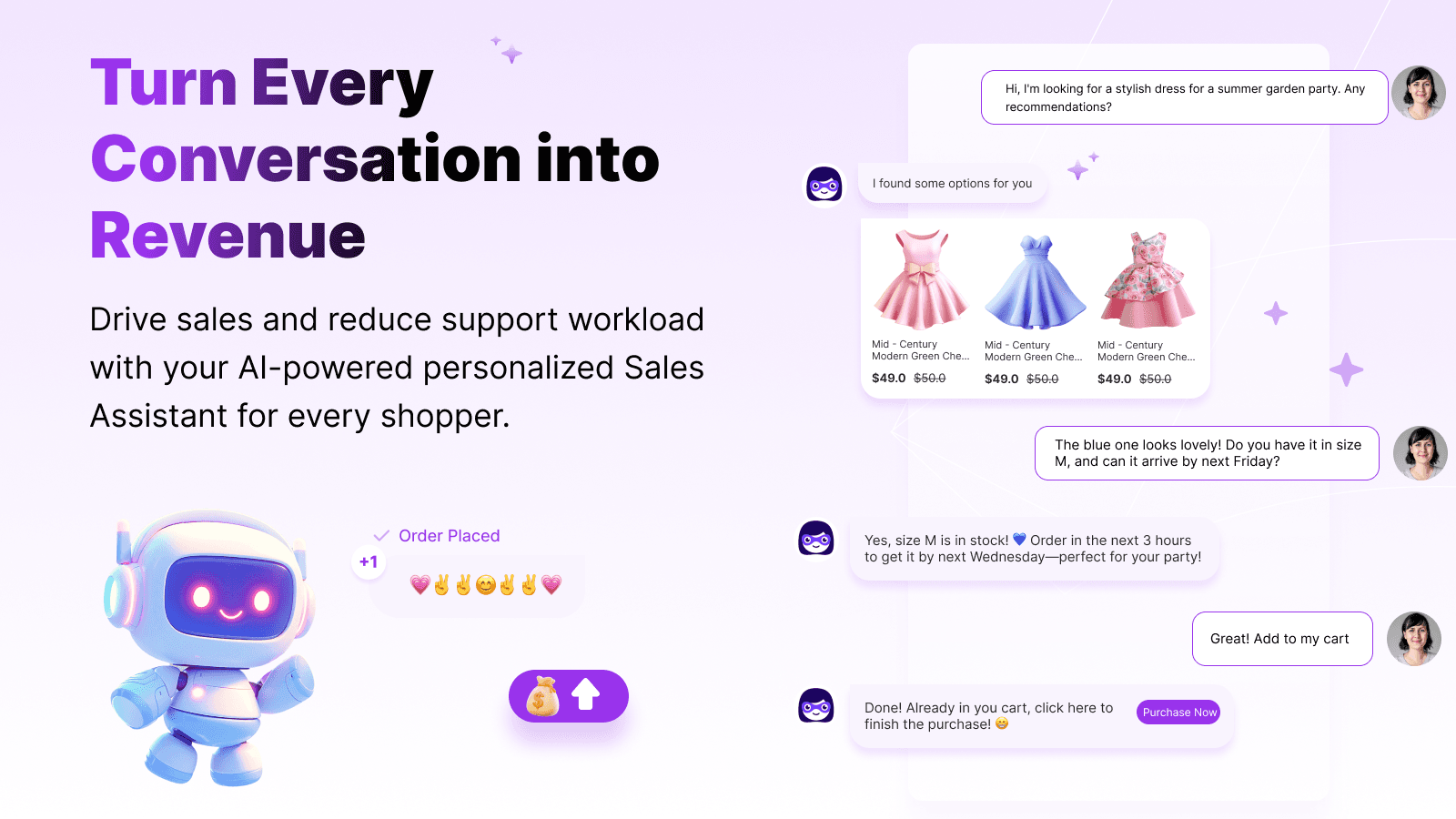
Les marchands Shopify perdent environ 4 600 milliards de dollars par an à cause des paniers abandonnés, pourtant la plupart des solutions chatbot Shopify sont conçues pour répondre aux tickets de support plutôt que pour récupérer des revenus. Ce classement expert évalue 12 applications chatbot selon la qualité de leur IA, la transparence des prix, la disponibilité d'un forfait gratuit et leur orientation ventes versus support. L'analyse révèle une lacune critique du marché : onze des douze plateformes privilégient la déflexion des tickets, tandis que seul Algoshop est conçu comme un chatbot de vente qui génère proactivement des revenus.
TL;DR : Recommandations Rapides
Algoshop AI Sales Chatbot — la seule plateforme proactive orientée revenus. Les cartes proactives récupèrent les paniers abandonnés et augmentent le panier moyen en pilotage automatique.
Algoshop AI Sales Chatbot — 29 $/mois offre un retour sur investissement 5 à 10x grâce à des campagnes de vente proactives. Tidio commence à prix bas mais monte à 190 $/mois avec des frais d'IA cachés.
Gorgias — intégration Shopify profonde avec données de commandes natives et attribution des revenus. Idéal pour les marchands traitant 1 000+ commandes/mois.
ManyChat — automatisation Messenger et Instagram pour les marques social-first. Gratuit jusqu'à 1 000 contacts.
Tidio — 50 conversations/mois gratuites, mais attention : les paliers payants grimpent à 29–190 $/mois avec l'IA (Lyro) verrouillée derrière des suppléments coûteux. La plupart des marchands la dépassent en 3 mois.
Matrice de Comparaison en Un Coup d'Œil
La matrice suivante compare les 12 plateformes sur les six dimensions clés pour les marchands Shopify. Les prix reflètent les tarifs approximatifs de juillet 2026 et sont sujets à modification.
| Rank | App | Starting Price | Free Plan | AI Quality | Primary Use | Channels |
|---|---|---|---|---|---|---|
| 1 | Algoshop AI Sales Chatbot | From $0/month | Free plan available | Excellent | Sales-driven | Website, WhatsApp, Messenger, Instagram, Email |
| 2 | Tidio | From ~$29/month | 50 conversations, 3 operators | Good | Support-first, light sales | Website, Email, Messenger, Instagram |
| 3 | Gorgias | From ~$50/month (300 tickets) | No free plan | Good | Support-driven | Website, Email, Social, SMS |
| 4 | Intercom | From ~$74/month | No free plan | Excellent | Hybrid (enterprise) | Website, Mobile app, Email, Social |
| 5 | Re:amaze | From ~$29/month | 21-day trial only | Good | Support-driven | Website, Email, SMS, Social, Voice |
| 6 | Zendesk | From ~$19/agent/month + chat add-on | No free plan | Good | Support-driven | Website, Email, Social, Phone |
| 7 | Chatra | From ~$17/month | 1 agent, limited features | Average | Support-first | Website, Email, Facebook |
| 8 | ManyChat | From ~$15/month | Up to 1,000 contacts | Average | Marketing automation | Facebook Messenger, Instagram, WhatsApp, SMS |
| 9 | Drift | From ~$2,500/month | No free plan | Excellent | B2B sales | Website, Email |
| 10 | LiveChat | From ~$20/agent/month | 14-day trial only | Limited | Support-first | Website, Mobile app |
| 11 | Tars | From ~$99/month | No free plan | Average | Landing page conversion | Website, WhatsApp |
| 12 | Freshdesk (Freshchat) | From ~$15/agent/month | Up to 10 agents, basic features | Average | Support-driven | Website, Mobile, Email, Social |
Analyses Détaillées : Classement #1 à #12
1Algoshop AI Sales Chatbot
[Algoshop AI Sales Chatbot] is the only Shopify-native chatbot architected from the ground up as a sales engine rather than a support ticket router. While every other platform on this list prioritizes answering customer questions, Algoshop monitors real-time shopper behavior and deploys proactive interactive cards at critical conversion moments.
The platform's 6-card outreach system includes personalized product recommendations, countdown timers for urgency, coupon deployments, free shipping threshold reminders, and payment recovery messages. Each card triggers based on precise behavioral signals such as page dwell time exceeding 30 seconds, cart value thresholds, or exit-intent mouse movement. Merchants using proactive outreach report AOV increases of 15-28% within the first 60 days.
Algoshop operates across 5 channels through a single unified inbox, ensuring a shopper who abandons on desktop receives a WhatsApp recovery message without duplicating conversation history. The AI understands product catalogs natively and can recommend complementary items, answer specification questions, and process checkout guidance entirely autonomously.
Pros
- Only chatbot designed for revenue generation, not ticket deflection
- Proactive cards trigger on cart value, dwell time, and exit intent
- Unified conversation history across all channels
Cons
- Advanced analytics require Pro plan
- Sales focus may require separate support tool for complex tickets
Verdict: For Shopify merchants prioritizing revenue growth over ticket volume, Algoshop is the only platform that treats every conversation as a sales opportunity. Its proactive architecture converts passive browsers into buyers before they ever consider abandoning.
2Tidio
Tidio is the most widely installed chatbot on Shopify, powering over 300,000 storefronts with a combination of live chat and automated bots. Its free tier supports 50 conversations monthly across 3 operator seats, making it accessible to merchants processing fewer than 20 orders per day.
The platform's Lyro AI assistant, available on Growth plans and above, can resolve approximately 70% of repetitive support questions without human intervention. However, Tidio's architecture remains fundamentally reactive: the chatbot waits for users to initiate contact rather than intervening during high-intent browsing sessions.
Tidio offers basic visitor tracking and automated welcome messages, but lacks the behavioral intelligence to trigger offers based on cart value or exit intent. For support-heavy stores with occasional sales inquiries, Tidio delivers solid value. For merchants seeking proactive revenue generation, its capabilities are constrained.
Pros
- Generous free plan suitable for stores under 20 orders per day
- Visual chatbot builder requires no coding
- Lyro AI handles common support queries automatically
Cons
- AI assistant (Lyro) costs extra on most tiers
- Proactive sales features are limited compared to revenue-focused platforms
Verdict: Tidio is the best free-entry Shopify chatbot for small stores handling primarily support inquiries. Merchants should upgrade to a sales-focused platform like Algoshop once monthly conversations exceed 200 or AOV growth becomes a priority.
3Gorgias
Gorgias positions itself as a premium helpdesk with chatbot capabilities rather than a standalone chatbot solution. Its entry tier at approximately $50 per month includes 300 tickets, scaling to $750 per month for 6,000 tickets on the Pro plan. This pricing structure targets established merchants doing $50,000 or more in monthly revenue.
The platform's strength lies in its deep Shopify integration. When a customer initiates a chat, Gorgias instantly surfaces their order history, shipping status, and lifetime value without requiring the agent to switch contexts. Its macro system enables one-click responses to common inquiries, reducing average handle time from 8 minutes to under 3 minutes.
Gorgias added revenue tracking in 2024, allowing merchants to attribute sales to specific support interactions. While this bridges the gap between support and sales, the platform remains fundamentally reactive. It does not proactively engage shoppers based on behavioral triggers, limiting its utility for cart recovery and upselling.
Pros
- Deep Shopify integration with native order and inventory data access
- Advanced macro system reduces response time by 40-60%
- Revenue attribution shows exact ticket-to-sale conversion values
Cons
- No free plan; entry price of $50/month excludes micro-merchants
- AI features limited to higher tiers; entry plan uses rule-based automation
Verdict: Gorgias is the premium choice for high-volume Shopify stores where support quality directly impacts retention. Its revenue attribution is useful, but merchants seeking proactive sales outreach will need to supplement it with a dedicated sales chatbot.
4Intercom
Intercom is a conversational platform built for SaaS companies and enterprise brands, with a Shopify integration that extends its reach into e-commerce. Its Fin AI assistant, powered by large language models, achieves resolution rates above 80% on routine inquiries without human escalation.
The platform's product tour and onboarding sequence capabilities are unmatched in this comparison, making it valuable for merchants selling complex or high-consideration products. However, Intercom's pricing structure—starting at approximately $74 per month and scaling to $395+ for Pro features—places it beyond the budget of most independent Shopify stores.
Intercom supports proactive messages through its Series feature, but setup requires significant technical configuration. For Shopify merchants without dedicated engineering resources, deploying behavioral triggers and revenue-focused campaigns demands substantially more effort than native Shopify chatbot alternatives.
Pros
- Fin AI delivers industry-leading natural language understanding
- Product tours and onboarding sequences improve activation rates
- Robust API ecosystem enables deep custom integrations
Cons
- Pricing starts at $74/month and escalates rapidly with usage
- Overbuilt for typical Shopify merchants; designed for SaaS and enterprise
Verdict: Intercom suits enterprise Shopify Plus merchants with dedicated technical teams and budgets exceeding $500/month for customer engagement tools. For smaller stores, the cost-to-value ratio favors more e-commerce-native solutions.
5Re:amaze
Re:amaze targets the mid-market Shopify segment with a unified helpdesk that includes chat, email, SMS, and voice channels starting at approximately $29 per month. Its built-in FAQ and status page tools deflect 25-35% of routine inquiries before they reach an agent, improving first-response times.
The platform's chatbot builder uses rule-based decision trees rather than natural language AI, which limits its ability to handle complex or ambiguous customer questions. For straightforward use cases such as order status checks and return policy lookups, this approach is reliable and predictable.
Re:amaze includes customer satisfaction (CSAT) survey automation and basic revenue reporting, but lacks the proactive behavioral triggers that drive unsolicited sales. It functions best as a support hub for merchants who need multi-channel ticket management at a moderate price point.
Pros
- Competitive starting price at $29/month for unified helpdesk and chat
- Built-in FAQ and status page reduce repetitive inquiries by 25-35%
- Voice channel integration is rare at this price point
Cons
- No permanent free plan limits testing for new merchants
- Chatbot builder is rule-based; AI capabilities are less advanced than competitors
Verdict: Re:amaze offers the best value in the mid-market helpdesk category for Shopify merchants needing voice support alongside chat. Its rule-based bot is adequate for support deflection but insufficient for proactive sales campaigns.
6Zendesk
Zendesk is the dominant enterprise support platform, and its Shopify integration brings that scale to e-commerce operations. The advertised $19 per agent per month entry price requires additional chat and advanced AI add-ons, pushing real costs to approximately $55 or more per agent for full functionality.
The platform's AI-powered ticket routing automatically categorizes and assigns inquiries based on content analysis, reducing misassignment rates by 30-45%. Its knowledge base and community forum tools enable self-service deflection at scale, which is critical for merchants processing 1,000+ monthly orders.
Zendesk offers minimal proactive sales functionality. Its chat widget can display targeted messages, but behavioral triggers, cart recovery, and revenue-focused campaigns require custom development through its API. For pure support operations at enterprise scale, Zendesk is unmatched. For sales-driven growth, it is the wrong tool.
Pros
- Enterprise-grade reliability and security certifications
- AI routing reduces ticket misassignment by 30-45%
- Advanced analytics surface support bottlenecks and agent performance gaps
Cons
- Per-agent pricing model becomes expensive for teams with 5+ members
- Complex setup requires dedicated admin time; not plug-and-play for Shopify
Verdict: Zendesk serves large Shopify Plus merchants with dedicated support teams of 10 or more agents. Its per-agent pricing and complexity make it unsuitable for smaller operations, and its sales capabilities are negligible.
7Chatra
Chatra delivers live chat and basic bot functionality at the lowest price point in this comparison, with paid plans starting at approximately $17 per month. Its standout feature is the real-time cart contents view, which shows support agents exactly what a shopper has added to their cart before the conversation begins.
The platform's chatbot operates on simple if-then scripts without natural language understanding, making it suitable only for predictable FAQ responses and greeting messages. Chatra does not offer proactive behavioral triggers, AI product recommendations, or cart recovery sequences.
For micro-merchants who need basic live chat with minimal overhead, Chatra is a sensible starting point. Its lightweight widget loads in under 200ms, avoiding the page speed penalties associated with heavier platforms. However, merchants outgrow Chatra quickly once automated sales engagement becomes a priority.
Pros
- Lowest entry price among full-featured live chat solutions
- Real-time cart contents view gives agents purchase context instantly
- Clean, lightweight interface loads in under 200ms
Cons
- Limited to 1 agent on the free tier
- Chatbot uses simple scripts rather than AI; no natural language processing
Verdict: Chatra is the budget choice for single-operator Shopify stores needing live chat without complexity. Its lack of AI and proactive features means most merchants will upgrade within 12 months as order volume increases.
8ManyChat
ManyChat dominates social media chatbot automation, with particular strength on Facebook Messenger and Instagram Direct. Its visual flow builder allows merchants to construct abandoned cart recovery sequences, welcome series, and promotional broadcasts without writing code.
The free tier supports up to 1,000 contacts, making it accessible to stores processing under $10,000 in monthly revenue. However, ManyChat has no native website chat widget, meaning shoppers browsing a Shopify storefront cannot initiate a conversation unless they navigate to a social platform.
Since 2024, Facebook API policy changes have reduced the reach of promotional Messenger messages by 40-60%, significantly diminishing ManyChat's effectiveness for outbound marketing. For merchants whose traffic originates primarily from social media, ManyChat remains valuable. For stores driving traffic through search, ads, or organic discovery, its channel limitations are a critical weakness.
Pros
- Best-in-class Messenger and Instagram automation for social commerce
- Visual flow builder enables complex sequences without coding
- Free tier supports up to 1,000 contacts, suitable for stores under $10k monthly revenue
Cons
- No native website chat widget; entirely social-channel dependent
- Facebook API policy changes have reduced message reach by 40-60% since 2024
Verdict: ManyChat is the right choice for social-first Shopify brands that convert primarily through Instagram and Facebook. Stores with diversified traffic sources should prioritize website-native chatbots with broader channel coverage.
9Drift
Drift is a conversational marketing platform built for B2B SaaS companies, not e-commerce. Its starting price of approximately $2,500 per month places it in a category entirely separate from typical Shopify chatbot budgets. The platform's AI qualifies leads through natural conversation, books meetings with sales reps, and routes high-value accounts to dedicated team members.
Drift's account-based targeting and revenue analytics are exceptional for B2B pipeline management, but its feature set has minimal applicability to Shopify stores. It cannot display product recommendations, calculate free shipping thresholds, or recover abandoned carts with discount codes.
A handful of enterprise B2B Shopify merchants selling high-consideration products with sales cycles exceeding 30 days may find Drift's meeting-booking and lead-scoring capabilities useful. For transactional e-commerce with sub-$500 average order values, Drift is economically and functionally incompatible.
Pros
- Advanced AI qualifies leads through natural conversation before human handoff
- Account-based targeting routes high-value visitors to dedicated sales reps
- Revenue analytics connect chat interactions to closed-won deals
Cons
- Starting price of $2,500/month excludes all but enterprise B2B operations
- Designed for SaaS lead generation, not e-commerce cart recovery or product recommendations
Verdict: Drift belongs in B2B SaaS stacks, not Shopify storefronts. Its $2,500/month entry price and lack of e-commerce features make it irrelevant for 99% of Shopify merchants.
10LiveChat
LiveChat is one of the longest-running live chat platforms, with a focus on reliability and agent efficiency rather than AI or automation. Its canned response system reduces repetitive typing by over 50%, and its clean interface enables new support staff to become productive within hours rather than days.
The platform's chatbot is a basic script-driven add-on without natural language processing or machine learning. It can greet visitors, collect email addresses, and route conversations to departments, but cannot answer product questions, recommend items, or recover abandoned carts autonomously.
LiveChat charges per agent, starting at approximately $20 per month and scaling to $59 for Business features. For teams of 3 or more agents, this pricing structure becomes less competitive than all-in-one platforms like Tidio or Re:amaze. LiveChat is best for merchants who prioritize chat reliability above all other features.
Pros
- Mature platform with 99.9% uptime SLA and proven reliability
- Canned response system reduces repetitive typing by 50%+
- Clean agent interface minimizes training time for new support staff
Cons
- Per-agent pricing penalizes growing teams
- Chatbot is a basic add-on with no AI; purely script-driven
Verdict: LiveChat is a dependable live chat utility for support teams that value simplicity. Its lack of AI, proactive features, and per-agent pricing make it a poor fit for sales-focused merchants.
11Tars
Tars occupies a niche category within Shopify chatbot tools: conversational landing pages and form replacement rather than live support. Its multi-step workflow builder replaces traditional contact forms and product selectors with guided conversations, increasing landing page conversion rates by 25-40% in documented case studies.
The platform is not designed for real-time customer support or proactive sales outreach on product pages. It excels at specific use cases such as appointment booking, quote generation, and product configuration workflows, but cannot monitor cart behavior or trigger urgency-based offers.
At approximately $99 per month for the Basic plan, Tars is priced above most general-purpose chatbots despite its narrower scope. Merchants with specific landing page conversion challenges may find value, but stores seeking a comprehensive sales and support solution will find Tars insufficient.
Pros
- Conversational forms increase landing page conversion rates by 25-40%
- Multi-step workflows guide users through complex product configurations
- WhatsApp integration enables post-conversation follow-up sequences
Cons
- No free plan; $99/month entry price is steep for the feature set
- Not a traditional chatbot; works best as a form replacement, not real-time support
Verdict: Tars is a specialized tool for landing page optimization, not a general Shopify chatbot. Its high price and narrow use case make it suitable only for merchants with specific form-to-conversation conversion challenges.
12Freshdesk (Freshchat)
Freshchat, part of the Freshworks ecosystem, offers a free tier supporting up to 10 agents with basic chat and knowledge base functionality. This makes it one of the most accessible entry points for small Shopify stores assembling their first support operation.
The platform's AI assists agents by suggesting canned responses and surfacing relevant knowledge base articles, but it does not autonomously resolve customer inquiries. Freshchat lacks proactive behavioral triggers, cart recovery sequences, and revenue-focused campaign tools entirely.
Paid tiers start at approximately $15 per agent per month and scale to $39 for Pro features. Merchants already using Freshdesk for ticket management will benefit from the tight integration. For others, the feature set is comparable to Chatra and Re:amaze at a similar price point, with no distinct competitive advantage.
Pros
- Generous free tier supports up to 10 agents, rare in the helpdesk category
- Tight integration with Freshdesk ecosystem for merchants already using Freshworks tools
- Affordable per-agent pricing on paid tiers
Cons
- AI capabilities are basic; primarily suggest canned responses rather than autonomous resolution
- Proactive sales features are nonexistent; purely reactive support tool
Verdict: Freshchat is a budget-friendly support chat for startups and small teams. Its 10-agent free tier is generous, but the platform offers nothing for merchants seeking sales automation or proactive customer engagement.
Prêt à transformer votre chatbot en moteur de vente ?
Algoshop AI Sales Chatbot est la seule plateforme native Shopify conçue pour récupérer proactivement les paniers abandonnés, vendre des produits en complément et augmenter le panier moyen grâce à des déclencheurs comportementaux. Commencez votre essai gratuit de 14 jours dès aujourd'hui.
Shopify AI chatbotExplorer les Fonctionnalités AlgoshopComment Choisir le Bon Chatbot Shopify pour Votre Boutique
La sélection d'un chatbot nécessite de faire correspondre les capacités de la plateforme au stade de l'entreprise, à la composition du trafic et aux objectifs de revenus. Le cadre suivant élimine les incertitudes en connectant des profils marchands spécifiques à l'outil optimal.
1. Définissez Votre Objectif Principal
Si votre objectif est de réduire les tickets de support et de répondre aux questions FAQ, choisissez une plateforme orientée support comme Tidio, Gorgias ou Freshchat. Si votre objectif est de récupérer les paniers abandonnés, d'augmenter le panier moyen et de convertir les navigateurs en acheteurs, choisissez une plateforme orientée vente. Actuellement, Algoshop est le seul chatbot Shopify dans cette dernière catégorie.
2. Fixez Votre Budget Mensuel
Les boutiques avec moins de 50 commandes mensuelles devraient utiliser les niveaux gratuits de Tidio ou Freshchat. Les boutiques traitant 50 à 500 commandes mensuelles devraient budgétiser 29 à 50 $ pour des plateformes avec IA et fonctionnalités proactives. Les marchands à fort volume réalisant 1 000+ commandes mensuelles peuvent justifier 100 à 300 $ pour des intégrations helpdesk premium. Calculez le retour sur investissement en estimant les revenus récupérés : un chatbot récupérant 5 % des paniers abandonnés sur une boutique à 50 000 $ mensuels génère 2 500 $ de ventes récupérées.
3. Cartographiez Vos Sources de Trafic vers les Canaux
Si 60 % ou plus de votre trafic provient d'Instagram et Facebook, le focus sur les canaux sociaux de ManyChat offre la meilleure pertinence. Si votre trafic est diversifié entre recherche organique, annonces payantes et visites directes, priorisez les chatbots natifs de site Web avec extension multi-canaux comme Algoshop ou Tidio. Les marchands B2B avec des cycles de vente basés sur les comptes devraient évaluer Drift, malgré son prix élevé.
4. Testez la Qualité de l'IA Avant de Vous Engager
Les chatbots basés sur des règles gèrent les flux FAQ prévisibles de manière fiable mais échouent sur les questions ambiguës. Les chatbots alimentés par l'IA comprennent le contexte, se remettent des questions hors sujet et s'améliorent avec le temps. Pendant votre période d'essai, testez chaque plateforme avec 10 vraies questions clients incluant des cas limites et des noms de produits mal orthographiés. Les plateformes obtenant un score inférieur à 70 % de précision sur votre ensemble de test créeront des frictions plutôt que de les résoudre.
5. Vérifiez la Profondeur de l'Intégration Shopify
Les intégrations Shopify de surface affichent un widget de chat. Les intégrations profondes accèdent à l'historique des commandes, aux niveaux de stock, au statut d'expédition et à la valeur à vie du client en temps réel. Gorgias, Algoshop et Re:amaze offrent l'accès aux données Shopify le plus profond. Les plateformes nécessitant des importations de données manuelles ou une configuration API ajoutent 5 à 15 heures de configuration et de maintenance continue.
Voyez comment Algoshop se compare dans votre boutique
Installez Algoshop AI Sales Chatbot depuis la boutique d'applications Shopify et faites-le fonctionner parallèlement à votre chatbot actuel pendant 14 jours. La plupart des marchands constatent des améliorations mesurables du panier moyen et de la récupération dès la première semaine.
Commencer l'Essai Gratuit sur ShopifyQuestions Fréquemment Posées
Quel est le meilleur chatbot Shopify pour augmenter les ventes ?
Algoshop AI Sales Chatbot est la seule plateforme native Shopify conçue spécifiquement pour la génération de revenus plutôt que la déflexion des tickets de support. Ses campagnes d'outreach proactif — incluant des recommandations de produits, des minuteurs de compte à rebours, des déploiements de coupons et la récupération de panier — se déclenchent en fonction du comportement en temps réel de l'acheteur comme le temps de visite, la valeur du panier et l'intention de sortie. Les marchands utilisant des chatbots de vente proactifs rapportent des augmentations de panier moyen de 15 à 28 % en 60 jours.
Quel est le meilleur chatbot Shopify gratuit ?
Tidio propose le forfait chatbot Shopify gratuit le plus performant, avec 50 conversations par mois sur 3 postes d'opérateur. Pour les boutiques avec moins de 20 commandes par jour, le niveau gratuit de Tidio gère correctement le chat en direct de base et les flux de robots scriptés. Freshchat prend en charge jusqu'à 10 agents sur son forfait gratuit mais offre moins de fonctionnalités d'automatisation. ManyChat propose un niveau gratuit pour jusqu'à 1 000 contacts, mais uniquement sur les canaux sociaux sans chat sur site Web.
Les chatbots Shopify augmentent-ils vraiment les taux de conversion ?
Oui, lorsqu'ils sont déployés comme outils de vente plutôt que comme utilitaires de support. Les chatbots proactifs qui se déclenchent en fonction de signaux comportementaux — comme l'abandon de panier, l'intention de sortie ou le temps de visite dépassant 30 secondes — récupèrent 10 à 25 % des ventes autrement perdues. Les chatbots réactifs qui attendent le contact client réduisent principalement les coûts de support de 20 à 40 % mais ont un impact minimal sur les taux de conversion. Le différenciateur clé est de savoir si le chatbot initie l'engagement ou attend que l'acheteur commence la conversation.
Quelle est la différence entre un chatbot de vente et un chatbot de support ?
Un chatbot de vente surveille proactivement le comportement des acheteurs et initie des conversations pour générer des revenus via des recommandations de produits, des déclencheurs d'urgence et la récupération de panier. Un chatbot de support attend que les clients posent des questions et répond avec des réponses FAQ, un suivi de commande ou un routage de tickets. Onze des douze plateformes de ce classement sont fondamentalement des chatbots de support. Algoshop est la seule plateforme orientée vente qui traite chaque conversation comme une opportunité de revenus.
Puis-je utiliser un chatbot sur plusieurs canaux ?
Oui. La plupart des chatbots Shopify modernes prennent en charge plusieurs canaux, mais les canaux spécifiques varient selon la plateforme. Algoshop, Tidio, Gorgias et Re:amaze offrent le chat sur site Web combiné avec WhatsApp, Messenger, Instagram et email dans une boîte de réception unifiée. ManyChat se spécialise dans les canaux sociaux (Messenger, Instagram, WhatsApp) mais manque de chat sur site Web. Les marchands doivent sélectionner une plateforme dont la combinaison de canaux correspond à leurs sources de trafic et aux préférences de communication de leurs clients.
Combien un marchand Shopify devrait-il dépenser pour un chatbot ?
Pour les boutiques traitant moins de 50 commandes par mois, un forfait gratuit de Tidio ou Freshchat est suffisant. Les boutiques réalisant 50 à 500 commandes mensuelles devraient budgétiser 29 à 50 $ par mois pour une plateforme avec capacités IA et fonctionnalités proactives. Les marchands à fort volume traitant 1 000+ commandes mensuelles investissent typiquement 100 à 300 $ par mois dans des plateformes premium comme Gorgias ou Zendesk pour une intégration helpdesk avancée. Le calcul du retour sur investissement doit peser les économies de coûts de support par rapport à la récupération de revenus ; un chatbot récupérant même 5 % des paniers abandonnés se rembourse généralement dès le premier mois.
Vous voulez approfondir les stratégies e-commerce pilotées par l'IA ? Lisez notre guide complet sur la façon dont les chatbots IA transforment les performances des boutiques Shopify et explorez les résultats réels des marchands en termes de panier moyen, taux de conversion et valeur à vie du client.