
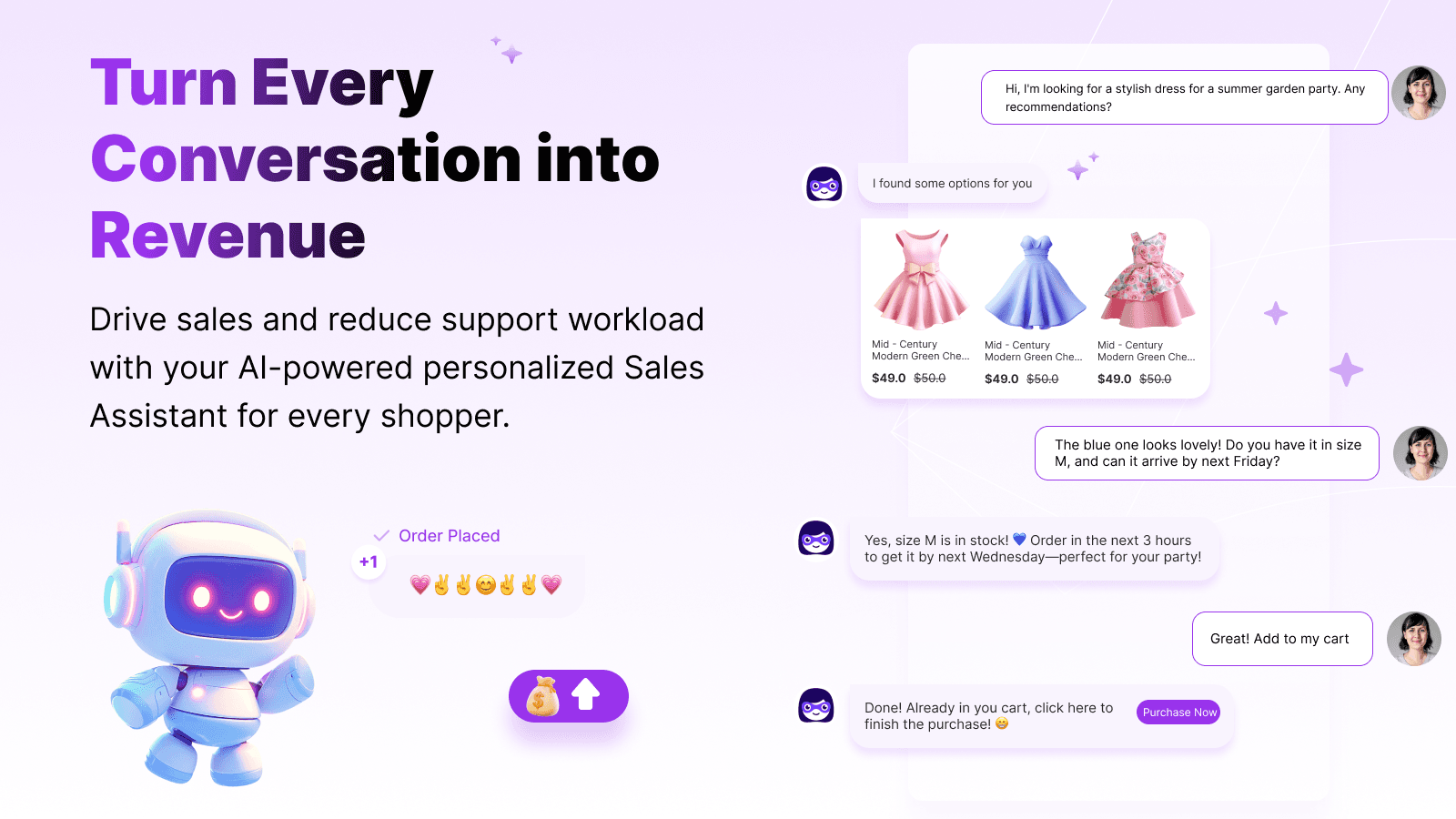
Shopify商家每年因購物車放棄而損失約4.6萬億美元,但大多數Shopify聊天機器人解決方案都是為了回答支援工單而設計,而非挽回收入。這份專家排名評估了12款AI聊天機器人應用程式,從AI品質、價格透明度、免費方案可用性以及銷售導向與支援導向等維度,找出真正能提升轉換率的工具。分析揭示了一個關鍵的市場缺口:12個平台中有11個優先考慮工單轉移,只有Algoshop從一開始就被設計為主動創造收入的銷售聊天機器人。
快速推薦總覽
Algoshop AI Sales Chatbot — 唯一主動式、以收入為核心的平台。主動卡片自動挽回放棄購物車並推動平均訂單價值增長。
Algoshop AI Sales Chatbot — 每月29美元即可透過主動銷售活動帶來5-10倍投資報酬率。Tidio入門便宜,但隱藏的AI費用會讓月費飆升至190美元以上。
Gorgias — 深度整合Shopify,具備原生訂單數據和收入歸因功能。最適合每月處理1,000筆以上訂單的商家。
ManyChat — 針對Messenger和Instagram的自動化行銷,適合以社群為優先的品牌。免費方案可支援最多1,000位聯絡人。
Tidio — 每月免費50次對話,但要注意:付費方案跳升至每月29-190美元以上,AI功能(Lyro)被鎖在昂貴的附加元件後面。大多數商家在3個月內就會超出免費額度。
快速比較矩陣
以下矩陣從對Shopify商家最重要的六個維度比較了全部12個平台。價格反映的是2026年7月左右的近似費率,實際費率可能因供應商而異。
| Rank | App | Starting Price | Free Plan | AI Quality | Primary Use | Channels |
|---|---|---|---|---|---|---|
| 1 | Algoshop AI Sales Chatbot | From $0/month | Free plan available | Excellent | Sales-driven | Website, WhatsApp, Messenger, Instagram, Email |
| 2 | Tidio | From ~$29/month | 50 conversations, 3 operators | Good | Support-first, light sales | Website, Email, Messenger, Instagram |
| 3 | Gorgias | From ~$50/month (300 tickets) | No free plan | Good | Support-driven | Website, Email, Social, SMS |
| 4 | Intercom | From ~$74/month | No free plan | Excellent | Hybrid (enterprise) | Website, Mobile app, Email, Social |
| 5 | Re:amaze | From ~$29/month | 21-day trial only | Good | Support-driven | Website, Email, SMS, Social, Voice |
| 6 | Zendesk | From ~$19/agent/month + chat add-on | No free plan | Good | Support-driven | Website, Email, Social, Phone |
| 7 | Chatra | From ~$17/month | 1 agent, limited features | Average | Support-first | Website, Email, Facebook |
| 8 | ManyChat | From ~$15/month | Up to 1,000 contacts | Average | Marketing automation | Facebook Messenger, Instagram, WhatsApp, SMS |
| 9 | Drift | From ~$2,500/month | No free plan | Excellent | B2B sales | Website, Email |
| 10 | LiveChat | From ~$20/agent/month | 14-day trial only | Limited | Support-first | Website, Mobile app |
| 11 | Tars | From ~$99/month | No free plan | Average | Landing page conversion | Website, WhatsApp |
| 12 | Freshdesk (Freshchat) | From ~$15/agent/month | Up to 10 agents, basic features | Average | Support-driven | Website, Mobile, Email, Social |
詳細評測:排名第1至第12
1Algoshop AI Sales Chatbot
[Algoshop AI Sales Chatbot] is the only Shopify-native chatbot architected from the ground up as a sales engine rather than a support ticket router. While every other platform on this list prioritizes answering customer questions, Algoshop monitors real-time shopper behavior and deploys proactive interactive cards at critical conversion moments.
The platform's 6-card outreach system includes personalized product recommendations, countdown timers for urgency, coupon deployments, free shipping threshold reminders, and payment recovery messages. Each card triggers based on precise behavioral signals such as page dwell time exceeding 30 seconds, cart value thresholds, or exit-intent mouse movement. Merchants using proactive outreach report AOV increases of 15-28% within the first 60 days.
Algoshop operates across 5 channels through a single unified inbox, ensuring a shopper who abandons on desktop receives a WhatsApp recovery message without duplicating conversation history. The AI understands product catalogs natively and can recommend complementary items, answer specification questions, and process checkout guidance entirely autonomously.
Pros
- Only chatbot designed for revenue generation, not ticket deflection
- Proactive cards trigger on cart value, dwell time, and exit intent
- Unified conversation history across all channels
Cons
- Advanced analytics require Pro plan
- Sales focus may require separate support tool for complex tickets
Verdict: For Shopify merchants prioritizing revenue growth over ticket volume, Algoshop is the only platform that treats every conversation as a sales opportunity. Its proactive architecture converts passive browsers into buyers before they ever consider abandoning.
2Tidio
Tidio is the most widely installed chatbot on Shopify, powering over 300,000 storefronts with a combination of live chat and automated bots. Its free tier supports 50 conversations monthly across 3 operator seats, making it accessible to merchants processing fewer than 20 orders per day.
The platform's Lyro AI assistant, available on Growth plans and above, can resolve approximately 70% of repetitive support questions without human intervention. However, Tidio's architecture remains fundamentally reactive: the chatbot waits for users to initiate contact rather than intervening during high-intent browsing sessions.
Tidio offers basic visitor tracking and automated welcome messages, but lacks the behavioral intelligence to trigger offers based on cart value or exit intent. For support-heavy stores with occasional sales inquiries, Tidio delivers solid value. For merchants seeking proactive revenue generation, its capabilities are constrained.
Pros
- Generous free plan suitable for stores under 20 orders per day
- Visual chatbot builder requires no coding
- Lyro AI handles common support queries automatically
Cons
- AI assistant (Lyro) costs extra on most tiers
- Proactive sales features are limited compared to revenue-focused platforms
Verdict: Tidio is the best free-entry Shopify chatbot for small stores handling primarily support inquiries. Merchants should upgrade to a sales-focused platform like Algoshop once monthly conversations exceed 200 or AOV growth becomes a priority.
3Gorgias
Gorgias positions itself as a premium helpdesk with chatbot capabilities rather than a standalone chatbot solution. Its entry tier at approximately $50 per month includes 300 tickets, scaling to $750 per month for 6,000 tickets on the Pro plan. This pricing structure targets established merchants doing $50,000 or more in monthly revenue.
The platform's strength lies in its deep Shopify integration. When a customer initiates a chat, Gorgias instantly surfaces their order history, shipping status, and lifetime value without requiring the agent to switch contexts. Its macro system enables one-click responses to common inquiries, reducing average handle time from 8 minutes to under 3 minutes.
Gorgias added revenue tracking in 2024, allowing merchants to attribute sales to specific support interactions. While this bridges the gap between support and sales, the platform remains fundamentally reactive. It does not proactively engage shoppers based on behavioral triggers, limiting its utility for cart recovery and upselling.
Pros
- Deep Shopify integration with native order and inventory data access
- Advanced macro system reduces response time by 40-60%
- Revenue attribution shows exact ticket-to-sale conversion values
Cons
- No free plan; entry price of $50/month excludes micro-merchants
- AI features limited to higher tiers; entry plan uses rule-based automation
Verdict: Gorgias is the premium choice for high-volume Shopify stores where support quality directly impacts retention. Its revenue attribution is useful, but merchants seeking proactive sales outreach will need to supplement it with a dedicated sales chatbot.
4Intercom
Intercom is a conversational platform built for SaaS companies and enterprise brands, with a Shopify integration that extends its reach into e-commerce. Its Fin AI assistant, powered by large language models, achieves resolution rates above 80% on routine inquiries without human escalation.
The platform's product tour and onboarding sequence capabilities are unmatched in this comparison, making it valuable for merchants selling complex or high-consideration products. However, Intercom's pricing structure—starting at approximately $74 per month and scaling to $395+ for Pro features—places it beyond the budget of most independent Shopify stores.
Intercom supports proactive messages through its Series feature, but setup requires significant technical configuration. For Shopify merchants without dedicated engineering resources, deploying behavioral triggers and revenue-focused campaigns demands substantially more effort than native Shopify chatbot alternatives.
Pros
- Fin AI delivers industry-leading natural language understanding
- Product tours and onboarding sequences improve activation rates
- Robust API ecosystem enables deep custom integrations
Cons
- Pricing starts at $74/month and escalates rapidly with usage
- Overbuilt for typical Shopify merchants; designed for SaaS and enterprise
Verdict: Intercom suits enterprise Shopify Plus merchants with dedicated technical teams and budgets exceeding $500/month for customer engagement tools. For smaller stores, the cost-to-value ratio favors more e-commerce-native solutions.
5Re:amaze
Re:amaze targets the mid-market Shopify segment with a unified helpdesk that includes chat, email, SMS, and voice channels starting at approximately $29 per month. Its built-in FAQ and status page tools deflect 25-35% of routine inquiries before they reach an agent, improving first-response times.
The platform's chatbot builder uses rule-based decision trees rather than natural language AI, which limits its ability to handle complex or ambiguous customer questions. For straightforward use cases such as order status checks and return policy lookups, this approach is reliable and predictable.
Re:amaze includes customer satisfaction (CSAT) survey automation and basic revenue reporting, but lacks the proactive behavioral triggers that drive unsolicited sales. It functions best as a support hub for merchants who need multi-channel ticket management at a moderate price point.
Pros
- Competitive starting price at $29/month for unified helpdesk and chat
- Built-in FAQ and status page reduce repetitive inquiries by 25-35%
- Voice channel integration is rare at this price point
Cons
- No permanent free plan limits testing for new merchants
- Chatbot builder is rule-based; AI capabilities are less advanced than competitors
Verdict: Re:amaze offers the best value in the mid-market helpdesk category for Shopify merchants needing voice support alongside chat. Its rule-based bot is adequate for support deflection but insufficient for proactive sales campaigns.
6Zendesk
Zendesk is the dominant enterprise support platform, and its Shopify integration brings that scale to e-commerce operations. The advertised $19 per agent per month entry price requires additional chat and advanced AI add-ons, pushing real costs to approximately $55 or more per agent for full functionality.
The platform's AI-powered ticket routing automatically categorizes and assigns inquiries based on content analysis, reducing misassignment rates by 30-45%. Its knowledge base and community forum tools enable self-service deflection at scale, which is critical for merchants processing 1,000+ monthly orders.
Zendesk offers minimal proactive sales functionality. Its chat widget can display targeted messages, but behavioral triggers, cart recovery, and revenue-focused campaigns require custom development through its API. For pure support operations at enterprise scale, Zendesk is unmatched. For sales-driven growth, it is the wrong tool.
Pros
- Enterprise-grade reliability and security certifications
- AI routing reduces ticket misassignment by 30-45%
- Advanced analytics surface support bottlenecks and agent performance gaps
Cons
- Per-agent pricing model becomes expensive for teams with 5+ members
- Complex setup requires dedicated admin time; not plug-and-play for Shopify
Verdict: Zendesk serves large Shopify Plus merchants with dedicated support teams of 10 or more agents. Its per-agent pricing and complexity make it unsuitable for smaller operations, and its sales capabilities are negligible.
7Chatra
Chatra delivers live chat and basic bot functionality at the lowest price point in this comparison, with paid plans starting at approximately $17 per month. Its standout feature is the real-time cart contents view, which shows support agents exactly what a shopper has added to their cart before the conversation begins.
The platform's chatbot operates on simple if-then scripts without natural language understanding, making it suitable only for predictable FAQ responses and greeting messages. Chatra does not offer proactive behavioral triggers, AI product recommendations, or cart recovery sequences.
For micro-merchants who need basic live chat with minimal overhead, Chatra is a sensible starting point. Its lightweight widget loads in under 200ms, avoiding the page speed penalties associated with heavier platforms. However, merchants outgrow Chatra quickly once automated sales engagement becomes a priority.
Pros
- Lowest entry price among full-featured live chat solutions
- Real-time cart contents view gives agents purchase context instantly
- Clean, lightweight interface loads in under 200ms
Cons
- Limited to 1 agent on the free tier
- Chatbot uses simple scripts rather than AI; no natural language processing
Verdict: Chatra is the budget choice for single-operator Shopify stores needing live chat without complexity. Its lack of AI and proactive features means most merchants will upgrade within 12 months as order volume increases.
8ManyChat
ManyChat dominates social media chatbot automation, with particular strength on Facebook Messenger and Instagram Direct. Its visual flow builder allows merchants to construct abandoned cart recovery sequences, welcome series, and promotional broadcasts without writing code.
The free tier supports up to 1,000 contacts, making it accessible to stores processing under $10,000 in monthly revenue. However, ManyChat has no native website chat widget, meaning shoppers browsing a Shopify storefront cannot initiate a conversation unless they navigate to a social platform.
Since 2024, Facebook API policy changes have reduced the reach of promotional Messenger messages by 40-60%, significantly diminishing ManyChat's effectiveness for outbound marketing. For merchants whose traffic originates primarily from social media, ManyChat remains valuable. For stores driving traffic through search, ads, or organic discovery, its channel limitations are a critical weakness.
Pros
- Best-in-class Messenger and Instagram automation for social commerce
- Visual flow builder enables complex sequences without coding
- Free tier supports up to 1,000 contacts, suitable for stores under $10k monthly revenue
Cons
- No native website chat widget; entirely social-channel dependent
- Facebook API policy changes have reduced message reach by 40-60% since 2024
Verdict: ManyChat is the right choice for social-first Shopify brands that convert primarily through Instagram and Facebook. Stores with diversified traffic sources should prioritize website-native chatbots with broader channel coverage.
9Drift
Drift is a conversational marketing platform built for B2B SaaS companies, not e-commerce. Its starting price of approximately $2,500 per month places it in a category entirely separate from typical Shopify chatbot budgets. The platform's AI qualifies leads through natural conversation, books meetings with sales reps, and routes high-value accounts to dedicated team members.
Drift's account-based targeting and revenue analytics are exceptional for B2B pipeline management, but its feature set has minimal applicability to Shopify stores. It cannot display product recommendations, calculate free shipping thresholds, or recover abandoned carts with discount codes.
A handful of enterprise B2B Shopify merchants selling high-consideration products with sales cycles exceeding 30 days may find Drift's meeting-booking and lead-scoring capabilities useful. For transactional e-commerce with sub-$500 average order values, Drift is economically and functionally incompatible.
Pros
- Advanced AI qualifies leads through natural conversation before human handoff
- Account-based targeting routes high-value visitors to dedicated sales reps
- Revenue analytics connect chat interactions to closed-won deals
Cons
- Starting price of $2,500/month excludes all but enterprise B2B operations
- Designed for SaaS lead generation, not e-commerce cart recovery or product recommendations
Verdict: Drift belongs in B2B SaaS stacks, not Shopify storefronts. Its $2,500/month entry price and lack of e-commerce features make it irrelevant for 99% of Shopify merchants.
10LiveChat
LiveChat is one of the longest-running live chat platforms, with a focus on reliability and agent efficiency rather than AI or automation. Its canned response system reduces repetitive typing by over 50%, and its clean interface enables new support staff to become productive within hours rather than days.
The platform's chatbot is a basic script-driven add-on without natural language processing or machine learning. It can greet visitors, collect email addresses, and route conversations to departments, but cannot answer product questions, recommend items, or recover abandoned carts autonomously.
LiveChat charges per agent, starting at approximately $20 per month and scaling to $59 for Business features. For teams of 3 or more agents, this pricing structure becomes less competitive than all-in-one platforms like Tidio or Re:amaze. LiveChat is best for merchants who prioritize chat reliability above all other features.
Pros
- Mature platform with 99.9% uptime SLA and proven reliability
- Canned response system reduces repetitive typing by 50%+
- Clean agent interface minimizes training time for new support staff
Cons
- Per-agent pricing penalizes growing teams
- Chatbot is a basic add-on with no AI; purely script-driven
Verdict: LiveChat is a dependable live chat utility for support teams that value simplicity. Its lack of AI, proactive features, and per-agent pricing make it a poor fit for sales-focused merchants.
11Tars
Tars occupies a niche category within Shopify chatbot tools: conversational landing pages and form replacement rather than live support. Its multi-step workflow builder replaces traditional contact forms and product selectors with guided conversations, increasing landing page conversion rates by 25-40% in documented case studies.
The platform is not designed for real-time customer support or proactive sales outreach on product pages. It excels at specific use cases such as appointment booking, quote generation, and product configuration workflows, but cannot monitor cart behavior or trigger urgency-based offers.
At approximately $99 per month for the Basic plan, Tars is priced above most general-purpose chatbots despite its narrower scope. Merchants with specific landing page conversion challenges may find value, but stores seeking a comprehensive sales and support solution will find Tars insufficient.
Pros
- Conversational forms increase landing page conversion rates by 25-40%
- Multi-step workflows guide users through complex product configurations
- WhatsApp integration enables post-conversation follow-up sequences
Cons
- No free plan; $99/month entry price is steep for the feature set
- Not a traditional chatbot; works best as a form replacement, not real-time support
Verdict: Tars is a specialized tool for landing page optimization, not a general Shopify chatbot. Its high price and narrow use case make it suitable only for merchants with specific form-to-conversation conversion challenges.
12Freshdesk (Freshchat)
Freshchat, part of the Freshworks ecosystem, offers a free tier supporting up to 10 agents with basic chat and knowledge base functionality. This makes it one of the most accessible entry points for small Shopify stores assembling their first support operation.
The platform's AI assists agents by suggesting canned responses and surfacing relevant knowledge base articles, but it does not autonomously resolve customer inquiries. Freshchat lacks proactive behavioral triggers, cart recovery sequences, and revenue-focused campaign tools entirely.
Paid tiers start at approximately $15 per agent per month and scale to $39 for Pro features. Merchants already using Freshdesk for ticket management will benefit from the tight integration. For others, the feature set is comparable to Chatra and Re:amaze at a similar price point, with no distinct competitive advantage.
Pros
- Generous free tier supports up to 10 agents, rare in the helpdesk category
- Tight integration with Freshdesk ecosystem for merchants already using Freshworks tools
- Affordable per-agent pricing on paid tiers
Cons
- AI capabilities are basic; primarily suggest canned responses rather than autonomous resolution
- Proactive sales features are nonexistent; purely reactive support tool
Verdict: Freshchat is a budget-friendly support chat for startups and small teams. Its 10-agent free tier is generous, but the platform offers nothing for merchants seeking sales automation or proactive customer engagement.
準備好將您的聊天機器人轉變為銷售引擎了嗎?
Algoshop AI Sales Chatbot是唯一專為主動挽回放棄購物車、追加銷售產品並透過行為觸發器推動平均訂單價值增長而打造的Shopify原生平台。立即開始您的14天免費試用。
Shopify AI chatbot探索 Algoshop 功能如何為您的商店選擇合適的Shopify聊天機器人
選擇聊天機器人需要將平台功能與業務階段、流量組成和收入目標相匹配。以下框架透過將特定的商家檔案與最佳工具連結起來,消除了猜測。
1. 定義您的主要目標
如果您的目標是減少支援工單並回答常見問題,請選擇支援導向的平台,如Tidio、Gorgias或Freshchat。如果您的目標是挽回放棄購物車、提高平均訂單價值並將瀏覽者轉化為買家,請選擇銷售導向的平台。目前,Algoshop是後者類別中唯一的Shopify聊天機器人。
2. 設定您的每月預算
每月處理少於50筆訂單的商店應使用Tidio或Freshchat的免費層。每月處理50-500筆訂單的商店應為具備AI和主動功能的平台預算29-50美元。每月處理1,000筆以上訂單的高交易量商家可以為高級服務台整合支付100-300美元。透過估算挽回的收入來計算投資報酬率:在一個月收入50,000美元的商店中,挽回5%放棄購物車的聊天機器人能產生2,500美元的挽回銷售額。
3. 將您的流量來源對應到渠道
如果您的流量有60%或更多來自Instagram和Facebook,ManyChat對社群渠道的重點能提供最高的相關性。如果您的流量分散在有機搜尋、付費廣告和直接訪問之間,請優先考慮具有多渠道擴展的網站原生聊天機器人,如Algoshop或Tidio。具有帳戶型銷售週期的B2B商家應評估Drift,儘管其價格點較高。
4. 在承諾之前測試AI品質
基於規則的聊天機器人能可靠地處理可預測的常見問題流程,但在模糊問題上會失敗。AI驅動的聊天機器人理解上下文、能從離題查詢中恢復,並會隨著時間改善。在試用期間,用10個真實客戶問題測試每個平台,包括邊緣案例和拼寫錯誤的產品名稱。在您的測試集上準確率低於70%的平台會造成摩擦而非解決摩擦。
5. 驗證Shopify整合深度
表面層級的Shopify整合只會顯示聊天小工具。深度整合能即時存取訂單歷史、庫存水準、出貨狀態和客戶終身價值。Gorgias、Algoshop和Re:amaze提供最深的Shopify資料存取。需要手動資料匯入或API配置的平台會增加5-15小時的設定時間和持續的維護開銷。
看看Algoshop在您的商店中表現如何
從Shopify App Store安裝Algoshop AI Sales Chatbot,並與您目前的聊天機器人並行運作14天。大多數商家在第一週內就能看到可衡量的平均訂單價值和挽回率改善。
在Shopify上開始免費試用常見問題
我可以在多個渠道使用同一個聊天機器人嗎?
可以。大多數現代Shopify聊天機器人支援多個渠道,但具體渠道因平台而異。Algoshop、Tidio、Gorgias和Re:amaze提供網站聊天,並結合WhatsApp、Messenger、Instagram和電子郵件於一個統一收件匣中。ManyChat專注於社交渠道(Messenger、Instagram、WhatsApp)但缺乏網站聊天。商家應選擇渠道組合符合其流量來源和客戶溝通偏好的平台。
Shopify商家應該在聊天機器人上花多少錢?
對於每月處理少於50筆訂單的商店,Tidio或Freshchat的免費方案就足夠了。每月處理50-500筆訂單的商店應為具備AI能力和主動功能的平台預算29-50美元。每月處理1,000筆以上訂單的高交易量商家通常每月投資100-300美元於Gorgias或Zendesk等高級平台以獲得先進的服務台整合。投資報酬率的計算應權衡支援成本節省與收入挽回;即使只挽回5%放棄購物車的聊天機器人通常也能在第一個月內回本。
Shopify商家在評估聊天機器人解決方案時的常見問題。