
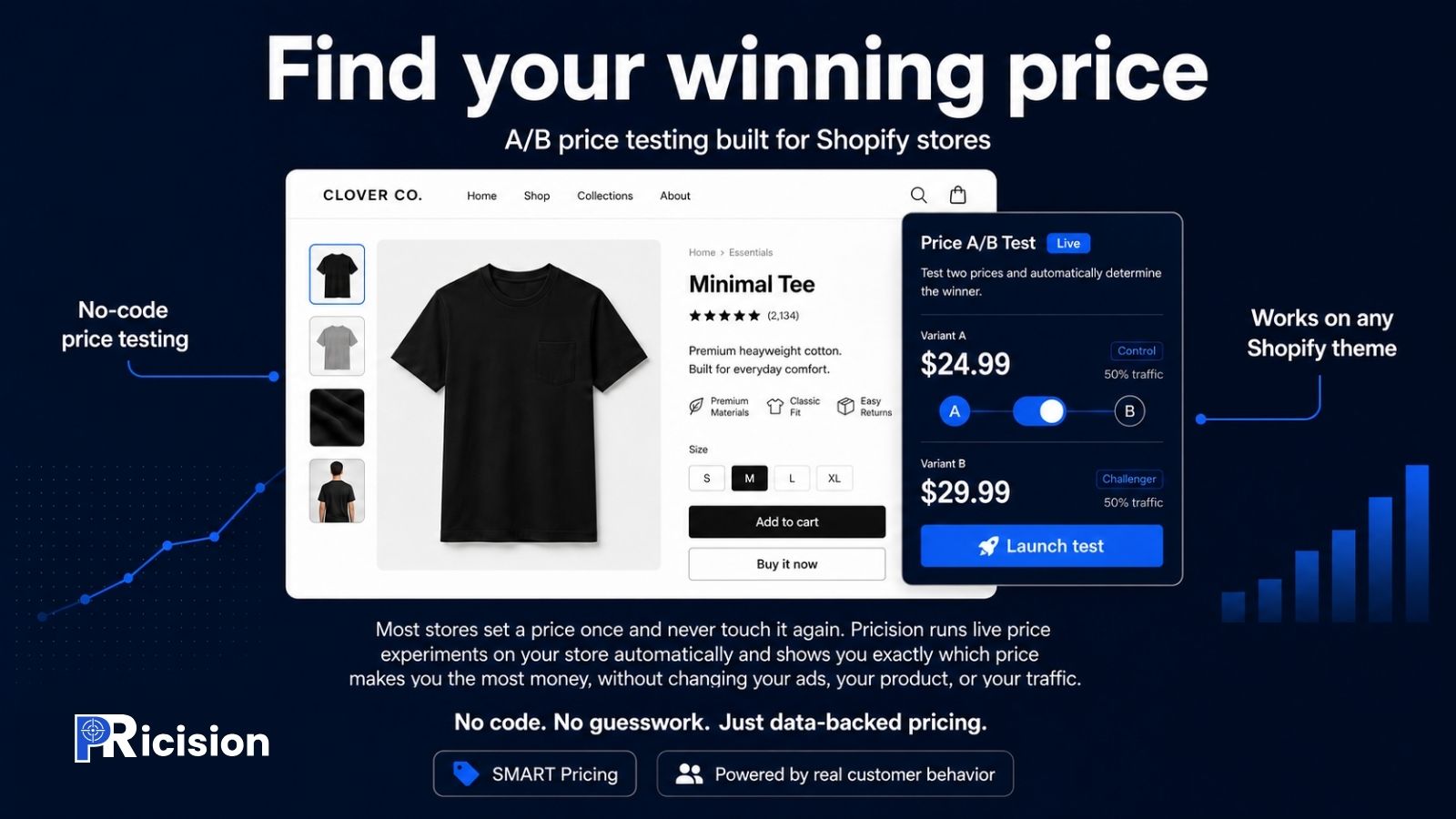
Pricision's illustration introduces live price testing. The displayed prices and charts are examples, not results from our store.
A lower price can make a product easier to buy while leaving less room to pay for the sale. A higher price can protect the value of each order while making some customers hesitate. The useful question is not simply which price sells more units, but which price supports the business goal you are trying to achieve.
Pricision: Price Range Testing runs live Shopify price experiments across multiple price points, with conversion, revenue and profit-per-visitor insights. Its official description emphasizes no-code setup and approval over price changes. It is designed to turn a pricing choice into an experiment, not to guarantee an absolute best price for every future customer or selling period.
This article is prepared through a reciprocal content collaboration. It explains official materials and recommended experiment planning; we have not run a Pricision test or measured a profit improvement.
A lower price is not automatically better
Price changes involve a tradeoff between what each purchase contributes and how people respond to the offer. Looking only at orders can hide that tradeoff. Looking only at revenue can hide it too, because revenue does not tell you which costs have been paid.
Decide the business question before launching a test. Are you evaluating a product's normal selling price, reconsidering a discount, or trying to understand whether buyers will accept a different position in the market? These are related questions, but they should not become an experiment with no clear decision at the end.
Write down what you will use the result to decide. That simple step helps prevent changing the goal after seeing whichever metric looks most attractive. It is a recommended planning practice, not an additional feature claimed for Pricision.
Test a range rather than two alternatives
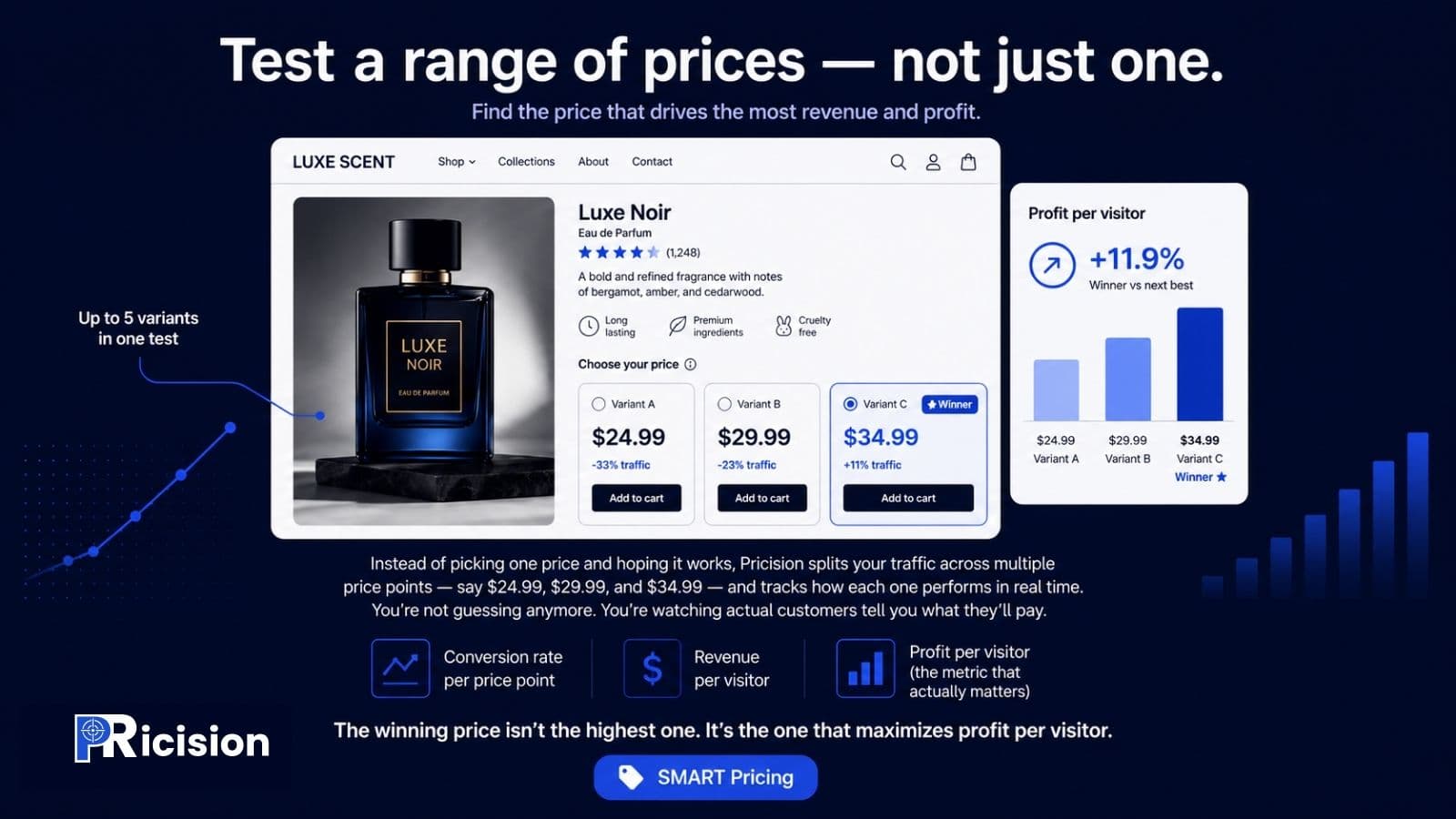
Comparing several price options is different from choosing only one alternative. The chart is a vendor illustration, not a measured profit improvement.
The Pricision website describes multi-option experiments, including price endings, and performance comparisons rather than a choice limited to one control and one alternative. This is the app's central distinction: the question can be how shoppers respond across a range, not merely whether one proposed change beats the old price.
A range still needs a commercial rationale. Use prices you could actually keep if the result supports them. A test of options that the business cannot sustain may produce an interesting chart without producing a usable decision.
Do not confuse price options with product variants. A different test price is a condition within an experiment. A size, color or other Shopify variant is a catalog distinction. The plan table separates product-price testing from variant testing; select the appropriate plan and scope rather than assuming every price experiment covers every variant.
Avoid describing a reported winner as proof that all untested prices are worse. The result concerns the options, audience and period included in the test. It is useful information about a real choice, not a complete map of every possible future price.
Prepare the product and buying experience
Pricision's site describes keeping a visitor's price consistent within a session and using the same price at checkout. Its listing says setup requires no code or theme edits. Those are useful product descriptions, but the merchant still needs to review the full buying journey used by the store.
Look at where a price appears: the product page, basket, promotional messaging and checkout. Also consider active discounts, bundles or sales channels. A feature tag or a broad compatibility statement does not explain every interaction in your particular configuration.
Choose the product carefully. A substantial change in photography, stock availability, advertising or the offer itself can make the period harder to interpret. You do not need to freeze the entire business; you do need to know what else changed while the experiment was running.
Prepare a decision you can act on
Define the scope
Identify the product or variant being considered and the question the test should answer. Keep that scope clear to merchandising and marketing colleagues.
Set commercially usable options
Choose prices the business could sustain. Review the cost assumptions behind the decision instead of relying on sales volume alone.
Review the customer journey
Check price presentation and checkout with the relevant promotions and purchasing paths. This checklist is editorial preparation, not a report of a completed app test.
Read conversion, revenue and profit together
The official materials discuss conversions, revenue and profit per visitor, with the website also describing revenue per visitor. Each draws attention to a different part of the decision. None should be treated as a complete explanation on its own.
Swipe horizontally to read the full table.
| Measure | Decision question | Interpretation caution |
|---|---|---|
| Conversion | Are the exposed shoppers completing the purchase? | More purchases alone do not establish a better margin. |
| Revenue | What sales value is associated with the tested offer? | Sales value is not the amount left after all costs. |
| Revenue per visitor | How does sales value relate to the visitors included? | Use the tool's actual visitor and revenue definitions. |
| Profit per visitor | What profit contribution is reported relative to visitors? | Understand which cost inputs are included before treating this as net business profit. |
These are explanations of the questions the metrics address, not a reconstruction of Pricision's private calculation or statistical model. The public material does not fully establish the treatment of every cost, refund or visitor type. Ask how those definitions work for your setup if they are central to the decision.
Keep the amount of information in view alongside the direction of a result. A price with a handful of purchases and a price observed over a broader period should not be compared casually without understanding the test's reporting. We are not assigning a universal visitor threshold, test length or confidence guarantee: those depend on the experiment and the methodology actually used.
For a broader view of store profitability, our Margeny profit-analytics article addresses a different task. An experiment helps compare price options; a profit-analysis tool helps explain the wider business. One should not be described as automatically replacing the other.
Turn the result into an approved decision
From tested option to a live pricing decision
Choose the options
The website describes testing price endings such as .00, .95, .98 and .99. Keep the options within a commercially usable range; an ending is a test choice, not a promised psychological effect.
Read the recommendation
Compare the reported conversions, revenue per visitor and profit with the goal set before the test. A winning option is strongest among the tested choices, not proof that every possible price has been evaluated.
Apply deliberately
The site describes one-click application alongside automatic winner selection. Confirm the approval controls for the installed version, then record which price was put into use and why.
A recommendation, a selected winner and a live price change are different stages. Pricision's public copy describes automatic winner selection as well as approval and one-click application. Before starting, confirm when approval is required and what selecting a winner actually changes in the store.
Keep a short decision record outside the headline result: what was tested, the goal, what else changed during the period and why the chosen price is commercially acceptable. That gives colleagues a reason they can understand rather than a number they have been told to trust.
Also decide what would prompt a later review. A new supplier cost, a different promotion or a change in customer audience can change the business context. The value of testing is learning from a defined period; it is not a promise that one result remains optimal indefinitely.
Choose a plan by experiment and visitor limits
The current Shopify listing and website plan table, checked October 8, 2026, show:
Swipe horizontally to read the full table.
| Plan | Monthly price | Listed testing scope |
|---|---|---|
| Free | $0 | One live product-price experiment; up to 1,000 visitors. |
| Standard | $19.95 | Up to five live experiments, one per product; unlimited visitors. |
| Pro | $49.95 | Unlimited experiments and visitors; variant testing and advanced insights. |
Paid plans list a 7-day free trial. The website also contains older FAQ and broad marketing statements that do not match this table. Confirm the current terms with Pricision before purchasing; the limits above come from the explicit current plan tables, not those contradictory statements.
Choose based on the experiments you intend to run, not simply the word unlimited. A plan with more capacity will not compensate for unclear product scope or a decision that has not been defined.
Frequently asked questions
Does Pricision require theme edits?
The official listing and website describe no-code setup without theme edits. Review compatibility with your actual buying paths before starting a live test.
Will the app permanently change prices without approval?
The listing emphasizes approval, while other copy describes automatic winner selection and one-click application. Confirm those separate stages with the team rather than assuming automatic selection means an unapproved permanent change.
Can it test Shopify product variants?
The current plan tables include variant testing in Pro. Product-price testing and variant scope should not be treated as identical features across all plans.
How many visitors make a result reliable?
There is no universal number established by this article. Ask about the app's visitor definition and decision methodology, and consider the purchases and context behind the result rather than a fixed rule of thumb.
See Pricision on Shopify and its official site for the current offer and a demonstration of the experiment controls.