
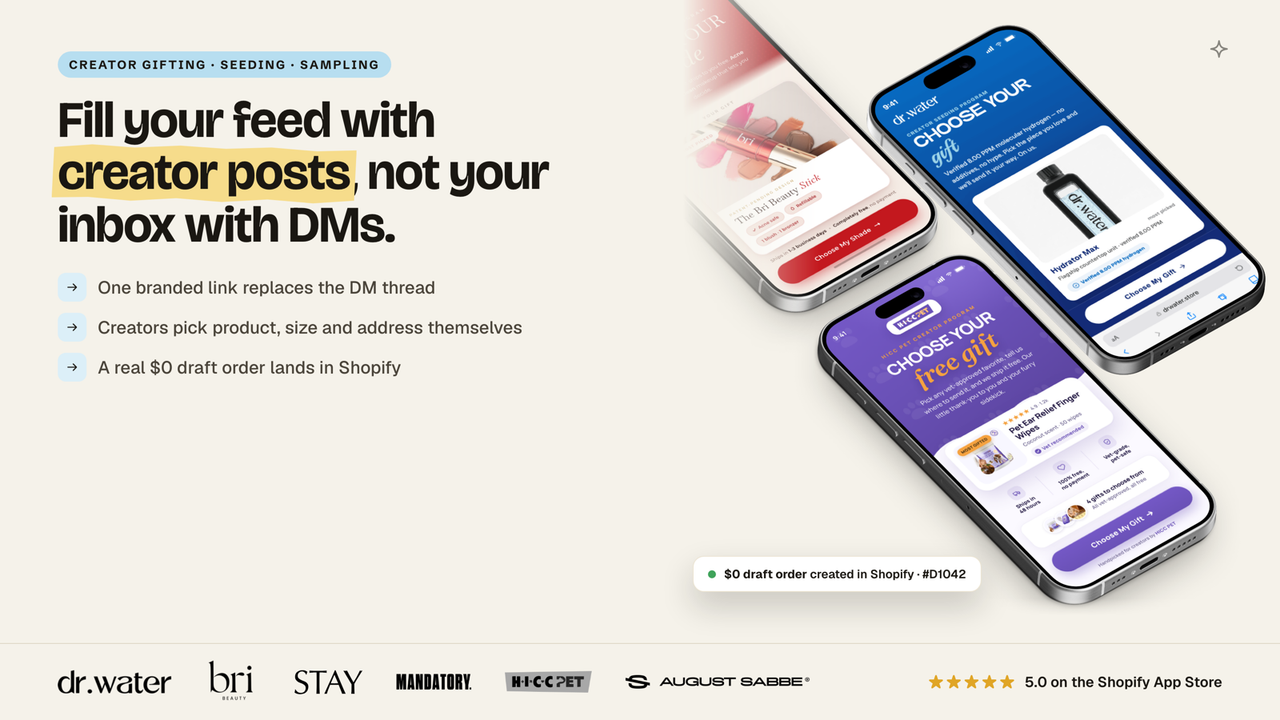
A creator agrees to receive a product. Then the practical questions begin: which item, which size, which address, and where does the fulfillment team find that information? The marketing conversation is only the start of the work.
Seed: Influencer Gift Form brings product selection and shipping details into a gift-form workflow. A creator chooses an available product and enters their details; a $0 draft order appears in Shopify for the merchant to approve and ship. Its main advantage is connecting creator outreach to an operational record instead of leaving the shipment scattered across messages.
This article is part of a reciprocal content collaboration with Seed. It describes the documented product workflow, not a campaign we have run or a guarantee of creator posts.
A gift link replaces a chain of administrative questions
The official product page describes a branded form where creators select products from live stock and supply their own address. For apparel, choosing a variant can capture the size or color directly rather than making staff reconstruct it from a DM.
The benefit is a cleaner handoff. The creator sees the selection task in one place; the merchant receives structured information that can become an order. This does not remove the relationship work: the invitation, content expectations and product suitability still need a clear conversation.
Before sharing the link, decide which products the campaign should offer. A generous gift policy and an unrestricted catalog are not the same thing. The app's gallery shows cart limits, which help define how many items a creator can select. Set those limits around the actual campaign budget and stock available for gifting.
The creator and merchant have different jobs
One selection, two responsibilities
Creator: choose and submit
Use the gift form to select the relevant product variant and provide delivery information. The merchant should explain what the invitation includes before the creator submits.
Merchant: approve and fulfill
Review the resulting Shopify draft order, confirm the intended gift and progress it through the store's fulfillment process. Creating a draft is not the same as dispatching a parcel.
This division is important when marketing and warehouse teams work separately. “The creator filled in the form” means the selection information has arrived. “The gift shipped” means the operational task has progressed. Keep those milestones distinct so a campaign does not lose track of a promised item between the two teams.
Why the $0 draft order matters
The Shopify listing explicitly describes a draft order tagged to the campaign. The merchant approves and ships it. A draft order is therefore the start of the fulfillment handoff, not proof of payment, shipment or delivery.
Seed does not require the creator to redeem a 100%-off coupon through ordinary checkout. That avoids using a public discount code as the mechanism for a private gift invitation. It also means your campaign administration can focus on the approved product selection rather than helping each creator through a discount checkout.
Do not read “$0 order” as “zero cost to the brand.” The goods, packaging and shipping still have a cost. International gifts may also require handling destination-specific charges and delivery conditions. Agree on those responsibilities before promising a gift, rather than assuming the software removes them.
Keep campaign progress beside the gift record
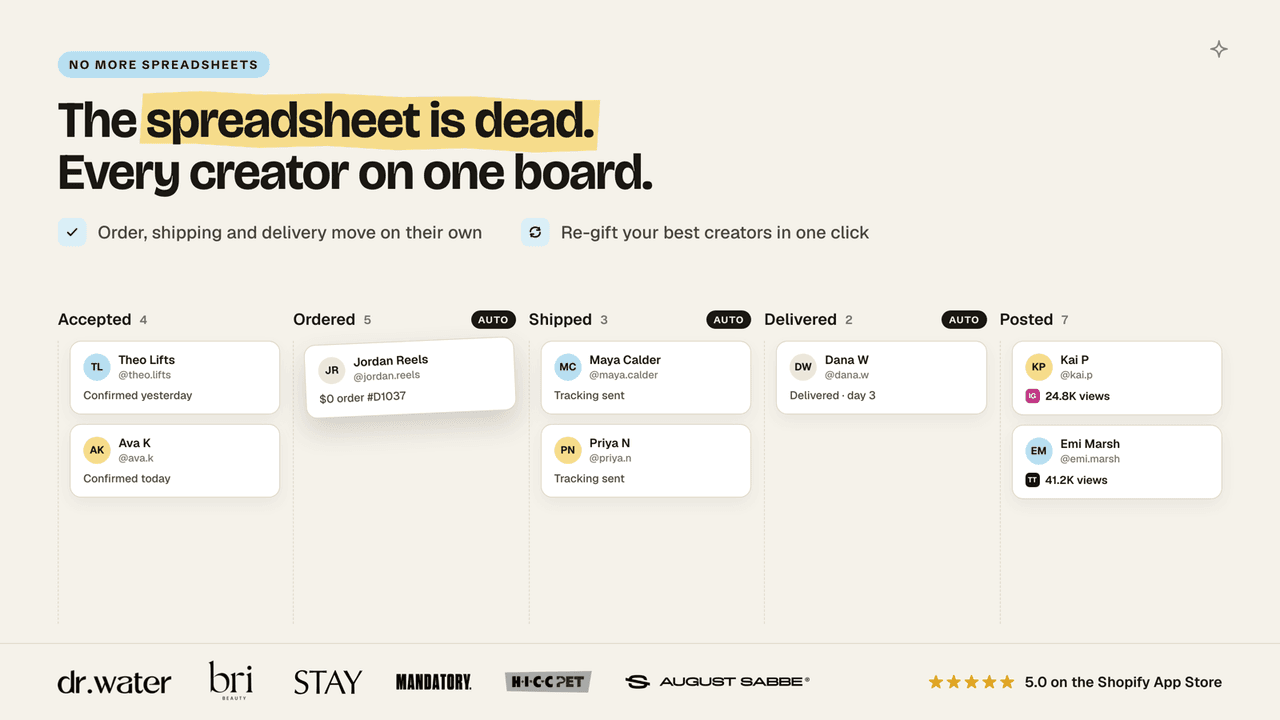
The board brings gift and campaign progress together. People and counts shown are vendor examples.
Seed's product materials describe a creator board and fulfillment updates. That gives a campaign team a place to distinguish creators who have accepted, selected, received or progressed to content follow-up.
Operational tracking is particularly useful when a second colleague takes over. They need to know which gift was selected and whether a shipment is underway, not just whether someone reacted positively to an invitation. Notes and campaign context help the next person continue the relationship without asking the creator to repeat everything.
The website shows a creator board and describes automatically updated order and delivery status. It separately labels automated DM follow-ups as coming soon. A board that helps the team organize follow-up is not the same as an automated reminder already being sent to creators. Keep that reminder work in your team's process until the feature is available.
Campaign setup before the first gift
The creator-facing link
Seed describes forms on the brand's own domain, with logo, colors and copy set per campaign. Make the invitation and form agree about the products being offered.
The fulfillment record
The creator's product choice and delivery details become a $0 Shopify draft order. The merchant still owns approval and shipping; a submitted form is not proof of delivery.
The relationship after delivery
Use the creator board to see the campaign's progress. Agree on any content expectations directly and distinguish manual follow-up from the announced automated-DM roadmap.
A published case shows the workflow—not a universal result
Seed's Bri Beauty case study reports 74 gift orders in the first week. That is a vendor-published account of a named brand, not a result measured by Algoshop or a forecast for another store.
The useful takeaway is the operational sequence: an accepted invitation can become a product selection and a gift order without relying on a coupon code. Whether another brand receives the same response depends on its audience, products, outreach and relationship with creators.
Keep that distinction when evaluating gifting tools. Software can organize selection and fulfillment; it cannot make an unsuitable product relevant to an audience or turn a weak invitation into a dependable content commitment.
Budget for the gifts as well as the subscription
The listing, checked October 7, 2026, gives the following self-managed plan capacities.
Swipe horizontally to read the full table.
| Plan | Monthly price | Listed campaign capacity |
|---|---|---|
| Free | $0 | Up to 5 gift orders per month and 1 campaign |
| Starter | $49 | Up to 50 gift orders and 5 campaigns |
| Seed: Scale Gifts | $99 | Unlimited gift orders and campaigns |
Starter and Scale Gifts show a three-day trial. The paid plans describe own-domain forms and creator CRM features; confirm the current plan details before treating a branded form as equivalent to full domain customization.
The website pricing describes the free allowance differently, as the first five gifts. Check the current installation terms for the billing period. Its Concierge description also differs from the listing about who supplies creators, so this guide does not recommend that service on an unconfirmed sourcing promise.
For an internal budget, separate the subscription from product cost, shipping and staff time. A campaign with no coupon leakage can still be expensive if the gifts are poorly targeted or require repeated logistical follow-up.
The creator relationship still needs clear expectations
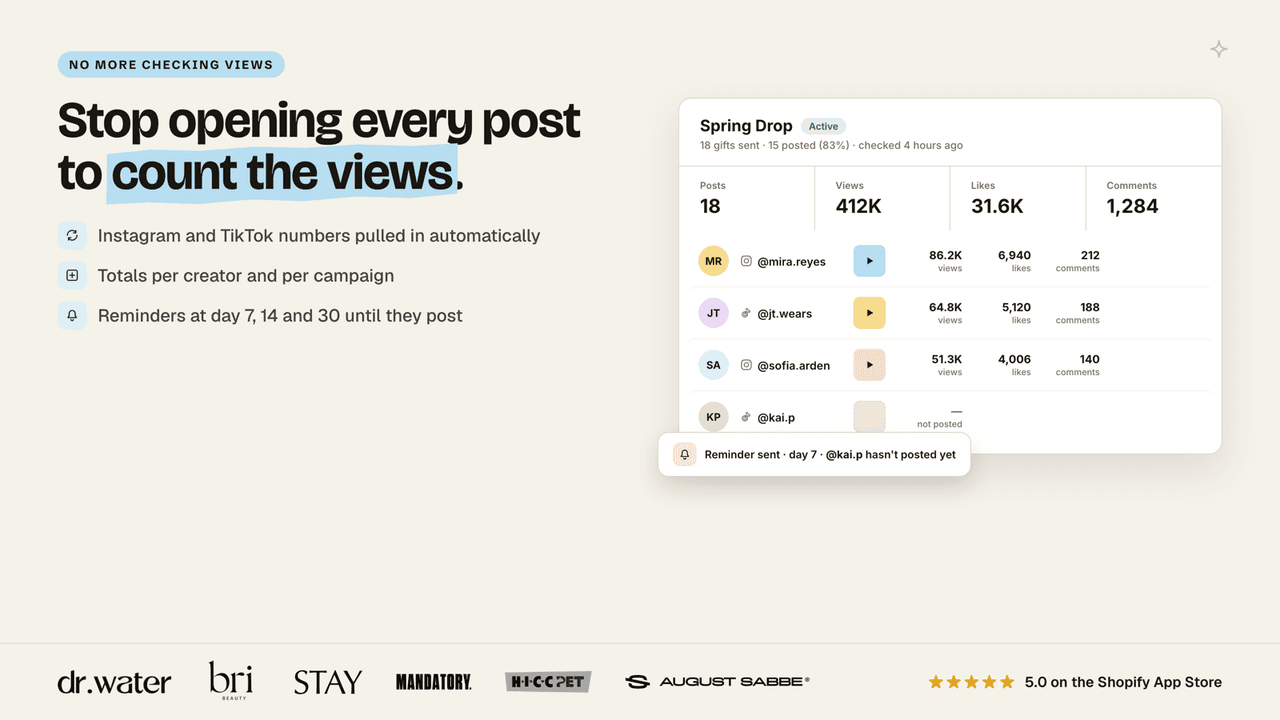
The official example brings post activity into the campaign view; a gift does not guarantee a post.
Set the product scope, delivery expectations and content arrangement before sending the selection link. A gift and a contracted deliverable are different agreements. Content rights, reuse permissions and required disclosures should not be inferred from an order record.
Seed's resource library offers gifting playbooks and agreement-related tools. Those resources can help a team prepare the conversation; they are not features automatically included in every gift-form submission.
A useful starting approach is to agree on the relationship first, make selection easy second, and keep fulfillment visible third. That lets the form reduce administrative friction without asking it to replace the work of choosing and communicating with creators.
Frequently asked questions
Can creators select their own size or color?
Seed's gallery and product description show variant selection. The available choices should come from the products and stock included in the campaign.
Does the form generate a completed Shopify order?
The documented starting record is a $0 Shopify draft order. The merchant reviews, approves and ships; form submission alone does not mean fulfillment is complete.
Do creators need a discount code?
The gift-form workflow does not rely on a coupon-code checkout. It creates the gift record directly for the merchant to handle.
Does Seed guarantee a post or a return on gifting?
No such guarantee is made here. Selection, tracking and follow-up help organize a campaign; content delivery depends on the agreement and the creator relationship.
Explore Seed's gift-form workflow and the Shopify app. Choose it when the gap between a creator's “yes” and a fulfillable gift has become the administrative problem you need to solve.