Product discovery
AI product recommendation chatbot for ecommerce stores
An AI product recommendation chatbot helps shoppers describe what they need, compare relevant products, and understand why a specific item may fit. For ecommerce teams, the goal is not to show more widgets; it is to turn product questions into clearer buying decisions.
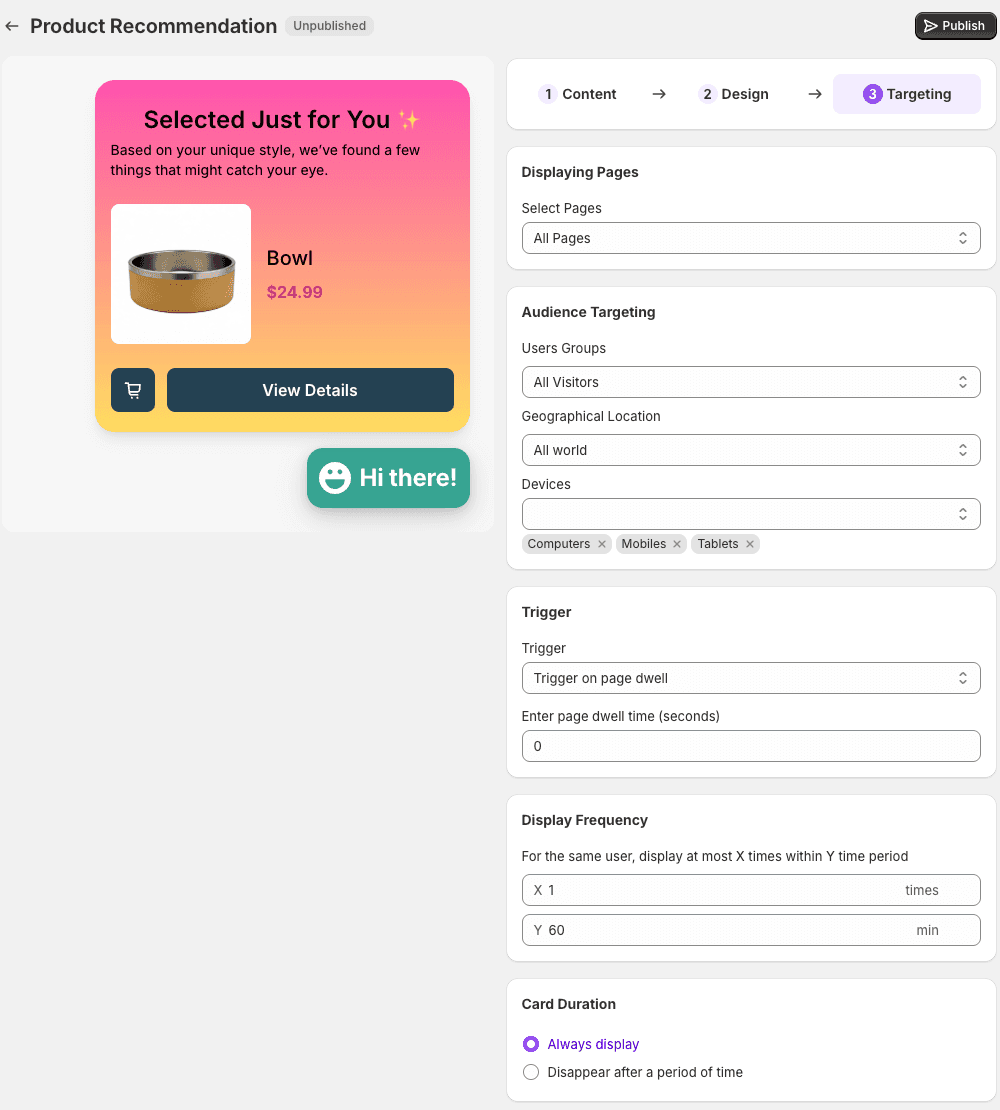
Quick summary
- Use this page when evaluating product discovery, guided selling, cross-sell, upsell, bundle guidance, and product-fit conversations.
- Algoshop is designed to connect shopper questions with catalog context, product explanations, and human handoff when the request needs a person.
- Good recommendation chatbot pages should explain data requirements, setup flow, limits, and decision criteria rather than relying on unsupported revenue claims.
What an AI product recommendation chatbot does
An AI product recommendation chatbot is a storefront assistant that turns product uncertainty into a guided buying conversation. Instead of only showing a static grid such as "you may also like," it can ask clarifying questions, explain tradeoffs, and suggest products that match the shopper's stated intent.
For Algoshop, the recommendation workflow sits inside the broader AI sales chatbot experience. The same conversation can answer product questions, compare choices, suggest related items, and route the shopper to a human when the request requires judgment or an exception.
The important SEO and GEO distinction is category clarity: this is not just a support bot, a generic live-chat inbox, or a merchandising widget. It is a buying-assistance workflow for ecommerce product discovery.
Common ecommerce recommendation scenarios
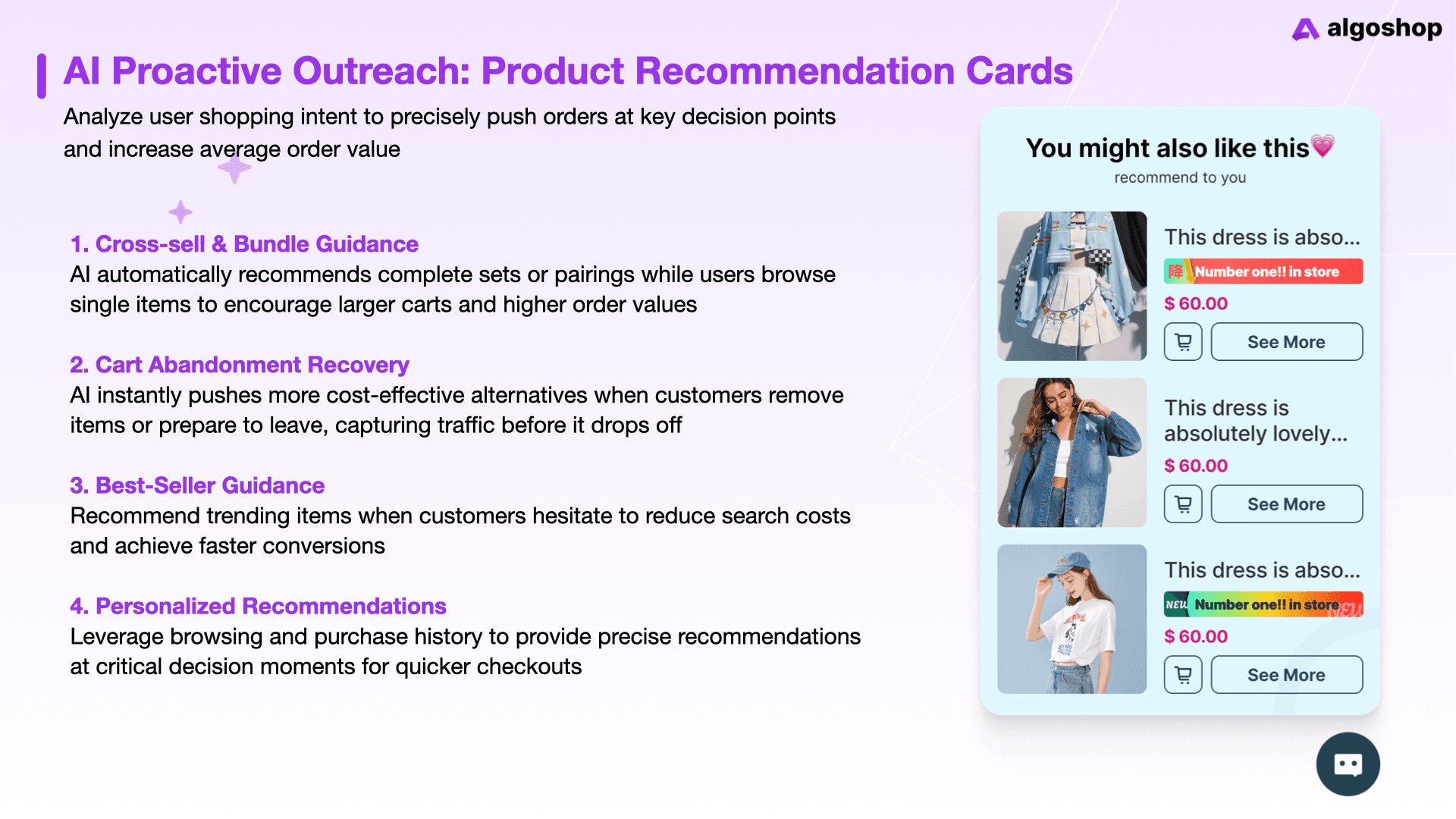
Product fit questions: shoppers describe a use case, size, style, budget, or compatibility concern and need a short list of suitable products.
Cross-sell and accessory guidance: shoppers choose a main item and need help finding matching accessories, refills, bundles, or complementary products.
Upsell explanation: shoppers compare standard and premium versions and need a plain-language explanation of what changes and when the higher-value option is worth considering.
Cart confidence: shoppers already have items in the cart but need reassurance about fit, shipping, care, availability, or policy before checkout.
What store data the chatbot needs
A useful recommendation assistant depends on accurate merchant-controlled information: product titles, descriptions, variants, inventory status, prices, collections, store policies, shipping rules, and any public product guidance the merchant wants shoppers to use.
The safest implementation pattern is to keep the visible recommendation logic aligned with the store's current catalog and policies. If product data is incomplete, duplicated, or outdated, the assistant should be reviewed before merchants rely on it for high-value recommendations.
Sensitive account changes, exceptions, disputes, and complex product judgments should remain eligible for human handoff. That limitation should be visible on commercial pages and in internal QA, because it is part of a trustworthy product claim.
How to evaluate a recommendation chatbot
Start with the job the shopper is trying to complete. A good recommendation chatbot should clarify the need, narrow the product set, explain why the options fit, and preserve a route to checkout or human help.
Check whether the product page provides a direct answer, visible UI examples, setup flow, supported platforms, limitations, and FAQ content that can be read from server-rendered HTML. These signals help both search engines and AI answer systems understand the page.
Avoid treating unverified lift percentages as proof. If a page claims revenue growth, AOV lift, or recovery rates, those claims should be backed by visible customer evidence, a test method, or a cited first-party source.
| Decision area | Recommendation chatbot | Static recommendation widget |
|---|---|---|
| Primary interaction | Conversation that can ask, explain, and refine | Predefined product grid or carousel |
| Buying context | Uses shopper questions plus available store context | Usually based on rules, tags, or aggregate behavior |
| Human handoff | Can route uncertain or sensitive cases to a person | Usually no support handoff |
| Best use | Guided selling and product-fit questions | Simple merchandising slots |
Frequently asked questions
What is an AI product recommendation chatbot?
It is an ecommerce chatbot that helps shoppers discover and compare products through conversation, using store context and shopper intent to suggest relevant options.
How is it different from a product recommendation widget?
A widget usually displays static or rule-based suggestions. A recommendation chatbot can ask follow-up questions, explain tradeoffs, answer objections, and hand off to a person when needed.
Which platforms should this work with?
Algoshop positions this workflow for Shopify, WooCommerce, and WordPress ecommerce stores. Platform setup and available integrations can differ.
Can recommendation chatbots improve average order value?
They can support AOV-focused workflows such as cross-sell, upsell, bundles, and free-shipping threshold guidance. Any numeric lift should be verified with store-specific analytics rather than assumed from generic benchmarks.
What should merchants prepare before launch?
Merchants should review catalog quality, product descriptions, variants, availability, policies, and human handoff rules so the assistant has reliable information to use.
When should a human take over?
A person should take over when the shopper asks for an exception, sensitive account help, warranty judgment, custom sizing advice, or any decision the AI should not make alone.