
A discount code gives one shopper a reason to buy. A group-buying offer gives that shopper a reason to invite someone else: the offer depends on other people joining. That difference changes both the promotion and the questions customers need answered before they participate.
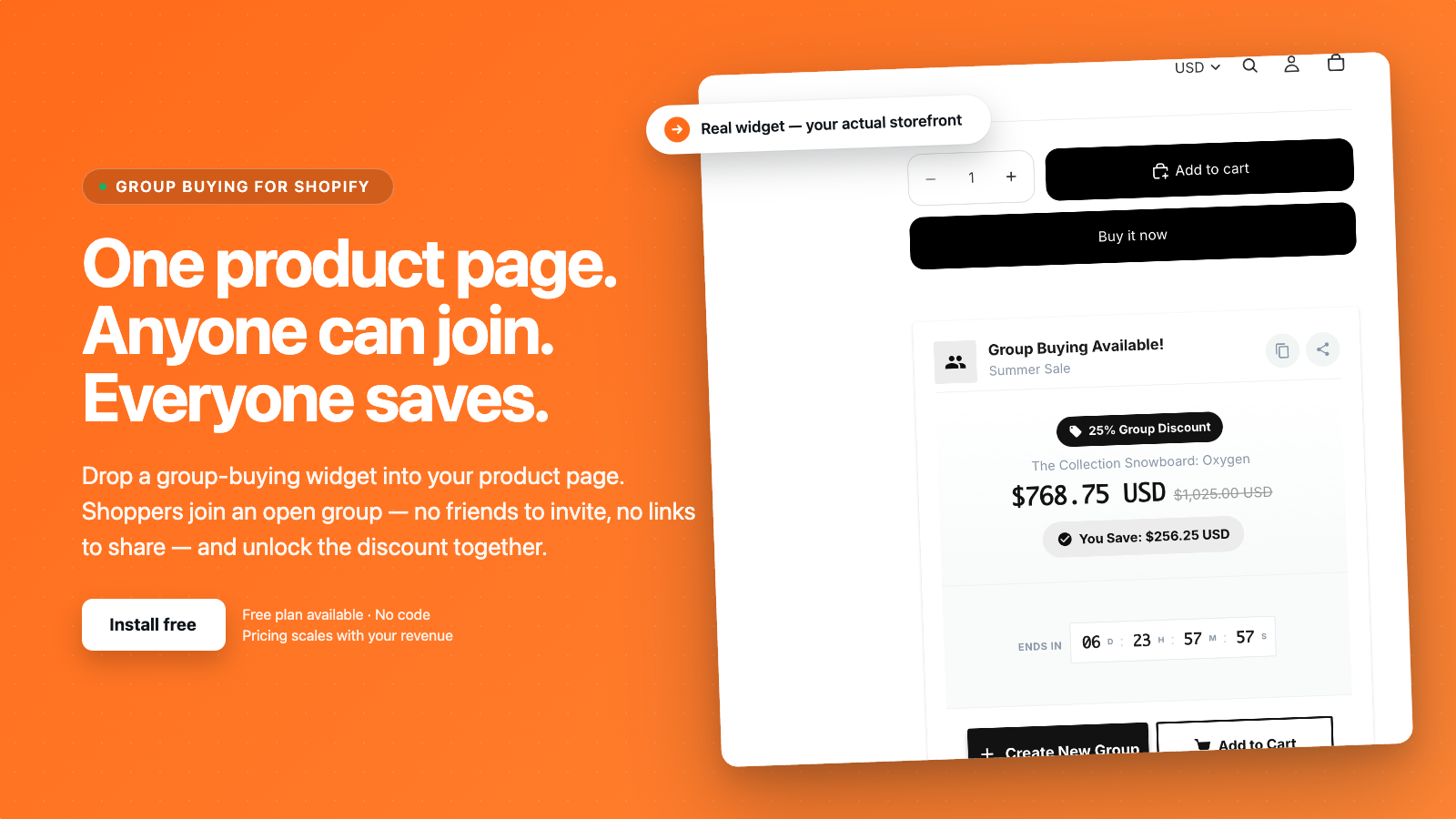
Farabiulder – Group Buying lets Shopify merchants run campaigns in which customers create or join groups and invite others to unlock a discount. The product brings the group offer into the storefront, connects it with Shopify orders and provides campaign reporting. It is most relevant when a product has a natural shared audience and the merchant can explain the participation conditions clearly.
This is a reciprocal collaboration article based on official product materials and the resources supplied by Farabiulder. We have not run a campaign for this guide; merchant-planning recommendations are distinguished from product features.
Group buying is more than a larger discount
Group buying ties an offer to participation by multiple customers. It is different from a volume discount, where one customer buys more units, and from a referral reward, where the original buyer receives a separate benefit for a referred purchase.
Farabiulder's supplied resource on the Pinduoduo group-buying model explains the social mechanism behind this approach: a customer shares an offer because other participants help make the group price possible. The useful lesson for a Shopify merchant is the incentive structure, not the scale of a marketplace or a promise of its acquisition results.
The shared interest must make sense. Before choosing a product, ask whether a customer can name someone who might genuinely want it. A familiar product with a clear use can be easier to explain in a message than a complicated product that requires a long sales pitch. That is a planning consideration, not a claim that any particular category will produce a guaranteed completion rate.
Set the terms before customers share
The official listing describes controls for the campaign's products, markets, group size, discount and duration. These settings belong together: an attractive offer that is difficult to complete may leave customers confused, while an easy-to-fill group can still be commercially unsuitable if the discount is too expensive.
| Campaign decision | What needs to be clear to the merchant and customer |
|---|---|
| Product and market | Which item and market the offer covers, rather than an implied store-wide discount. |
| Group size | What participation condition must be met for the group offer to succeed. |
| Discount | The actual benefit, including how the offer is presented alongside the normal buying option. |
| Duration | When customers can participate and how the deadline is communicated. |
Work through the offer as a complete customer promise. Could someone understand it after seeing only a shared link? Does the product page explain the condition as clearly as the promotional message? Would a customer know what happens if the group remains incomplete?
Avoid borrowing a percentage or group size from another campaign simply because it appears in a case study. Your product margin, audience and fulfillment commitments differ. Decide the offer using those constraints, then make the wording consistent across the campaign and the channels used to introduce it.
Follow the shopper's group journey
Farabiulder describes customers creating or joining a group, sharing invitations and receiving the discount when the group fills. Its current official widget illustration also shows open groups that any shopper can join without an invitation. Sharing can help a group grow; the shopper should not be told they must personally recruit every participant. The storefront widget is where that process becomes understandable to someone who has never used group buying before.
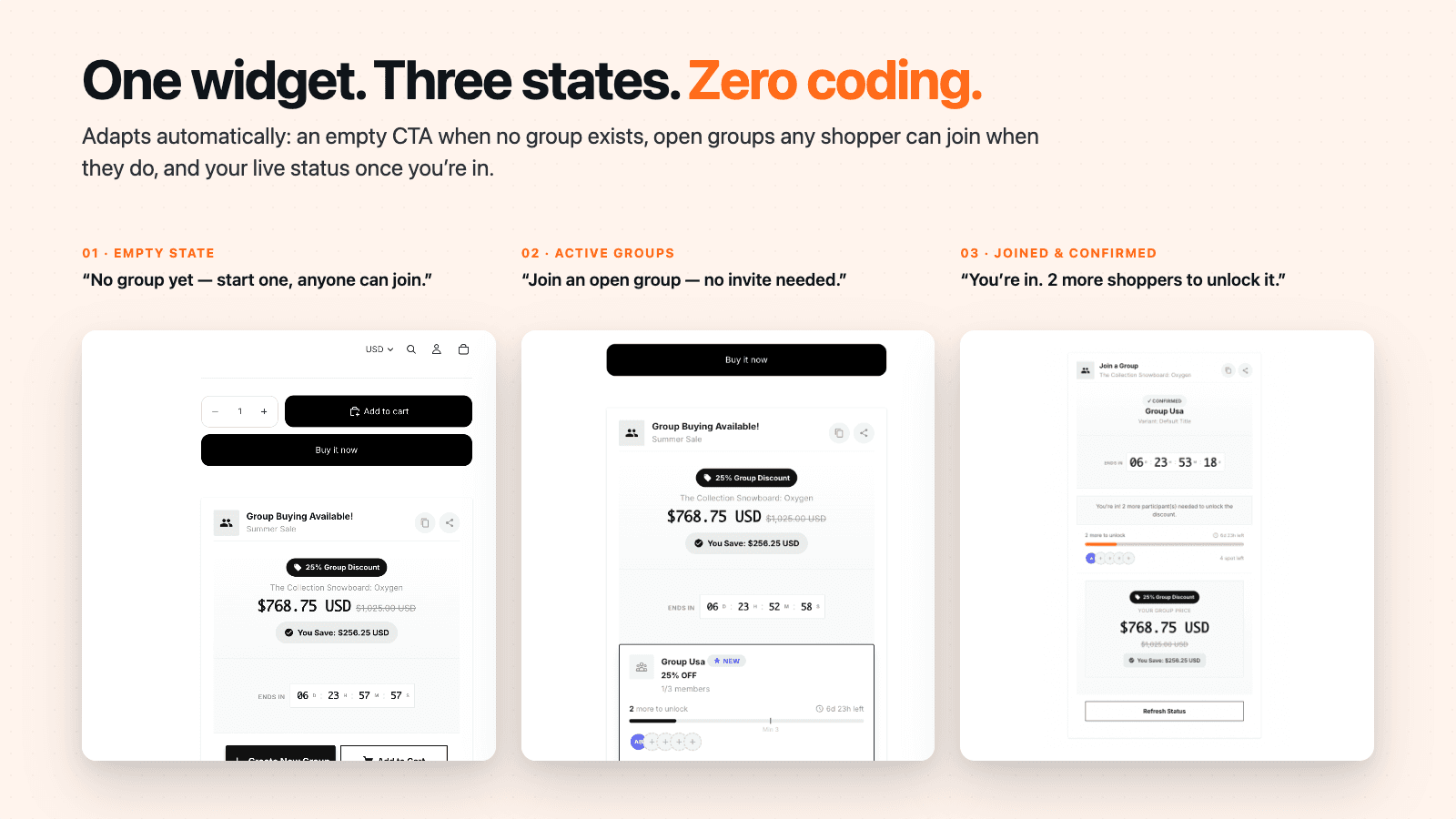
Customers can start a group, join an open group or follow the group's progress after joining.
The questions each stage should answer
Discover the offer
Explain the product, group benefit and participation condition. A customer should not have to infer the terms from a discounted price alone.
Join or create a group
Make it clear whether the shopper is joining an existing offer or starting one. The participation step and the invitation step should not be described as the same action.
Share and follow progress
Tell participants how others can join and how to understand the group's status. Keep promotional urgency tied to the actual campaign conditions.
Understand the outcome
State what successful completion means and what happens if it does not complete. Confirm payment and order timing with Farabiulder before turning this recommended communication sequence into checkout instructions.
The listing describes an Online Store 2.0 app block and names Dawn, Sense, Refresh and Craft among its supported themes. The block puts the group-buying offer on the product page, where a shopper can see it alongside the product information. Check its placement in your own theme, including the mobile view, so the participation terms are visible rather than separated from the buying decision.
The public description does not establish every detail of when payment is taken or an order is created. Do not fill that gap using the behavior of another group-buying service. Those details belong in the merchant's agreed campaign instructions.
Explain what happens when a group does not fill
The Shopify listing describes automatic refunds for unfilled groups with Shopify Payments and Stripe. That is a payment-specific statement, not a promise of immediate refunds through every payment method.
Before promoting an offer, establish the customer's unsuccessful-group journey: how the outcome is communicated, which payment methods are covered and how a customer can ask about a refund. The listing does not provide a complete refund timetable or every edge case, so those should come from Farabiulder's support rather than a guessed FAQ answer.
Support staff should also distinguish a pending group from a failed one. A customer asking why the order has not progressed needs an explanation of the current campaign state, not a generic shipping delay message. Describe the offer conditions before purchase so support does not become the first place customers learn them.
Read campaigns alongside real orders
Farabiulder's official description includes standard Shopify orders with visible discounts, plus reporting for campaigns, groups, participants and revenue. Those are useful views of different parts of the activity, not interchangeable measures of business success.
Campaign participation tells you whether people joined. Order and revenue information helps you understand the purchases associated with the campaign. Neither, by itself, proves that every participant is a new customer or that every sale would have been lost without group buying.
For your own review, bring campaign information together with discounts, product costs, fulfillment costs and app fees. Keep successful and unsuccessful groups separate, and decide how refunded purchases should be treated in your internal report. This is recommended business analysis; it does not imply the app calculates every component of net profit or incremental acquisition for you.
Learn from the official examples
The partner's Pinduoduo model explainer focuses on a specific offer relationship: a solo price and a lower team price conditional on participation. Use that explanation to make the customer's choice clearer, rather than copying claims about another business's acquisition cost.
| Customer question | What the campaign should explain |
|---|---|
| Why are there two prices? | The group benefit depends on the stated participation condition; it is not an unconditional markdown |
| Can I join an existing group? | Explain the available join or create paths shown by the store's widget |
| What should I send a friend? | A shareable explanation of the product, participation condition and campaign deadline |
| What if it does not complete? | The applicable outcome and payment-specific refund information, without guessing a timetable |
This is a communication worksheet based on the described model and widget, not an account of a campaign we ran. The margin given up, merchandise costs and any app fee still belong in the merchant's economics; a shared link does not make acquisition free.
The partner supplied group-buying examples resource is useful for thinking about products and sharing contexts. Treat its category examples as vendor material, not universal benchmarks for the discount or completion rate your store should achieve.
Its named Benalor Jewelry case study describes promoting a Josie Ring group offer through Instagram content. One particularly useful detail is the emphasis on explaining participation: buyers needed to understand joining a shared offer, rather than assuming they personally had to recruit everyone.
That makes a practical editorial lesson: explain the mechanism before relying on urgency to sell it. A product photograph and a countdown cannot answer every question about a new buying format. Prepare the short explanation that a customer can share with someone else, and make sure it matches the campaign's actual conditions.
We are not using the case study's financial figures as an expected outcome or an independent performance assessment. The useful example is how the offer was introduced and explained, not a promise that another merchant can reproduce the reported result.
Budget for monthly and sales-based fees
Farabiulder's Shopify pricing, checked October 8, 2026, combines the following monthly plans with a group-buy sales fee:
Swipe horizontally to read the full table.
| Plan | Monthly subscription | Group-buy sales fee |
|---|---|---|
| Free to install | No monthly subscription listed | 4.2% |
| Starter Flex | $14.99 | 2.5% |
| Growth Flex | $29.99 | 1.9% |
| Pro Flex | $59.99 | 1.4% |
“Free to install” does not mean the campaign has no app cost. Compare the subscription with the percentage fee and the discount you plan to offer. Confirm how the sales-fee base and refunded orders are handled before making a profitability calculation; the headline percentage alone does not establish those details.
If the task is improving the offer inside a single shopper's basket rather than organizing several participants, that is a different purchase journey. Our cart offer guide explains that distinction from the cart side.
Frequently asked questions
Is group buying the same as buying several units at once?
No. Group buying involves multiple participants meeting the offer's condition. A single customer's quantity purchase is a different mechanism.
What if the group remains incomplete?
The listing describes automatic refunds for unfilled groups using Shopify Payments and Stripe. Confirm the applicable process, timing and other payment-method arrangements before launching.
Does a completed group prove that everyone is a new customer?
No. Participation and campaign revenue are not the same as incremental acquisition. Review customer and order context separately.
Is there a completely fee-free installation plan?
The free-to-install plan lists a 4.2% group-buy sales fee. Factor that into the offer alongside the discount and fulfillment costs.
Explore the official Farabiulder app, then design a campaign whose conditions your customers can explain as easily as its discount.