
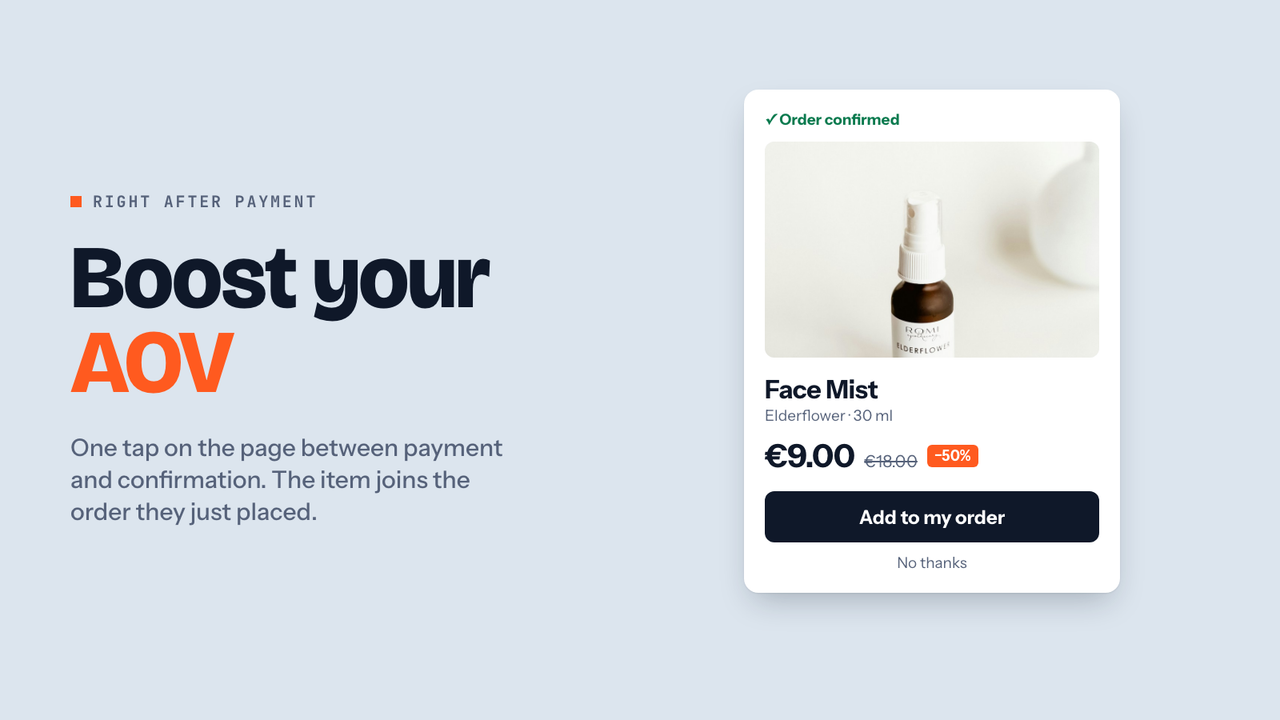
The shopper has paid. Your next offer no longer needs to compete with the decision to place the original order—but it still needs to be relevant, clear and appropriate for that shopper's payment method.
Post Purchase Upsell Abakira focuses on that moment. It places an offer between payment and order confirmation, supports a one-click addition to an eligible order, and lets the next offer respond to acceptance or refusal. A thank-you page placement provides another route for orders that do not reach the post-purchase page.
This article is part of a reciprocal content collaboration. Product details come from the official listing and information supplied by Abakira's developer; the buying recommendations below are editorial guidance, not measured results.
Three placements that should not be confused
A cart offer appears before the shopper pays. A post-purchase offer follows payment. A thank-you page offer appears later in the journey. Abakira also describes an in-checkout placement for Shopify Plus stores on its Scale Plus plan.
These distinctions matter when comparing apps. A feature available inside checkout to a Plus merchant is not automatically available in the same place to every store. Likewise, “thank-you offer” does not mean every payment method supports the exact same one-click post-purchase transaction.
Swipe horizontally to read the full table.
| Placement | Where it appears | Important distinction |
|---|---|---|
| Post-purchase | After payment, before confirmation | Eligibility affects whether this offer can appear |
| Thank-you page | On the thank-you page | A separate route for orders that miss post-purchase placement |
| In-checkout | During checkout | Abakira's developer identifies this with Scale Plus and Shopify Plus |
What the one-click offer changes
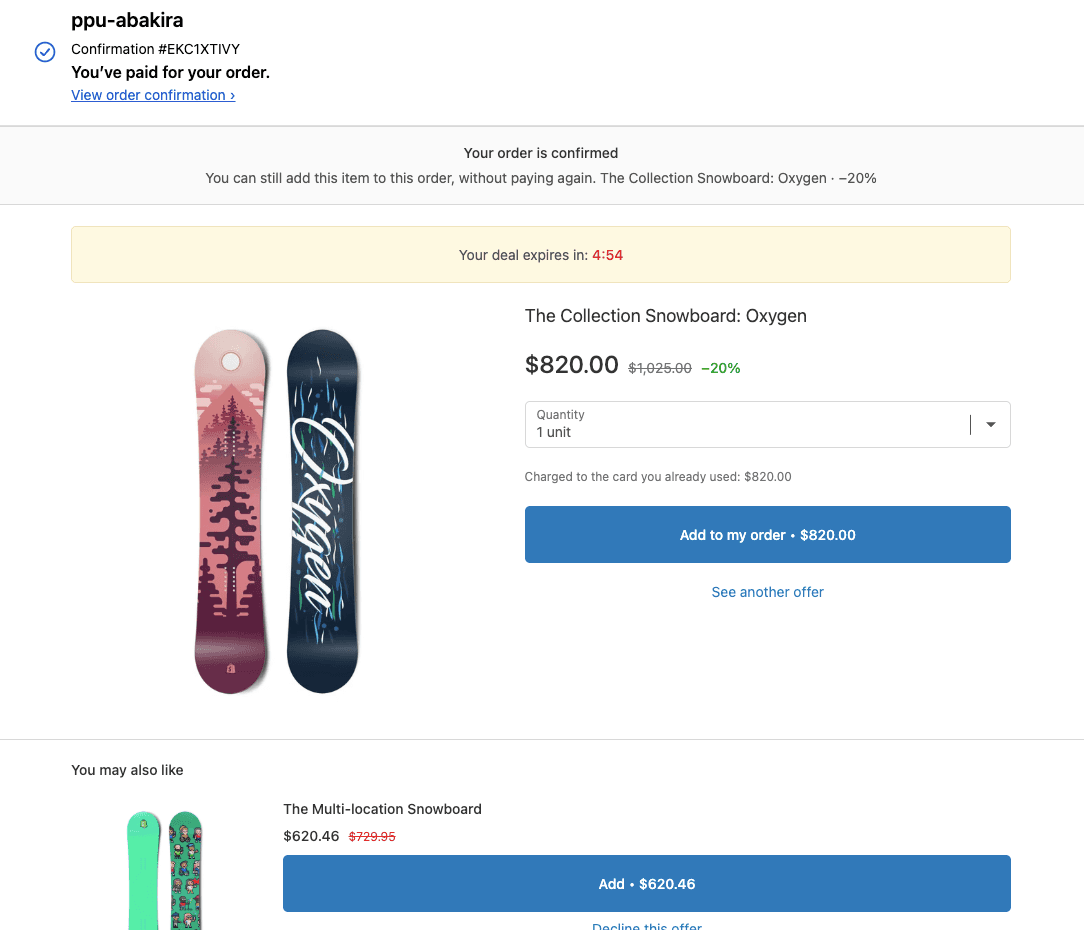
Abakira's supplied test order shows the shopper adding an offered item to the confirmed purchase.
The official listing describes adding an accepted item to the existing order using the payment card already used. The shopper does not need to create a separate checkout for that supported post-purchase offer.
For the merchant, the interesting part is continuity. The additional purchase belongs to the order just placed rather than requiring the shopper to restart the buying process. For the shopper, the important question remains whether the extra item complements what they already bought.
Choose a relevant addition before choosing a countdown or discount. A lower-friction transaction does not turn an unrelated offer into a useful one. It also does not guarantee that the extra item can ship in the same parcel under every warehouse process; fulfillment depends on the merchant's operating setup.
Acceptance and refusal both have a next step
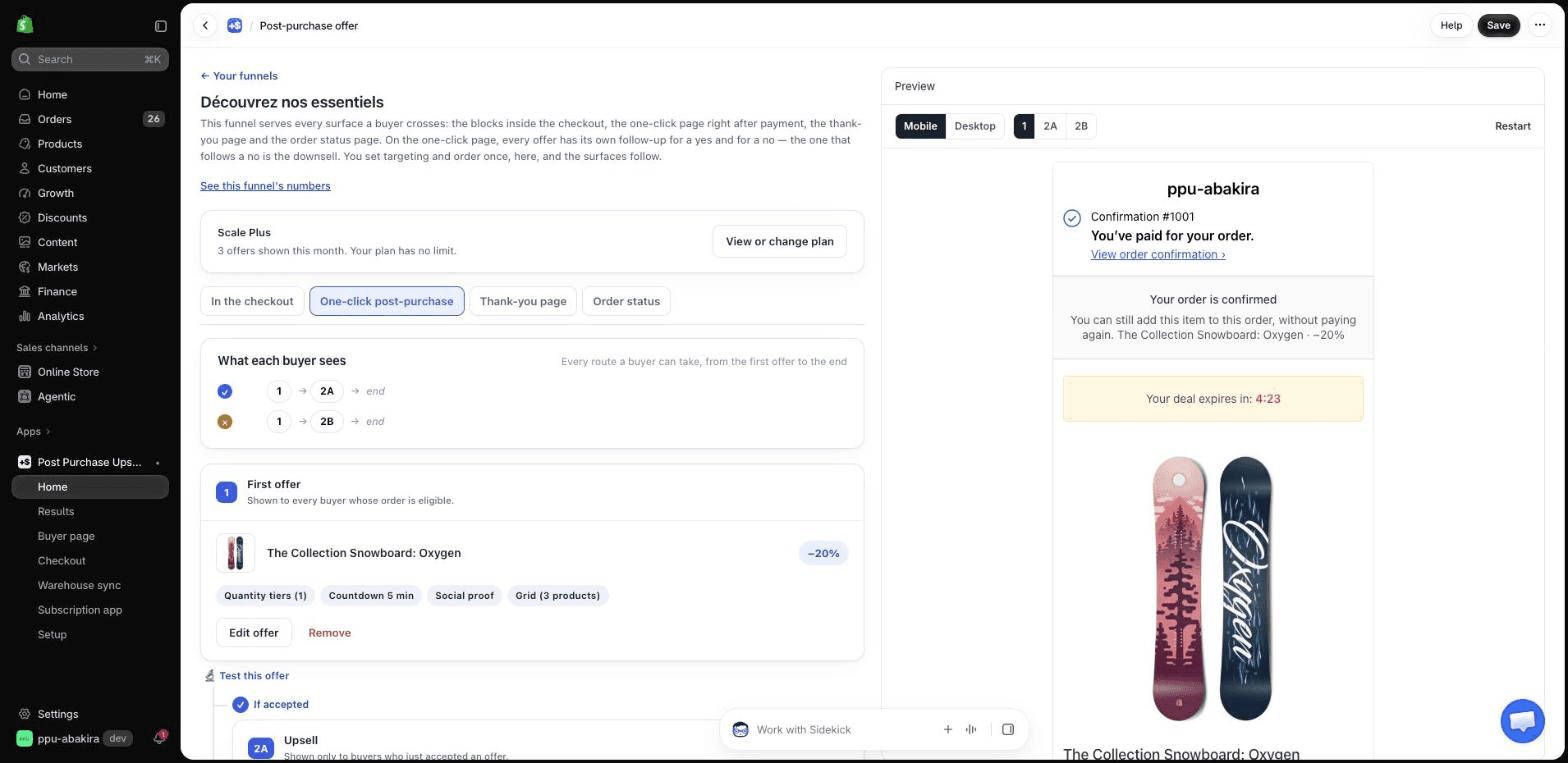
The editor selects different next offers for an acceptance and a refusal.
Abakira's distinguishing feature is branching. An offer can have a yes path and a no path, with up to three levels described in the listing. A refusal can lead to a downsell rather than ending the sequence immediately.
Two answers, two different follow-ups
The shopper accepts
The next offer can build on the accepted purchase. Review whether continuing the sequence still adds value, rather than assuming more offers are always better.
The shopper declines
A downsell can present a different proposition. Consider why the first offer might not fit: quantity, commitment or price may matter more than the product itself.
A downsell is not simply the same offer displayed again. The opportunity is to respond meaningfully to a refusal. That requires a deliberate product and pricing choice; the branch structure does not decide the merchandising strategy for you.
Keep each step understandable on its own. The buyer should know what is being added, what it costs and whether accepting it changes the order. Avoid designing a chain that depends on urgency while hiding the actual purchase decision.
Why payment eligibility deserves its own review
The listing specifically says Apple Pay and PayPal orders receive an offer on the thank-you page. The developer's email also discusses other payment methods that do not reach Shopify's post-purchase page. Those details should be checked for the store's actual payment configuration before selecting a placement.
This is not a minor setup footnote. A merchant whose customers frequently use a particular payment method needs to know where those customers will see the offer. Otherwise, a perfectly designed post-purchase funnel may reach only part of the audience the merchant had in mind.
Inspect the buyer experience for each relevant payment route. Do not assume that an offer's presence on the thank-you page means its acceptance and payment behave identically to an eligible post-purchase offer. Ask the developer to confirm that flow where the documentation is incomplete.
Pricing, offer limits and the free trial
Swipe horizontally to read the full table.
| Capability | What the current listing distinguishes | What to confirm for the store |
|---|---|---|
| Branching offers | Pro describes three levels, seven offers and a downsell after refusal | Products and prices on each yes/no path |
| Four-way offer testing | Scale adds A/B/C/D comparison | Which audience and outcome the experiment compares |
| In-checkout offer | Scale Plus inherits Scale and is for Shopify Plus stores | The placement enabled in checkout, rather than the separate post-purchase page |
| Delivery protection | Scale Plus describes protection at the merchant's chosen price | The actual service, coverage and fulfillment responsibility |
These distinctions come from the current plan table. They do not establish compatibility with every subscription or fulfillment provider. A protection fee is not pure profit: the store still needs to define what it will do for a customer and how the service is funded.
The developer supplied the following pricing, consistent with the listing's plan structure. The unit in the free plan is offers shown, not orders placed.
Swipe horizontally to read the full table.
| Plan | Monthly price | Key decision |
|---|---|---|
| Free | $0 | Up to 100 offers shown per month |
| Pro | $19.99 | Uncapped offers, 20 targeted funnels and configurable thank-you rules |
| Scale | $49.99 | Pro features plus four-way testing, subscription upsells and 3PL synchronization; 14-day trial |
| Scale Plus | $79.99 | Shopify Plus in-checkout placement; a 14-day trial stated by the developer |
Pro removes the monthly display cap and provides 20 targeted funnels based on cart contents or order total. Its quantity breaks and configurable thank-you rules help merchants vary the offer instead of showing the same promotion to every buyer. Scale adds four-way testing for comparing offers and subscription upsells for eligible purchases. Its 3PL synchronization is relevant when accepted additions need to stay aligned with fulfillment; confirm the supported connection and timing with the developer rather than assuming every warehouse will combine the shipment.
The developer specifies the 14-day trial for Scale and Scale Plus. Do not read that as a promise that every paid plan has the same trial. Abakira also describes fixed monthly pricing without a revenue commission; the subscription cost is still separate from the margin on the products offered.
When evaluating price, look beyond additional revenue. Product cost, discounts, returns and fulfillment affect whether an accepted offer is commercially useful. A sale attributed to a funnel is not automatically profit.
Switching tools and keeping the operating details intact

The supplied test-order confirmation shows the accepted item alongside the original purchase.
Abakira's developer offers funnel rebuilding on paid plans and direct support. Treat that as a service to discuss with the team: confirm which existing funnels will be reproduced and whether the original rules can be represented accurately.
A migration should preserve the meaning of an offer, not merely its appearance. Product selection, eligibility, discounts and refusal paths deserve the same attention as branding. If subscriptions or warehouse integrations are involved, confirm the relevant connection and order behavior before relying on them.
The supplied test-order images show the offer and accepted addition in a buyer journey. They illustrate that flow, not a typical acceptance rate or a universal fulfillment outcome.
What to look for in funnel reporting
Start by identifying what each metric counts. An eligible order, a displayed offer and an accepted offer are different events. If an offer never appears because of eligibility, the shopper has not declined it.
Similarly, screenshots of a dashboard show that particular screen, not a performance promise for another store. Compare the report with the orders it represents and account for discounts and product costs before drawing a profitability conclusion.
Abakira is most relevant when a merchant wants to merchandise the period after payment and adapt the sequence to the buyer's answer. Review its Shopify listing, confirm your payment routes and plan, and keep the first funnel focused on a clear, relevant addition.
Frequently asked questions
Is a downsell available after a rejected offer?
Yes. Abakira describes yes/no branches, including a downsell on the no path, within its supported funnel structure.
Is Shopify Plus required for all Abakira offers?
The developer identifies Plus with the in-checkout placement on Scale Plus. Do not confuse that placement with the app's separate post-purchase and thank-you features.
Does every order reach the post-purchase page?
No. Payment eligibility matters. The official listing specifically describes thank-you offers for Apple Pay and PayPal orders.
Which plans have the 14-day trial?
The developer supplied that trial for Scale and Scale Plus. Check the current listing when selecting a plan.
Learn more about the developer on the Abakira website, alongside the Shopify app details above.