

Selling a Korean product starts well before a shopper asks where their order is. You need the right source option, a clear English listing and a delivery promise that matches the route from Korea. Those are also the facts a merchant should make available when using Algoshop AI Sales Chatbot to answer customer questions.
K-Dropshipping connects Korean marketplace sourcing with product import, AI translation, inventory alerts and order fulfillment for Shopify. Its distinctive value is the connection between sourcing software and a Korea-based operation—not simply a larger product catalog.
This guide explains how to choose a sourcing route, prepare an accurate offer and follow the order through fulfillment. It draws on the provider's published guides rather than an invented product or a hypothetical profit result.
How K-Dropshipping connects sourcing with store operations
The Shopify listing focuses on Gmarket and Coupang sourcing. Instead of recreating each product by hand, merchants can import products in bulk, translate their information and monitor source inventory. Automated fulfillment connects the storefront order to the next operational step.
| Capability | Where it helps a merchant |
|---|---|
| Korean marketplace sourcing | Bring an eligible source product into the store's assortment |
| Bulk import and management | Prepare a selected product group without rebuilding every listing |
| AI translation | Make Korean product information understandable to shoppers |
| Inventory tracking and alerts | Notice availability changes that need attention |
| Order fulfillment | Move eligible store orders into the supported fulfillment process |
The store-integration page adds an important distinction: this is connected operations, not just a translation tool. A supported store connection carries product and order workflows into a Korea-based purchasing and fulfillment team. That is useful when the seller needs help obtaining the item as well as presenting it.
Authorize the connection, choose the product workflow and verify how eligible orders enter fulfillment. Before enabling a larger assortment, establish which actions happen automatically and which need approval. A connection should make the handoff easier to follow, not obscure who owns it.
Choose a manageable sourcing offer
The official website separates marketplace purchases, warehouse stock and pre-orders. Choose the route that fits the buying promise you want to make.
Swipe horizontally to read the full table.
| Sourcing route | Best reason to consider it | What your storefront must explain |
|---|---|---|
| Marketplace sourcing | An eligible Korean listing matches your planned assortment | Procurement as well as international delivery |
| Ready-to-ship stock | The product is already held in the Korea warehouse | Availability and the selected delivery service |
| Pre-orders | An eligible release is not yet available as ordinary stock | Release timing, allocation and delay handling |
The website describes ready-stock carrier handoff in 2–4 Korean business days. That is warehouse handling, not customer delivery, and it does not include purchasing an item from another seller. Most eligible products can be sourced from one unit, but that does not make every item a wholesale purchase. Price depends on its supply channel.
Think in terms of a coherent assortment. A K-pop release range needs release and allocation communication; a replenishment range needs dependable availability. These are different merchandising jobs even when they use the same fulfillment partner.
The provider's Shopify setup guide recommends beginning with one category. Use that focus to learn the practical questions buyers ask: the exact version, set contents, sizing or dispatch expectations. Do not copy general category claims into your store as proof that a particular item is suitable for your market.
Map the source product to a Shopify variant
A translated product name is not enough to identify what must be purchased. Keep the source option attached to the store variant, especially when similar packaging represents a different size, shade or set.
The Coupang sourcing guide describes a Service Agent route. Merchants can submit a product URL or a clear image with the product name and required specification. The agent searches, checks the exact option and provides a quote. After approval, a dedicated listing can be connected to the store.
Use the following as a merchant-owned review record, not as a claim about the app's required fields.
| Information to keep | What it resolves |
|---|---|
| Source URL or clear reference image | Which item the request concerns |
| Exact source option | Which size, shade, quantity or set must be bought |
| Approved quotation and date | Which price and conditions the merchant accepted |
| Shopify product and variant | Which storefront option the source fulfills |
| Included items and specification | What the customer will actually receive |
| Review owner | Who updates the offer if the source changes |
For a set, list the contents rather than relying on a promotional photograph. For variants, check each option separately; one product-level image may not establish every variant's specification. Before bulk import, review one approved product from source reference through storefront display.
Translate facts before publishing promises
The provider's Shopify guide describes an AI listing editor with optimization, translation and image tools. This matters when Korean text appears both in the description and on product images. Editing only the description can leave important buying information untranslated.
Treat the editorial job as two passes. First establish what the source actually says: option, quantity, materials or ingredients, dimensions and any limitations. Then write natural English around those facts. Lead with the useful buying distinction, explain the specification and make the package contents easy to find.
For image text, review the translated labels against the selected option. A campaign image may describe several products while the store sells only one. Translation should not turn a pictured accessory into an included item.
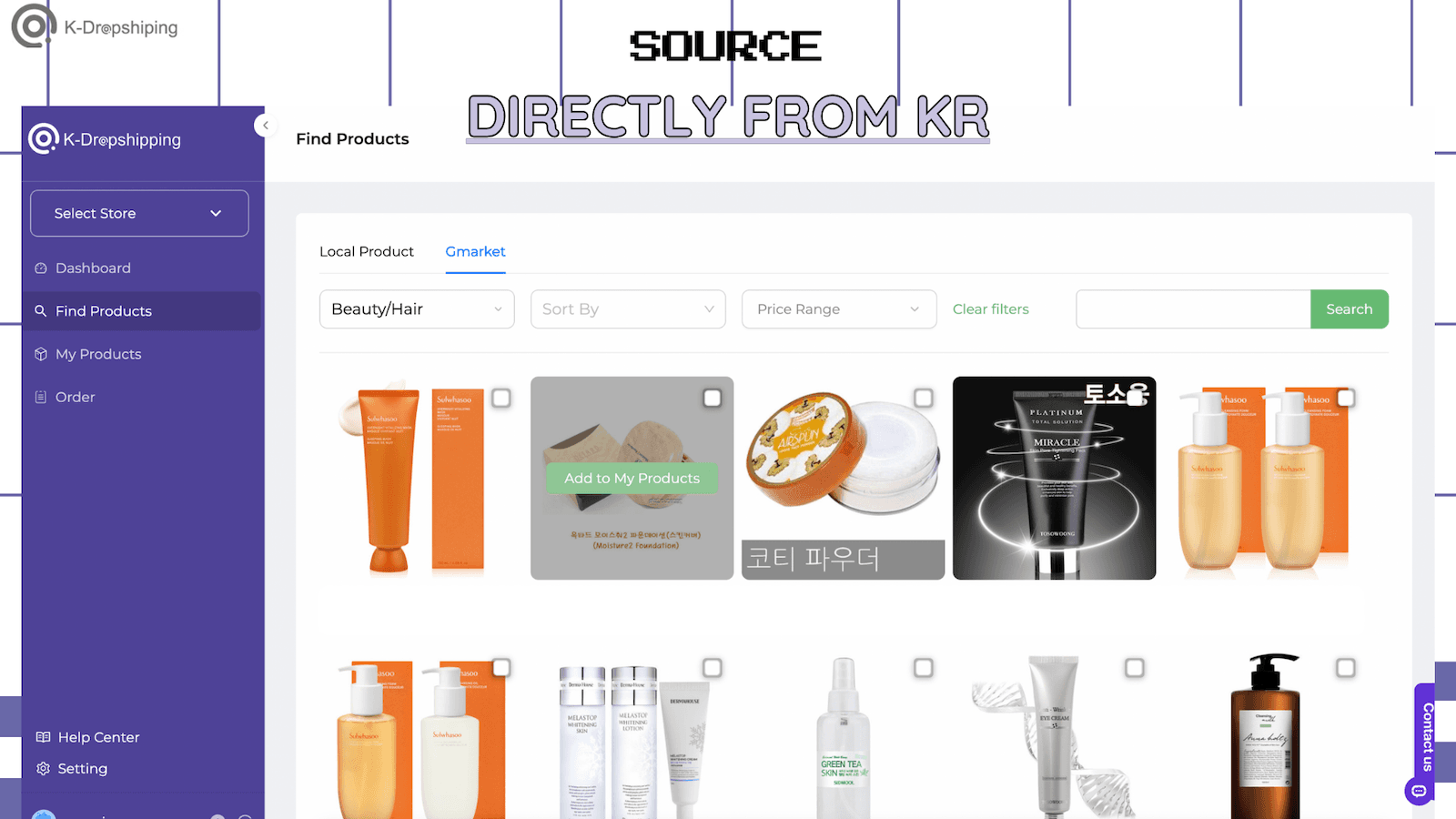
Review product information before making a Korean source item part of your store's assortment.
Keep the writing useful rather than inflated. Explain what the item is, who it suits and what comes with it. Do not infer certification from a symbol, country of manufacture from a sourcing location or a stronger performance claim from a more polished translation. This is merchant editing guidance, not a guarantee of the app's output.
Calculate the complete landed order cost
A product's source price does not establish what it costs to deliver a customer order. Build the price decision around confirmed inputs, with unknown charges still marked as pending.
| Cost input | Obtain before setting the final offer |
|---|---|
| Product purchase | Quote for the approved option and quantity |
| Sourcing and processing | Applicable account or service terms |
| Domestic movement and handling | Any applicable source-to-warehouse or additional handling charge |
| International shipping | Destination, parcel details and service quote |
| Import charges | Who bears applicable duties and taxes |
| Payment and currency conversion | Your actual payment arrangement |
| Exceptions | Your policy for returns, redelivery and unrecoverable costs |
The pricing page distinguishes the service fee from product purchase and international shipping. It also separates optional and exceptional costs from standard packing. Do not count a cost twice because its name appears in two different quotes.
There is a material pricing discrepancy as of October 4, 2026: the website describes a pay-per-success service without a monthly subscription, while the Shopify listing shows app plans and purchase-service discounts. Ask which terms apply to your account before building margins around either description. A discount percentage is not a complete fee quote.
For shipping, compare the accepted service and billable parcel weight rather than copying a headline saving. Use your quotation to decide the customer price and who pays for delivery; do not present a planning estimate as a confirmed fulfillment cost.
Trace payment, purchase and shipment
The most useful order view separates the customer's order from sourcing and physical shipment. The fulfillment resource describes receiving in Korea, visible checks, eligible consolidation, packing and dispatch. Visible condition checks should not be presented as laboratory testing or certification.
From customer order to international handoff
Connected store
Eligible customer orders enter the supported store-to-fulfillment workflow. Keep the customer order linked to the intended product options.
Korea receiving
Purchased goods arrive at the warehouse. Arrival and applicable checks establish what is actually ready for packing.
Packing and dispatch
Eligible items can be consolidated and prepared for the selected international service. A source purchase is not yet a carrier handoff.
Customer tracking
Use the shipment's tracking information to keep the customer-order update accurate.
These stages explain the published operating process; they are not asserted dashboard status names. The provider's Coupang guide says tracking is pushed back to the connected store when the order ships.
For your first order, check the source option, warehouse receipt, shipment reference and storefront tracking update together. If several products share a parcel, verify that the customer update represents the actual contents. Keep procurement references internal and send the customer the information they need to follow delivery.
Handle unavailable items and returns
A stock alert helps identify a problem, but it does not reserve marketplace stock. The Coupang guide explains that the Service Agent confirms a changed price, alternative listing or cancellation before proceeding. That is a meaningful part of the service: the seller has a contact for resolving a sourcing change rather than guessing which substitute to buy.
Make your own substitution rule explicit. A similar-looking item is not automatically an acceptable replacement. Where the product or timing changes, communicate the choice to the customer under your store policy.
The refund policy distinguishes a quotation request from a purchase already underway. Cancellation can become restricted after purchasing, reservation or fulfillment activity. Returns require written authorization and instructions; wrong, missing or damaged items need order and packaging evidence within the applicable reporting period.
That means your customer-facing return promise and the supplier's recovery process must be considered together. A Shopify refund alone does not establish that procurement has been cancelled. Assign an owner to coordinate both sides and retain the supporting records.
Launch a small catalog with a repeatable record
Start with an assortment you can explain and a route you can verify. Keep the approved source reference, variant mapping, offer wording, quotation and delivery policy together. Then follow a first order through the connected process before expanding.
For the shopper, a dependable offer answers practical questions: which version is this, what is included, where does it ship from and what happens if sourcing changes? For the merchant, the connected workflow should make those answers easier to maintain.
K-Dropshipping is worth evaluating when Korean sourcing is central to the assortment and the store also needs a Korea-based purchasing and fulfillment operation. Its strongest story is that connection. Build the storefront around confirmed product details and the actual service arrangement, rather than unsupported promises about speed or profit.