
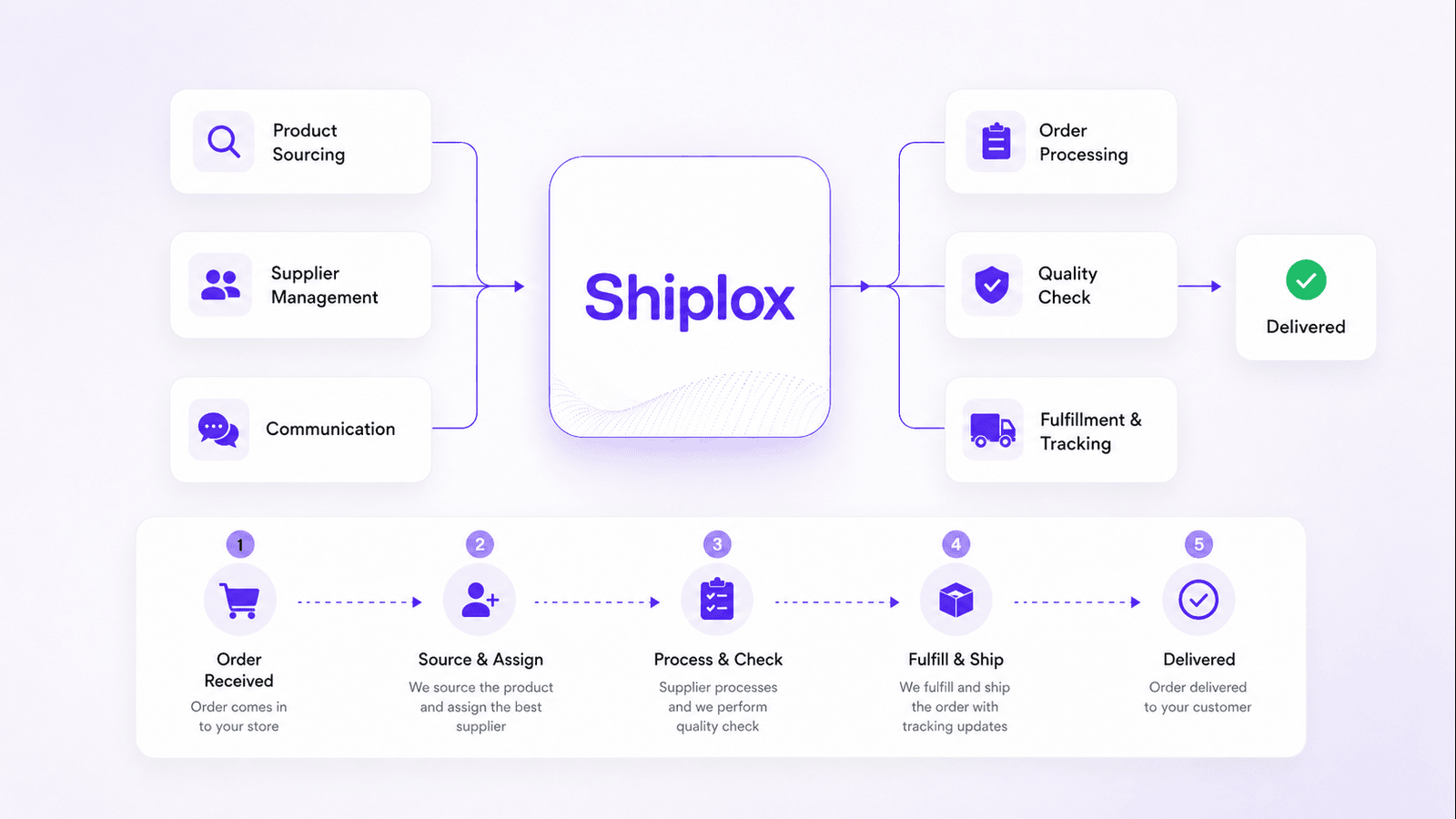
Finding a product is only the beginning of selling it. Before an order can reach a customer, someone must translate the product requirements into a supplier quote, agree the costs, prepare stock and keep the fulfillment handoffs moving. Those tasks become difficult to follow when the details are scattered across conversations and spreadsheets.
Shiplox: China Sourcing & 3PL brings sourcing requests, supplier quotations, Shopify orders and fulfillment progress into one workspace. Its value is the connection between those jobs: the product you want to buy, the terms you agree and the orders you need to deliver. It is a guided sourcing-and-operations tool, rather than a promise that installing an app makes every sourcing decision automatic.
Prepared as part of a reciprocal content collaboration, this guide explains the official feature descriptions and offers practical ways to organize the work. We have not placed a sourcing order or tested the service for this article.
Sourcing and fulfillment are different jobs
Sourcing answers questions about the product and supplier: what is available, what it costs and what terms apply. Fulfillment answers a different set: which customer orders need stock, how they are prepared and where the shipments are in their journey.
The two belong together, but neither replaces the other. A supplier quote is not a dispatched parcel. An imported order is not proof that stock is ready. A tracking number is not the same as delivery. Keeping those distinctions visible helps a team explain the status of an order without promising more than the latest information supports.
The Shiplox listing describes a workflow covering sourcing, order handling, returns, reships, tracking and support. For a merchant considering the service, the central question is whether that connected workspace matches the way the business wants to manage supplier and customer commitments.
Turn a product idea into a useful request
Shiplox accepts sourcing requests with product links, images and target quantities. Each input answers a different question: a link gives a reference, an image communicates appearance, and a quantity helps establish the scale of the request.
To make that request useful, distinguish the reference from the requirement. A product photo might show a finish you like, but it does not establish the material, dimensions or electrical specification. A competitor's page may help explain the category, but it is not a specification your supplier has agreed to meet.
Prepare a short product brief in your own words. Identify which characteristics are essential and which could be flexible. If different sizes or finishes are needed, make those differences explicit rather than leaving the supplier to infer them from a single image. This is preparation advice, not a claim that Shiplox has dedicated fields for every specification.
Keep questions separate from commitments. Asking whether a supplier can meet a quantity or lead time should not be treated internally as placing an order. Your team should know who can accept the quote and what information that person needs before approving a purchase.
From product reference to an agreed sourcing decision
Describe the requirement
Gather the reference link or image, target quantity and the characteristics that must not change. Separate those requirements from optional preferences.
Compare the available terms
Read the supplier quote as a combination of product, quantity, cost and timing. Resolve missing terms before making customer-facing promises.
Record the decision
Keep the approved specification and commercial terms accessible to whoever will manage stock and orders. These are recommended handoffs, not a claim about automatic approval in the app.
Read the quote beyond the unit price
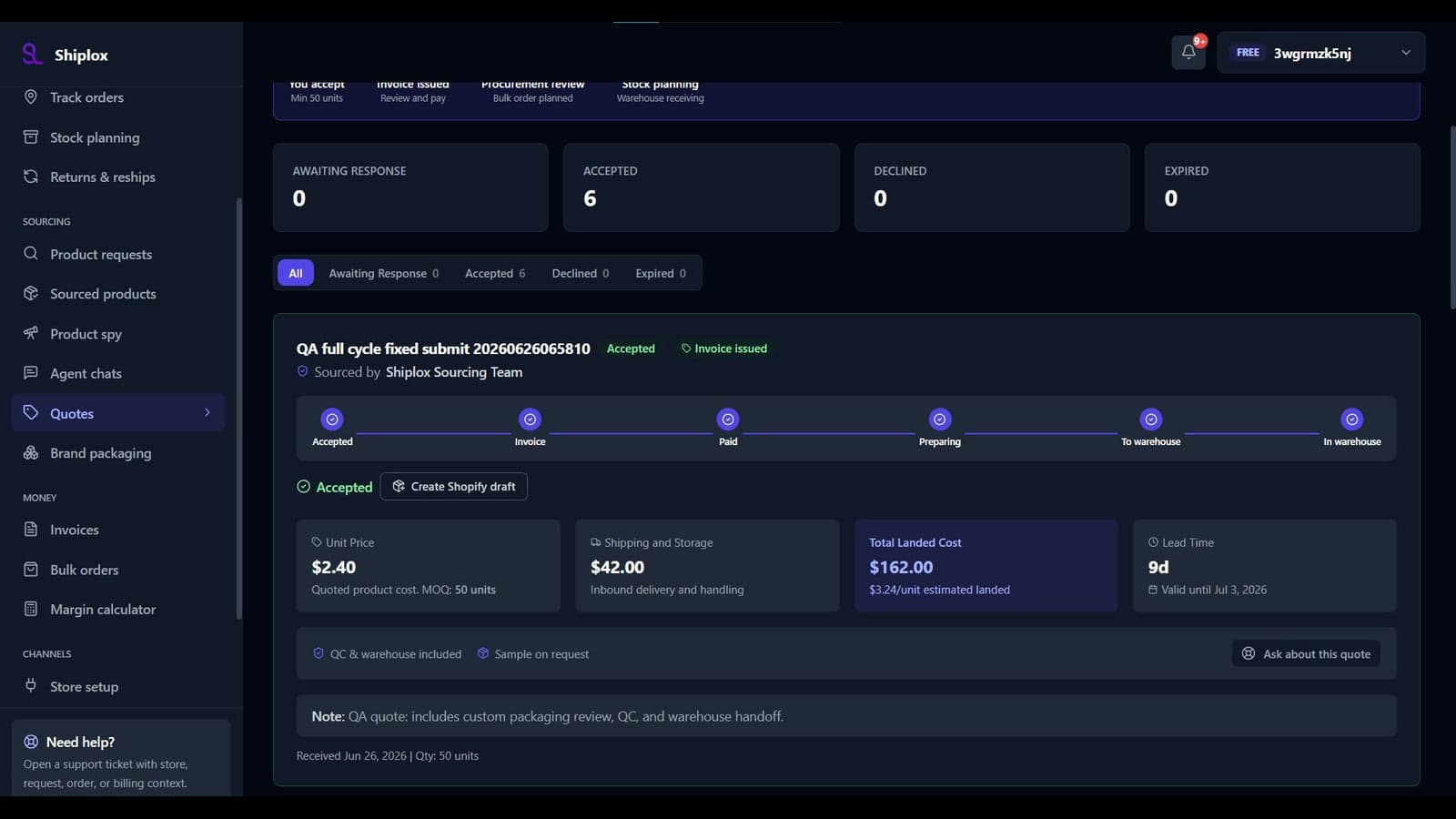
A quote brings the product cost, shipping information and timing together. The sample amounts shown are not an offer for your products.
The official description identifies MOQ, cost, shipping details and lead time as quote information. The lowest unit price is not necessarily the most workable option for the business. A larger minimum quantity, a different shipping arrangement or a longer preparation period can change the decision.
| Quote detail | The merchant question it should answer |
|---|---|
| Minimum order quantity | Can the business commit to this quantity without buying stock it does not yet need? |
| Product cost | Does the quote cover the exact specification and variants being considered? |
| Shipping details | What movement is covered, and which destination and service does the quoted arrangement refer to? |
| Lead time | Which stage does the stated time cover, and when could the next operational step begin? |
Do not treat a heading such as landed cost as a substitute for the underlying terms. Ask what is included and what is not: goods, transportation, duties, taxes, samples, inspections or packaging can be separate questions. Shiplox's public listing does not establish that every possible cost is included in every quote.
If the quote changes, keep the revised terms connected to the purchasing decision. Otherwise, one person may be budgeting from an older price while another is arranging fulfillment from a newer one. The goal is a shared understanding of the approved offer, not simply a long list of suppliers.
Connect sourcing decisions to Shopify orders
The listing connects sourcing requests, supplier quotes, imported Shopify orders and tracking. Read that as a sequence of handoffs, not a promise that one click completes the whole purchasing process.
What each handoff needs
Sourcing request
Supply product links or images and a target quantity. Record the required specification separately from a photo used only as a reference.
Supplier quote
Review MOQ, product cost, shipping details and lead time together. Decide who can approve the terms before committing stock to customer orders.
Fulfillment work
Use the imported Shopify order as the customer requirement and compare it with the approved product. Warehouse receiving, packing and shipment are later stages, not synonyms for order import.
Customer tracking
The plan description includes tracking synchronized to Shopify orders. Share the latest shipment status without treating a tracking reference as confirmation that delivery has occurred.
These handoff checks are suggested operating practices. The app's free installation does not remove the cost of goods and shipping, and the listing does not establish a universal sourcing or delivery deadline.
Shiplox lists Shopify product and order sync, order imports and tracking updates back to Shopify orders. That connection can bring the fulfillment work closer to the storefront orders that created it. It does not remove the need to understand whether the approved product is ready for those orders.
Receiving and preparation
The fulfillment description covers warehouse receiving and packing. As an operating practice, separate “expected stock” from “stock received” and “being prepared.” Customer support needs that distinction when answering whether an order has actually shipped.
Before handing over live orders, establish how your team will recognize the product being fulfilled and how changes should be communicated. A product update in Shopify, a supplier substitution and a revised sourcing specification are not interchangeable decisions. Agree who can approve a substitution rather than allowing a status update to stand in for approval.
Shipping and delivery information
The listing describes shipping, delivery status and tracking details. Use the latest shipment information when responding to customers, and distinguish the merchant's preparation work from the carrier's movement of the parcel.
A clear customer update says which stage the order has reached and what happens next. It should not turn an estimated dispatch date into a guaranteed delivery date. Country coverage, carrier services and delivery commitments need to come from the agreed service terms; they cannot be inferred from the app's China-sourcing label.
For stores coordinating orders between independent Shopify businesses, supplier order routing is a separate workflow. Shiplox's sourcing-and-fulfillment service should not be described as having another app's store-to-store routing features.
Plan for returns, reships and support
Returns, reships and support requests are included in Shiplox's feature description. They address different situations. A return concerns goods coming back; a reship concerns sending a replacement; a support request concerns resolving a question or exception. A replacement should not be assumed to follow automatically from every customer complaint.
Before committing to a service, ask who authorizes each action, what information is needed and which costs apply. Also clarify where a return goes and how the customer will receive instructions. These are service-policy questions, not fees or procedures we can establish from the listing alone.
For your own team, choose one owner for the customer conversation and one for the operational action, even if the same person holds both roles. Record what has been agreed before telling the customer that a refund, return or replacement is approved. A centralized workspace is useful when it helps the people involved work from the same decision.
Understand free installation and service costs
As of October 8, 2026, Shiplox is free to install. The listing includes unlimited free sourcing requests and a private sourcing assistant, and states that merchants pay for goods and shipping. It also notes that external charges may be billed separately from the Shopify invoice.
Free installation is therefore not free procurement or free delivery. Evaluate the service using the actual quote and any applicable handling or after-sales terms, not the installation price alone. The publicly accessible listing does not provide a complete schedule of returns, reshipment or other service charges.
Shiplox is worth exploring when you want a guided connection between finding products and handling their fulfillment. Bring a concrete product requirement to the conversation, ask for the commercial terms in writing and agree the operational handoffs before building delivery promises into your storefront.
Frequently asked questions
Can I request sourcing with a product image or link?
Yes. Product links, images and target quantities are listed as supported request inputs. Provide the essential specification separately so the reference does not leave important details ambiguous.
Does Shiplox connect with Shopify orders?
The listing describes order imports, product and order sync, and tracking synced to Shopify orders. Confirm the setup and timing appropriate to your fulfillment process before relying on it for customer updates.
Does free installation include the goods and shipping?
No. The listing explicitly separates the free app from goods and shipping costs. Obtain a quote for the sourcing and fulfillment work you need.
Are returns and reships always free?
The public feature description does not establish that. Ask Shiplox for the applicable policy and charges before offering a replacement or return arrangement to a customer.
Start with the official Shiplox Shopify listing and a well-defined sourcing request.
Explore sourcing and fulfillment options on the Shiplox website.