Definition Guide
What Is a Chatbot? Definition, How It Works & Types Explained 2026
A chatbot is a conversational software agent that uses AI (LLMs) to understand language, maintain context, and take action. In 2026, chatbots have evolved from FAQ scripts into proactive AI sales agents driven by large language models.
Quick summary
- A chatbot is a software application that conducts human-like conversations via text or voice. In 2026, the definition has shifted from 'a script that answers FAQs' to 'an LLM-powered agent that understands, decides, and acts autonomously.'
- Modern AI chatbots operate through a 5-step pipeline: Natural Language Understanding → Intent Mapping → Knowledge Retrieval → Response Generation → Action Execution. Each step runs in milliseconds.
- There are 4 distinct types of chatbots: rule-based (decision trees), AI/LLM-powered (context-aware conversations), hybrid (AI + human handoff), and voice (speech-based assistants). Each serves a different business need.
- For e-commerce, AI-powered chatbots like Algoshop deliver measurable business outcomes: 15–40% cart recovery rates, 20–35% AOV increases, and 60–80% cost reductions on customer-facing conversations.
How it works
User Sends a Message
The chatbot receives the raw input — whether typed text, voice transcription, or button click — and passes it to the Natural Language Understanding (NLU) engine. The NLU identifies the user's intent (asking a question, making a complaint, browsing products), extracts entities (order numbers, product names, dollar amounts), and detects sentiment (frustrated, curious, ready to buy).
Intent Mapping & Routing
The identified intent is matched against configured business logic rules. Different intents trigger different workflows: a 'product question' routes to catalog search; a 'shipping inquiry' triggers a real-time order lookup via the Shopify Admin API; an 'exit intent' behavioral signal triggers a cart recovery sequence with a time-limited discount offer.
Knowledge Retrieval
The chatbot queries its connected data sources in real time. For e-commerce, this means live calls to Shopify's API for product catalog, inventory levels, pricing, and order status. It may also query a knowledge base, FAQ database, or help center articles for policy questions. Advanced chatbots like Algoshop sync continuously — if a product sells out, the AI stops recommending it instantly.
Response Generation
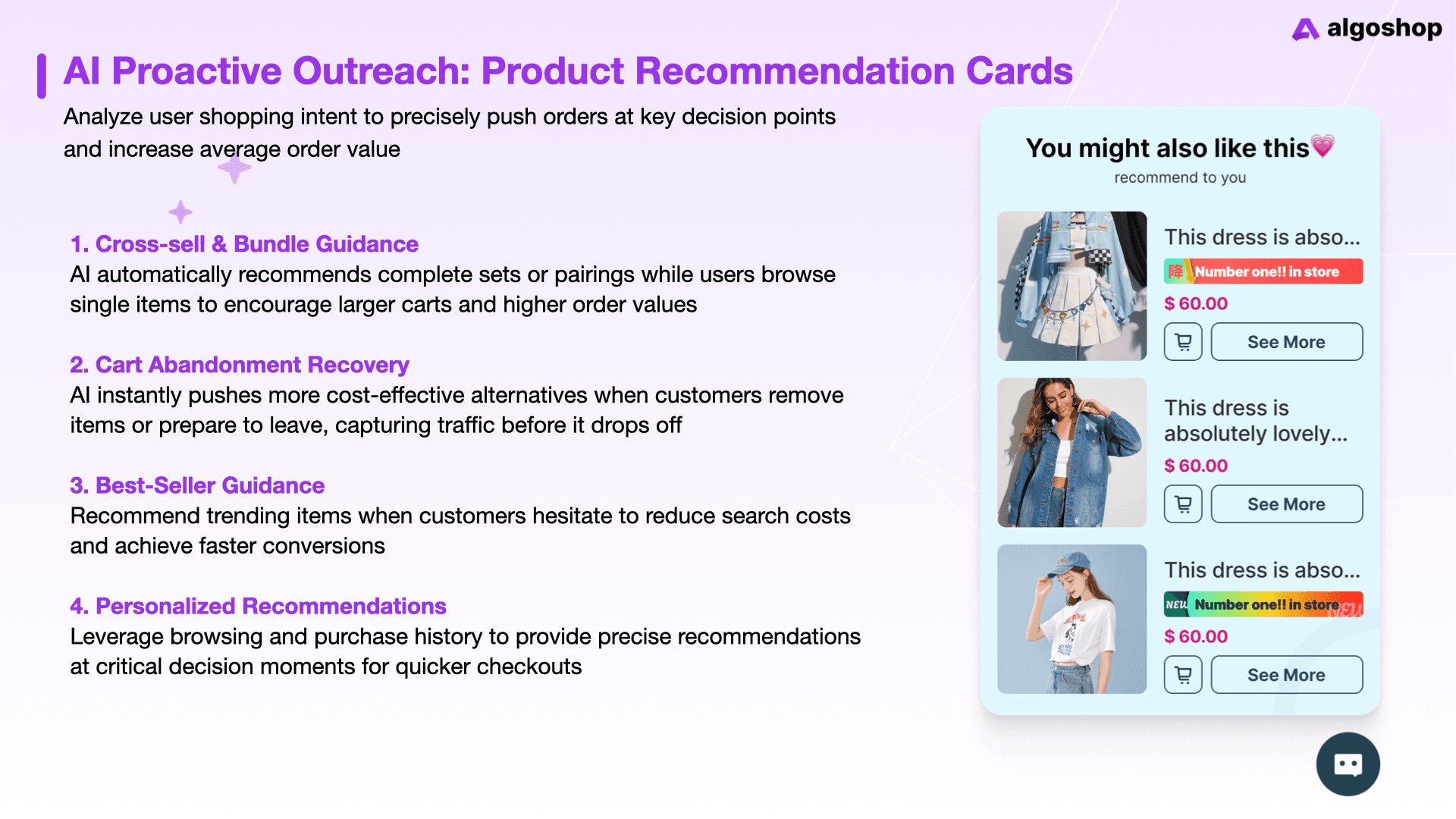
The LLM (large language model) generates a natural-language response incorporating the retrieved data, the brand's voice, and the full conversation history. Modern AI chatbots can generate multiple response variants and select the one most likely to achieve the desired outcome based on past performance data. For sales chatbots, this step may also trigger a proactive action like displaying a product recommendation card.
Autonomous Action Execution
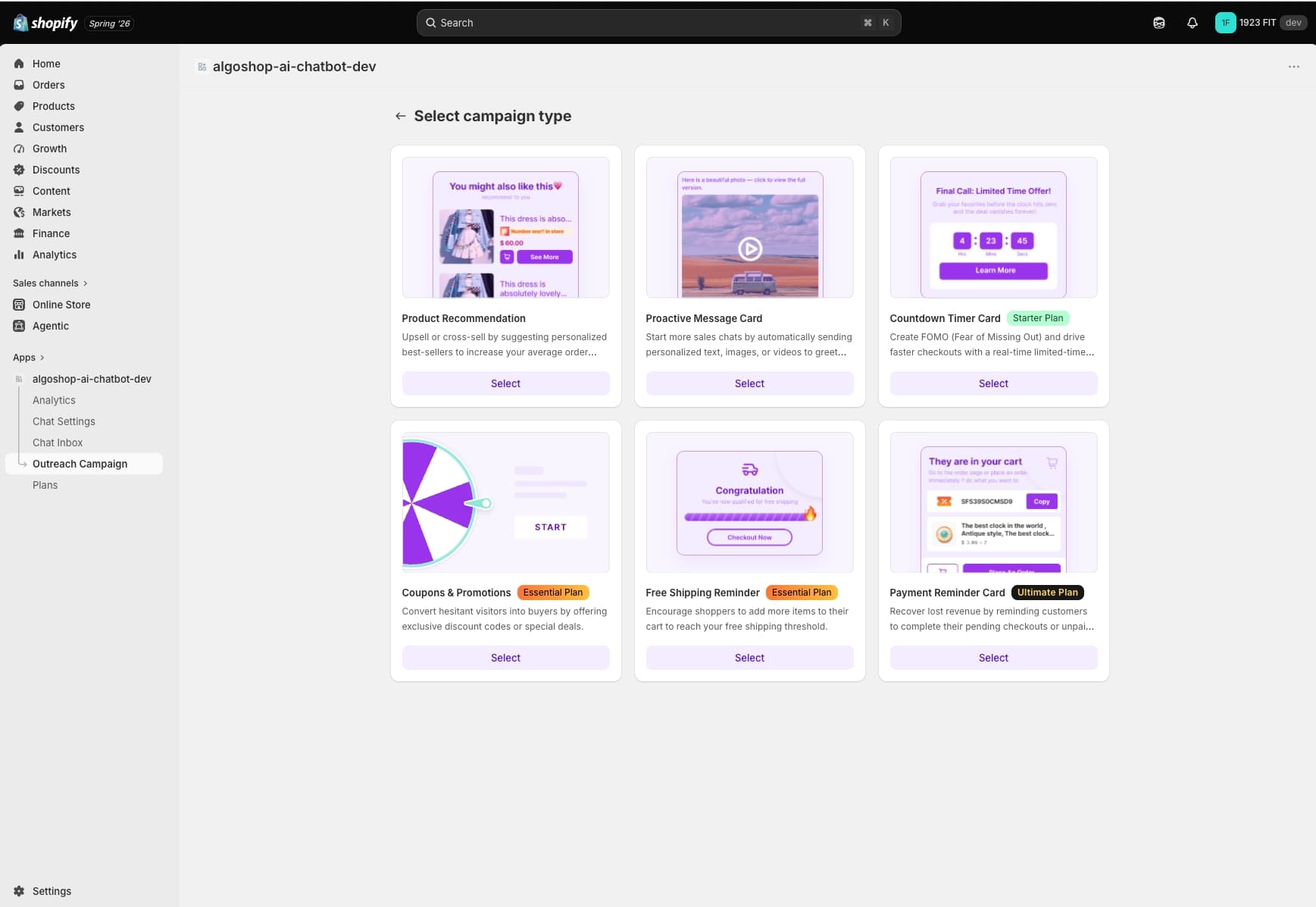
This is the layer that separates modern AI sales chatbots from simple FAQ bots. Beyond generating text, the AI can take direct action — adding a product to the shopper's cart, applying a discount code, initiating a checkout flow, creating a support ticket, or handing off to a human agent with full conversation context. Algoshop's 6-card outreach system executes these actions based on behavioral triggers like dwell time, cart value, and exit intent.
Learning & Continuous Optimization
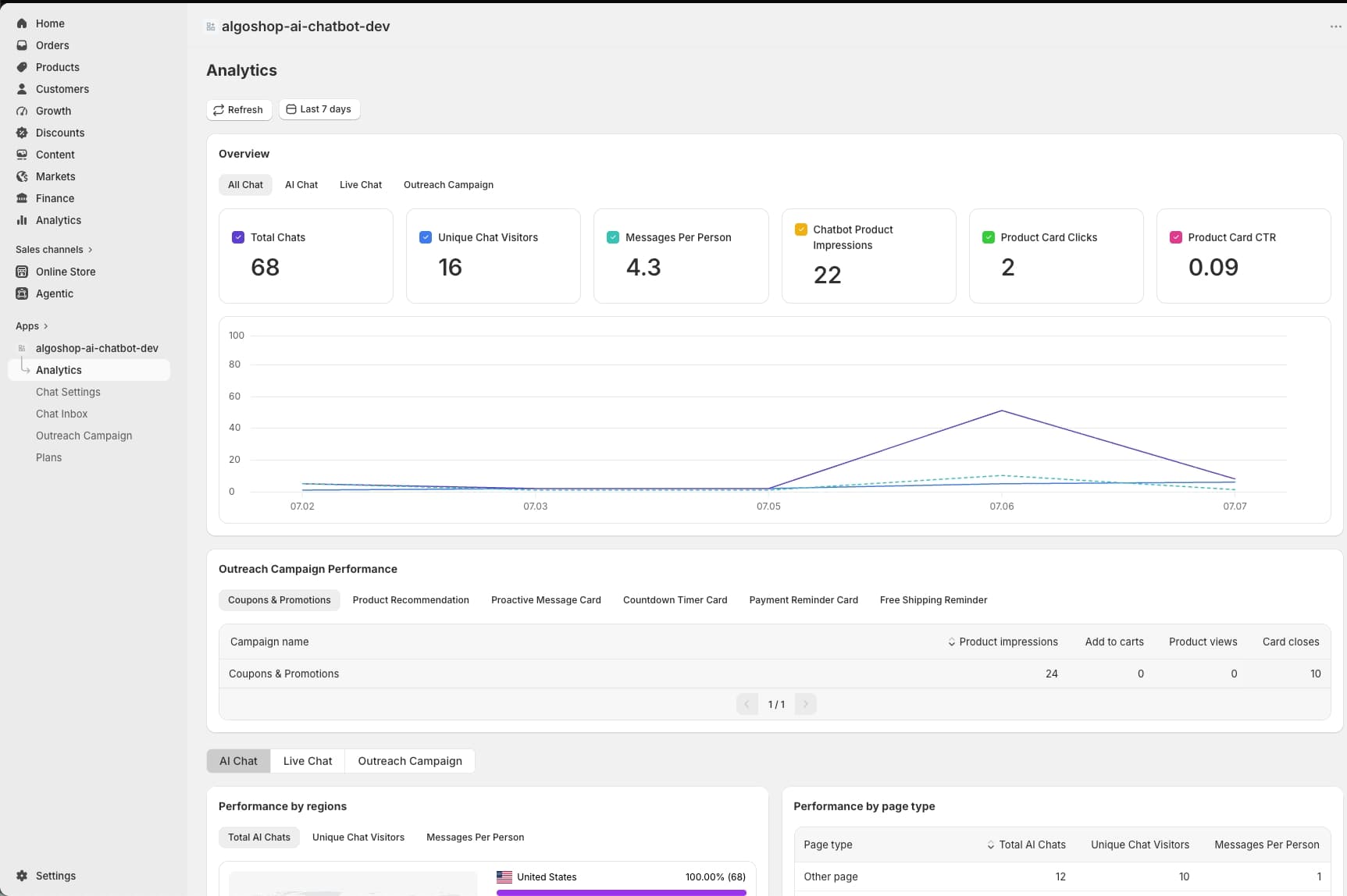
Every conversation is logged and analyzed. The AI identifies which messages drive conversions, which triggers are most effective, and where users drop off. These insights are surfaced in the analytics dashboard as actionable reports. Over time, the chatbot's response selection, trigger thresholds, and conversation flows improve automatically based on aggregate performance data.
What Is a Chatbot? — The 2026 Definition
A chatbot is a conversational software agent that conducts human-like interactions via text or voice. In 2026, this definition has fundamentally shifted. A decade ago, a 'chatbot' meant a rule-based script that matched keywords to pre-written answers. Today, it means an LLM-powered agent that understands context, learns from data, maintains memory across sessions, and takes autonomous action on your behalf.
The chatbot industry has evolved through three distinct eras. Era 1 (1966–2015) was the rule-based era — chatbots followed if-then-else decision trees and could only answer questions they were explicitly programmed for. ELIZA (1966), developed at MIT, was the first chatbot ever created, simulating a psychotherapist using simple pattern matching. Era 2 (2015–2023) was the FAQ bot era — platforms like ManyChat and ChatFuel enabled businesses to build keyword-matching bots without coding, but these bots still had no real understanding of language. Era 3 (2023–present) is the LLM era — chatbots powered by GPT-5.5, Claude Opus 4.7, Gemini 3, and DeepSeek V4 understand meaning, not just keywords. They can answer questions they have never seen before, maintain context across sessions, and proactively initiate conversations.
The practical business implication is profound. An Era 2 chatbot could answer 'Where is my order?' only if someone wrote a specific script for that question. An Era 3 AI chatbot can understand 'My package was supposed to arrive Tuesday but it is Thursday and I am really frustrated' — recognizing the emotion, looking up the order via the Shopify Admin API, checking the carrier's real-time tracking status, and offering either a solution or a human handoff. It does not need a pre-written script for that exact scenario.
For Shopify merchants, the practical definition is even more specific: a Shopify AI chatbot is a conversational agent that connects to your store's live data — product catalog, inventory, pricing, orders, customer history — and uses that data to answer questions, recommend products, recover abandoned carts, and close sales autonomously across every channel your customers use.
How Does a Chatbot Work?
Modern AI chatbots operate through a 5-step technical pipeline that runs in milliseconds. Each step builds on the previous one, transforming raw user input into a context-aware response and, in advanced systems, an autonomous business action:
1. Natural Language Understanding (NLU) — The raw message is processed to extract intent, entities, and sentiment. This is what separates AI chatbots from keyword-matching scripts. The NLU engine understands that 'Where is my stuff?' and 'Can you track my package?' are the same intent.
2. Intent Mapping & Business Logic — The identified intent is matched against the chatbot's configured business rules. A 'product question' triggers catalog search; a 'shipping question' triggers order lookup; 'exit intent' triggers cart recovery with a time-limited discount.
3. Knowledge Retrieval — The chatbot queries connected data sources in real time: live API calls to Shopify for product catalog, inventory, pricing, and orders. Critically, this data is live — if a product sells out, the AI stops recommending it immediately.
4. Response Generation — The LLM generates a natural-language response incorporating the retrieved data, the brand's voice, and the full conversation history. Advanced chatbots generate multiple response options and select the one most likely to convert.
5. Autonomous Action Execution — This is the layer that makes modern AI chatbots true sales agents. Beyond generating text, the AI can add products to cart, apply discounts, initiate checkout, create support tickets, or hand off to a human with full context. Algoshop executes this through its 6-card outreach system triggered by shopper behavior.
The 4 Types of Chatbots
Not all chatbots are created equal. Understanding the four distinct types helps businesses choose the right technology:
1. Rule-Based Chatbots — Follow pre-programmed decision trees (if X, respond Y). Cannot understand meaning, only match patterns. Capabilities: Answer up to 30% of FAQs, collect basic info, route to humans. Limitations: Cannot handle unscripted questions, no learning. Cost: $0–$30/month. Examples: Early ManyChat flows.
2. AI/LLM-Powered Chatbots — The current state of the art. Use GPT-5.5, Claude Opus 4.7, Gemini 3 to understand meaning, maintain context, and generate original responses. Capabilities: Nuanced conversation, proactive sales, personalized recommendations, autonomous cart recovery, 15+ languages. Cost: $0–$200/month. Examples: Algoshop.
3. Hybrid Chatbots (AI + Human) — AI handles 70–93% of conversations autonomously; complex issues escalate to humans with full context. Capabilities: All AI capabilities plus SLA management, agent routing, team inbox. Cost: $300–$3,000+/month. Examples: Gorgias, Zendesk, Intercom.
4. Voice Chatbots — Use ASR and TTS for spoken conversations. Capabilities: Hands-free interaction, phone support, accessibility. Cost: $500–$5,000+/month. Examples: Google Assistant, Amazon Alexa.
How Algoshop Redefines the Shopify Chatbot
Algoshop is the first Shopify chatbot architected from day one as a sales engine, not a support ticket router. While every other major Shopify chatbot platform — Tidio, Gorgias, Zendesk, Intercom — started as a helpdesk tool and later added AI features as an afterthought, Algoshop was built around a single foundational question: how do we use AI to generate revenue for Shopify merchants?
This architectural difference results in three paradigm shifts that fundamentally redefine what a Shopify chatbot can be for your business:
Shift 1 — Reactive to Proactive: Traditional Shopify chatbots sit idle until a shopper types a question. Algoshop monitors real-time shopper behavior and proactively initiates conversations at the exact moment of maximum commercial opportunity. A shopper lingering on a product page for 30+ seconds receives a personalized product recommendation card. A shopper whose mouse moves toward the browser close button receives a cart recovery message with a time-limited 10% discount.
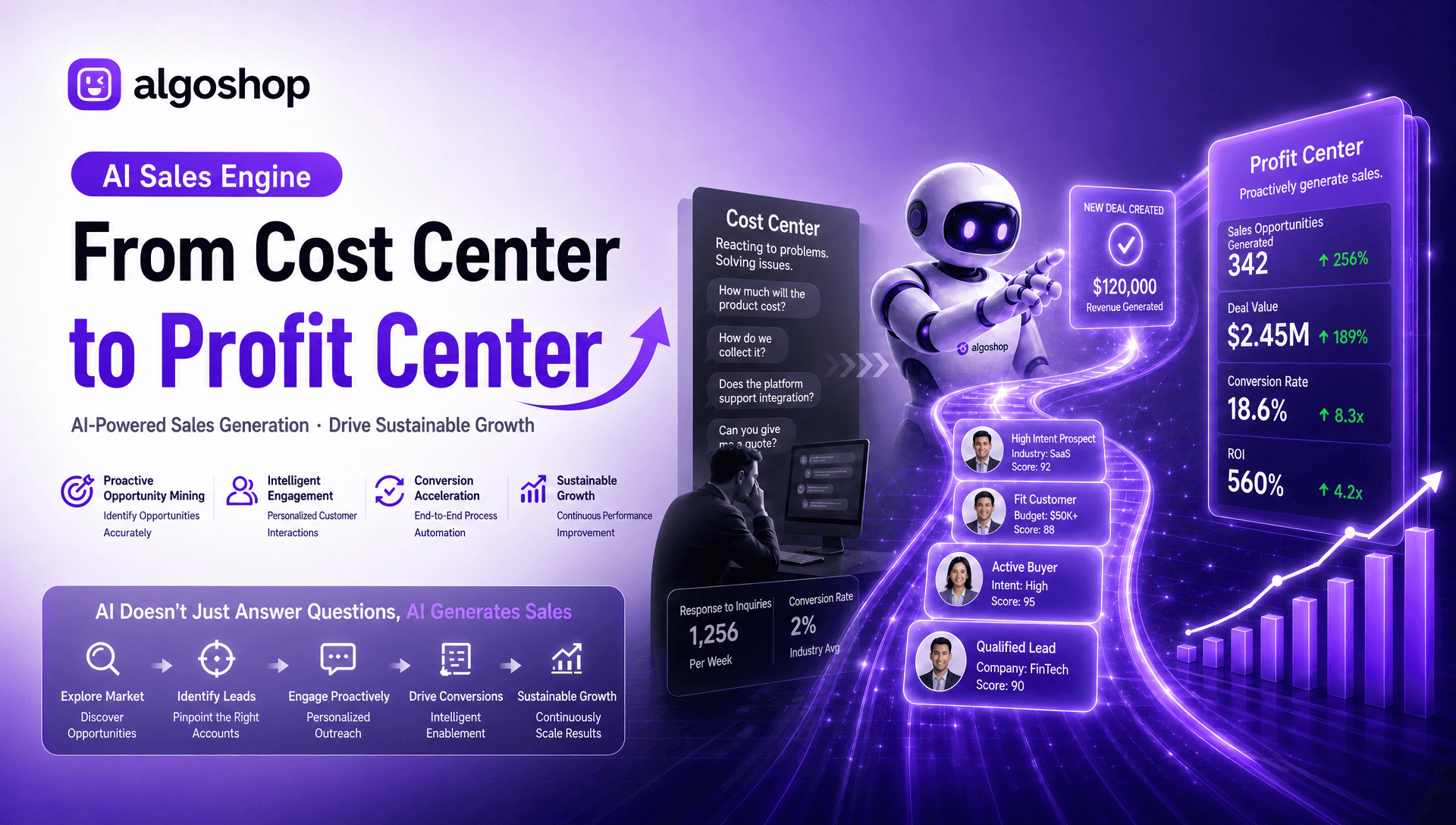
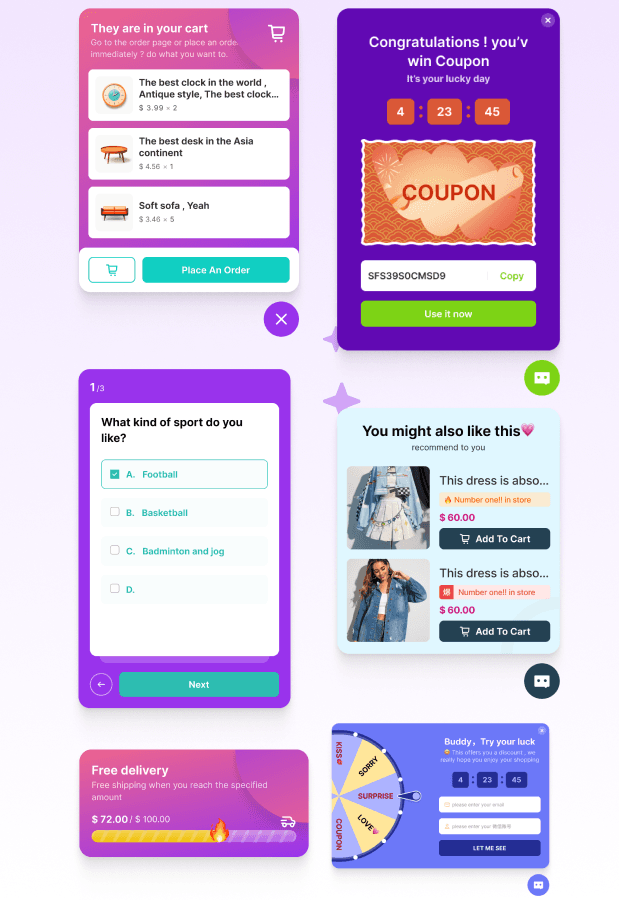
Shift 2 — Support to Sales: Traditional chatbot metrics are tickets deflected and response time — cost-center metrics. Algoshop is measured by conversations that led to a purchase, incremental revenue generated, and cart recovery rate — profit-center metrics. Algoshop deploys 6 types of proactive outreach cards: product recommendations, gamified scratch cards, spin-to-win wheels, cart reminders, countdown timers, and surveys. Each card drives a specific conversion outcome with measurable attribution.
Shift 3 — Single Channel to Omnichannel: Traditional Shopify chatbots operate only on the storefront. Algoshop extends the same AI brain across WhatsApp, Instagram, Messenger, and email — all managed from one inbox with full cross-channel context. A shopper who starts on desktop, adds items on mobile, and DMs you on Instagram gets a seamless conversation across all touchpoints.
The measurable results are clear. Algoshop merchants report cart recovery rates of 15–40% (vs 3–5% for email-only), AOV increases of 20–35%, operational cost reductions of 60–80%, and 5,000+ merchants across 15 languages. Start free →
What Can a Chatbot Do for Your Business?
A modern AI chatbot delivers five measurable business outcomes that directly impact your bottom line. These are not theoretical benefits — they are documented results from thousands of Shopify merchants using AI chatbots in production today.
1. 24/7 Customer Engagement at Scale — AI chatbots provide instant responses 24/7 across all time zones. 81% of shoppers expect immediate responses. AI delivers response times under one second, vs 2–40 minutes for live chat and 12–48 hours for email.
2. Direct Revenue Generation — AI sales chatbots proactively recommend products and recover abandoned carts. Conversational cart recovery achieves 15–40% recovery rates (vs 3–5% for email-only). AI product recommendations increase AOV by 20–35%. Algoshop's 6-card system drives measurable incremental revenue.
3. 60–80% Cost Reduction — AI handles 70–93% of conversations autonomously. Cost per AI conversation: $0.50–$2.00 vs $15–$25 for human agents. For a store doing 2,000 orders/month, this means $30,000–$100,000+ annual savings. See our pricing analysis.
4. Multilingual Scaling — AI operates in 15+ languages automatically. Serve international customers without hiring multilingual support staff.
5. Actionable Business Intelligence — Every AI conversation generates structured data on customer intent, product interest, and conversion patterns. These insights inform product development, marketing, and CX improvements.
Chatbot vs Live Chat vs FAQ Page: Which Should You Use?
Each customer engagement channel serves a different strategic purpose. The comparison table below evaluates the three most common channels across the eight dimensions that matter most for business decision-making. Use this to decide which channel — or combination — fits your current needs.
When to use an AI Chatbot: You want 24/7 automated sales conversations + support deflection. Best for stores with 200+ orders/month that want to recover more revenue without hiring more staff.
When to use Live Chat: You sell high-consideration products ($200+ AOV) where personal consultation directly drives conversion. Best for stores with complex product lines where human expertise is a competitive advantage.
When to use an FAQ Page: Your questions are predictable and rarely change. Best as a supplement to AI chatbot — not a replacement. FAQ pages alone recover zero abandoned carts.
How to Choose the Right Chatbot for Your Business
Choosing the right chatbot depends on three factors: your primary business goal, your technical resources, and your budget. Here is a practical decision framework based on real merchant scenarios:
If your goal is reducing support ticket volume — a rule-based FAQ bot or hybrid chatbot (AI + human) is sufficient. Cost: $0–$200/month. Deflects 30–50% of routine inquiries. The trade-off: zero incremental revenue.
If your goal is generating revenue through sales — cart recovery, product recommendations, proactive engagement — you need an AI/LLM-powered sales chatbot like Algoshop. Cost: $0–$200/month. Handles 70–93% of conversations. Pays for itself by recovering 2–3 abandoned carts per month.
If you need deep enterprise helpdesk integration — complex ticketing, SLA management, multi-department routing — a hybrid chatbot (like Gorgias or Zendesk) may work. Cost: $300–$3,000+/month due to per-resolution AI fees.
For most Shopify merchants processing 200–10,000 orders/month, an AI sales chatbot like Algoshop delivers the highest ROI — combining autonomous sales conversations, support deflection, omnichannel coverage (web + WhatsApp + Instagram + Messenger), and flat-rate pricing with no per-resolution fees. Full pricing comparison →
| Capability | AI Sales Chatbot | Live Chat (Human) | FAQ Page |
|---|---|---|---|
| Response Time | < 1 second | 2–40 minutes | |
| Availability | 24/7/365, unlimited | Business hours only | |
| Languages | 15+ auto-detected | 1–4 per agent team | |
| Cost per Conversation | $0.50–$2.00 | $15–$25 | |
| Proactive Sales | Yes — 6 card types | No — reactive only | |
| Cart Recovery | Yes — 15–40% rate | 3–8% (if agent online) | |
| Scalability | Unlimited, instant scale | Linear — hiring needed | |
| Learning | Improves with every conversation | Depends on individual agent | |
| Analytics | Full attribution & ROI tracking | Basic CSAT & response time | |
| Best For | Sales + Support automation | Complex issue resolution |
Frequently asked questions
What is a chatbot in simple terms?
A chatbot is a software program that can have conversations with people through text or voice. In 2026, modern AI chatbots use large language models (LLMs) to understand meaning and context — not just match keywords to scripted answers. Think of it as a virtual sales assistant that can answer questions, recommend products, and even complete purchases on your behalf 24/7. See how Algoshop's AI chatbot works for a practical Shopify example.
Are chatbots the same as AI?
No, they are related but distinct. A chatbot is the interface that conducts conversations. AI (specifically large language models) is the technology that powers the chatbot's ability to understand and generate natural language. An FAQ bot can exist without AI (using decision trees), but a modern conversational AI chatbot is built on LLMs. Algoshop uses multiple AI models including GPT-5.5, Claude Opus 4.7, Gemini 3, and DeepSeek V4, routing each conversation to the best model for that specific task.
How is Algoshop different from ChatGPT?
ChatGPT is a general-purpose AI chatbot built by OpenAI. It knows nothing about your Shopify store, your products, or your customers — unless you manually tell it, every single time. Algoshop is a specialized Shopify AI sales chatbot that connects to your store's live data via the Shopify Admin API, deploys 6 proactive outreach campaign types triggered by shopper behavior, operates across WhatsApp, Instagram, and Messenger from a single inbox, and provides analytics on sales attribution — showing exactly which conversations drove revenue.
Can a chatbot replace human customer service?
For 70–93% of routine conversations, yes. Modern AI chatbots can handle order inquiries, product questions, shipping lookups, and basic troubleshooting completely autonomously. For complex issues — refund disputes, account security, sensitive negotiations, escalated complaints — human handoff is still recommended. Algoshop supports both modes seamlessly: the AI handles the majority, and when it encounters a conversation beyond its capabilities, it escalates to a human agent with full conversation context — no repetition required.
How do AI chatbots learn about my products?
AI chatbots learn through two mechanisms. First, the underlying LLM is pre-trained on massive text datasets to understand language patterns generally. Second, the chatbot's specific deployment connects to your store's live data via API — it reads your Shopify product catalog, collections, pricing, inventory, orders, and customer data in real time. Algoshop does not need separate training on your products. It reads them live. You can also upload knowledge base articles and FAQ entries to expand what the AI knows beyond your product catalog.
What technology do chatbots use?
Modern AI chatbots use a stack of five integrated technologies: (1) Large Language Models (LLMs) like GPT-5.5, Claude Opus 4.7, and Gemini 3 for natural language understanding and generation, (2) Natural Language Processing (NLP) engines for intent detection and entity extraction, (3) Knowledge Retrieval databases for real-time data lookup, (4) API Integration layers for connecting to Shopify, Meta (WhatsApp/Instagram), and other business systems, and (5) Behavioral Trigger Engines that detect shopping signals like dwell time, exit intent, and cart changes. Algoshop integrates all five into a single platform.
How much does a chatbot cost for a business?
Costs range from free to $3,000+/month depending on the type and volume. Rule-based FAQ bots: $0–$30/month, limited capabilities. AI-powered chatbots like Algoshop: free plans (100 AI messages/month) up to $199.90/month for unlimited features — flat-rate, no per-message fees. Enterprise helpdesk chatbots (Gorgias, Intercom, Zendesk with AI add-ons): $300–$3,000+/month due to per-resolution AI fees that scale with usage. For most Shopify stores processing 200–10,000 orders/month, Algoshop at $39.90–$199.90/month delivers the best ROI. See our pricing comparison for a detailed breakdown.
Are chatbots secure for handling customer data?
Enterprise-grade AI chatbots implement encryption in transit and at rest, SOC 2 compliance, data isolation between customers, and configurable data retention policies. Algoshop processes all data through encrypted API connections to Shopify and Meta, and allows merchants to control exactly what data the AI can access. The platform does not store raw credit card information or sensitive payment data. All conversations are encrypted and can be automatically deleted after a configurable retention period.
Do chatbots work on mobile?
Yes — most modern AI chatbots are designed mobile-first. Algoshop's chat widget is fully responsive across all devices, from desktop to tablet to smartphone. The WhatsApp and Instagram integrations are mobile-native by design. According to Algoshop's aggregate analytics, approximately 70% of all conversations start on mobile devices. The chat interface is optimized for touch interaction, with large buttons, swipe gestures, and minimized typing requirements.
What is the future of chatbots?
The next evolution is autonomous AI agents — chatbots that not only converse but execute multi-step workflows independently. Future capabilities include: automatically processing returns and issuing refunds, coordinating with shipping carriers for reshipment, managing inventory adjustments across warehouses, placing restocking orders with suppliers, and proactively reaching out to customers with personalized offers based on predicted future needs. Algoshop is already moving in this direction with its proactive outreach campaigns and autonomous action execution layer.
AI model comparison
Learn more about the AI models behind today's conversational agents.
OpenAI — GPT-5.5
The latest generation of OpenAI's large language model, offering advanced reasoning, longer 128K-token context windows, and improved factual accuracy for real-time sales conversations.
Anthropic — Claude Opus 4.7
Anthropic's most capable model, designed for nuanced, context-aware conversations with strong safety guardrails. Ideal for handling complex sales objections and multilingual support across 15+ languages.
Google — Gemini 3
Google's flagship multimodal model that understands text, images, and video. Enables AI chatbots to analyze product images and shopper-uploaded photos within conversations for instant visual recognition.
DeepSeek — V4
A high-performance open-source model optimized for cost-efficient reasoning. Provides an alternative inference path for budget-sensitive conversation routing without sacrificing response quality.