
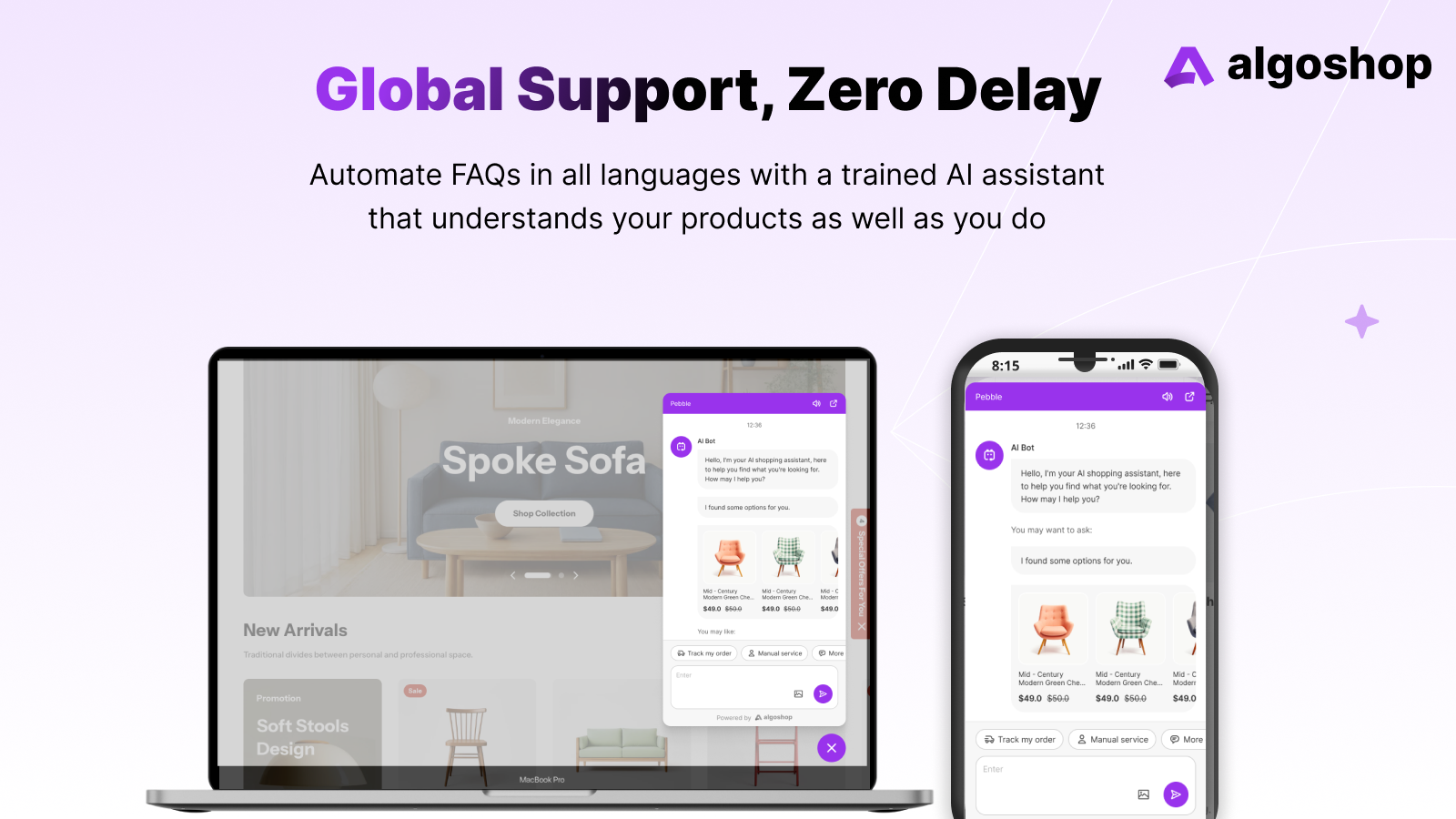
Algoshop product conversations on desktop and mobile. Official product imagery; interface examples are demonstration data.
A shopper sees “ships in two days” on a product page, “allow five days” on the shipping page and “arrives tomorrow” in a chat response. None of those statements can be evaluated in isolation. The problem is that the store is giving three different answers to the same buying question.
Consistency matters when merchants advertise products, answer pre-purchase questions and handle post-purchase concerns. A customer cannot make a sound decision if price, availability, delivery or return terms change depending on which page or channel they visit. This article is an editorial workflow for maintaining customer-facing information, not legal advice or a claim that a chatbot can certify Google Merchant Center compliance.
ClearCheck Compliance focuses on examining Shopify store information for issues relevant to Google Merchant Center, including product details and policy or contact-page gaps. Algoshop AI Sales Chatbot focuses on customer conversations, product guidance, order tracking and live-chat support. These are different jobs. The merchant should make the underlying facts reliable before asking any assistant to explain them. The two products are mentioned as examples of complementary review and communication roles; no direct integration is claimed.
Build one approved source for each promise
Start with the facts most likely to affect a buying decision. A small store may begin with product specifications, price and promotions, stock availability, shipping times, return conditions and contact information. An approved source does not need to be a complex database. It needs a named owner and a clear place where the current answer lives.
Swipe horizontally to read the full table.
| Shopper question | Source the merchant should approve | Risk when copies diverge |
|---|---|---|
| “What is this made of?” | Current product specifications | Chat or ads promise a material the item does not contain |
| “Is the discount valid?” | Active Shopify offer and its terms | A code is advertised after it expires or excludes the product |
| “When will it arrive?” | Shipping policy and current fulfillment estimate | A chat answer promises a delivery date the store cannot meet |
| “Can I return it?” | Actual return policy for that product and market | A generic answer conflicts with an exception on the policy page |
| “How do I contact you?” | Current support contact page | Ads or messages point to an abandoned inbox |
The product page should make the core choice understandable without requiring chat. The assistant can answer a follow-up, point to the relevant policy and offer a human handoff when the exact case depends on an order or exception. It should not silently become the authority over the store's terms.
Trace the customer journey, not just the homepage
A quick review of the homepage may miss the contradiction that matters. Choose a product currently promoted in an ad and follow the shopper's route: ad or search result → product page → cart → checkout-support question → shipping or returns page. Read the exact language at each step.
For example, imagine an outdoor jacket listed as water-resistant. A merchant's ad says “ready for rainy commutes,” the product page gives a material description and a customer asks the chat, “Is it fully waterproof?” The assistant should not turn “water-resistant” into “waterproof” to sound helpful. It should describe the approved property, acknowledge the limit and offer support if the shopper needs a technical specification. This is a hypothetical editorial example, not a test of either product on a live store.
An inconsistency review is also useful for discounts. “20% off this weekend” is incomplete if the actual Shopify rule excludes the featured item. The merchant should test the cart and checkout with an eligible and an ineligible product, then update the ad, popup and chat knowledge to match the real offer. A chatbot cannot make an invalid code valid.
Separate dispatch time from arrival time
The opening shipping example has a specific fix: identify what each time statement means. “Dispatches within two business days” concerns when the store hands the order to the carrier. A transit estimate concerns what happens afterward. A customer asking “Will it arrive before my trip?” needs those two stages explained together, plus any location-specific condition.
A useful suggested answer is: “Our policy gives a dispatch window and a separate transit estimate. Which destination are you shipping to?” Once the relevant policy is known, give that estimate and link its conditions. For an already placed order, use the tracking route; for a deadline the store cannot confirm, offer staff help. That is more informative than replacing every statement with a vague “delivery times vary.”
Swipe horizontally to read the full table.
| Wording problem | Clearer customer wording | Source to align |
|---|---|---|
| “Ships in two days” interpreted as arrival | State whether this means dispatch, then explain transit separately | Operations and shipping policy |
| “20% off everything” with product exclusions | Name the eligible range and make exclusions visible | The active discount rule |
| “Waterproof” when the specification says water-resistant | Use the actual property and explain its intended-use limit | Product specification |
These are editing examples, not universal policy language. They retain useful detail while removing a promise the source does not support.
Keep AI responses inside the approved facts
The Algoshop App Store listing describes AI chat, multilingual support, product recommendations, proactive outreach cards, order tracking and live chat. Those capabilities help a store answer questions across different moments of a visit. They also make content governance more important: a faster answer spreads an outdated promise faster.
Create an answer policy for three kinds of questions:
- Known general facts: give the approved specification or policy and a link to the current source.
- Account- or order-specific facts: use only authorized data available in the installed workflow; otherwise route to a person who can verify the case.
- Unresolved or high-risk claims: say what is known, avoid guessing and escalate for confirmation.
The customer should not be forced to decipher which system owns a fact. Internally, however, the team needs that distinction. Product staff own the specification, operations own the delivery promise, policy owners approve return language, and support owns the handoff when a specific order does not fit the standard answer.
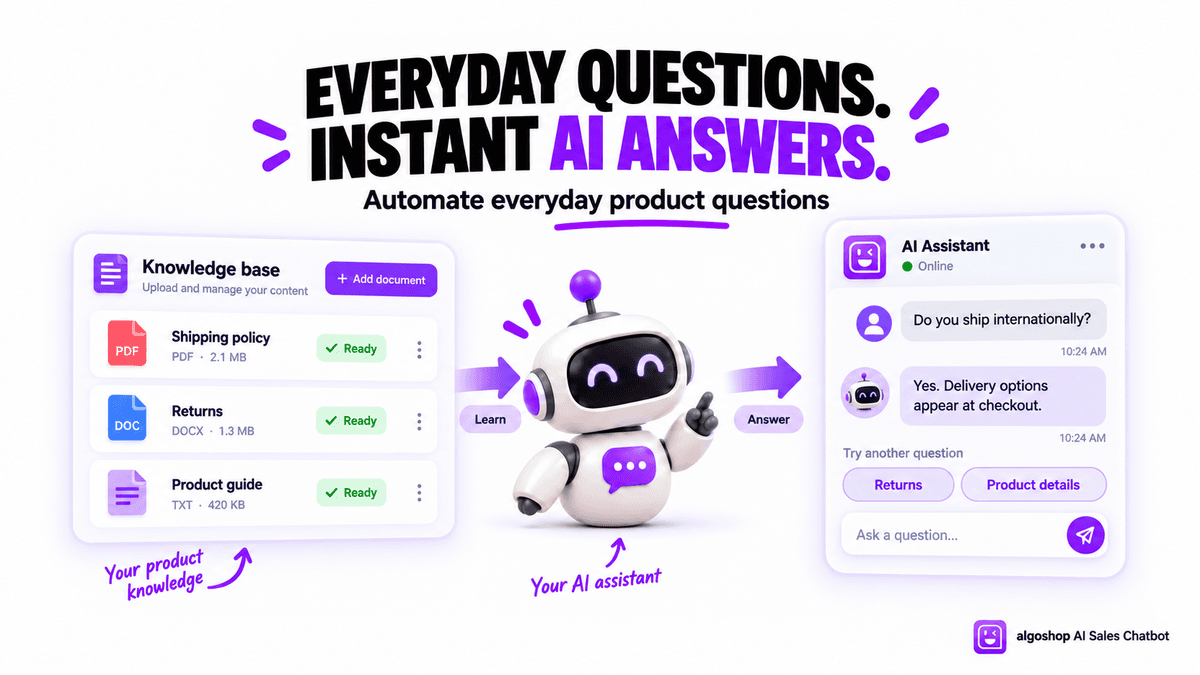
Give the assistant the same product and policy information customers see on the store. Algoshop's official product illustration shows that information-to-answer relationship.
Use the conversation to make the offer easier to understand
The customer benefit is not simply a faster response. A shopper reading a promotion may need to know which variant qualifies, whether a code can be used in their cart or where the return exception applies. A useful AI-chat answer connects that question to the relevant product or policy instead of repeating the banner.
For a suggested launch workflow, prepare the promoted product's key details, the offer dates and exclusions, and the support route for an exception. Ask the assistant a product question, a discount question and an arrival-deadline question before sending traffic to the page. Then inspect whether each answer gives the customer an actionable next step. Algoshop's conversational role and ClearCheck's store-review role remain separate; the merchant connects the work by maintaining one consistent offer.
Review changes before a campaign amplifies them
Most inconsistencies appear when something changes: a supplier revises a material, a sale ends, a shipping carrier slows down or a return exception is added. The change should trigger an editorial check across every place the old promise appeared.
Swipe horizontally to read the full table.
| Change | First verify | Then inspect |
|---|---|---|
| Product attribute revised | Source product record and approved detail | Product page, feed text, ad copy and chat answer |
| Promotion updated | Shopify discount configuration | Banner, popup, email and chat suggestion |
| Shipping estimate changed | Operations' current schedule | Shipping page, checkout wording and order-support reply |
| Policy amended | Merchant-approved policy page | FAQ, help article and any reusable AI response |
The ClearCheck site describes checks across products, policies, contact details and other store signals relevant to Google Merchant Center. That kind of review can identify issues the merchant then needs to resolve. It is not a substitute for the merchant's own approval of facts, nor does a score guarantee approval by any advertising platform.
A five-question QA pass before publishing
One launch, three promises to keep aligned
Consider a suggested jacket campaign with a product attribute, a collection discount and a dispatch window. Before adding traffic, write what each statement actually means. Keep the full details in the maintained product and policy sources; use shorter customer-facing versions where space is limited, without dropping a condition that changes the offer.
From campaign wording to a useful answer
Product property
If the verified specification is water-resistant, retain that term in the ad, product description and answer. A shopper asking about heavy rain needs the stated use limits or a relevant technical detail, not a stronger synonym. If the store has no verified test information, offer support for that specific question.
Promotion
A collection-only discount should name the eligible collection and show material conditions. When a customer asks why their basket does not qualify, check the actual items and rule through the appropriate support workflow. Do not turn a banner's shorter wording into a promise of universal eligibility.
Delivery
State whether the published window concerns dispatch or transit. A customer buying for a trip needs the relevant destination estimate and any conditions, while an existing order needs its tracking route. A quick general answer should not become a guaranteed arrival date.
Keep the answer specific when you cannot make a guarantee
Shopper: “Will this jacket arrive by Friday, and does the launch code work on this color?”
Suggested response pattern: Address the color's offer eligibility from the current terms, then distinguish dispatch from transit for the relevant destination. If the deadline cannot be confirmed, say so and give a support route to check the case.
This is more useful than either extreme: a confident “Yes” without evidence or a generic “Please contact support” that discards everything the store already knows. The assistant can explain the supported part now and carry the unresolved part to a person. The store should make the boundary easy for the customer to understand, not ask them to diagnose which internal system owns it.
After the promotion ends, retire the old answer too
A campaign ending is a content change across several surfaces. Check the banner, popup, reusable email wording, product-page message and any support material that refers to the offer. For customers who saw the earlier campaign, keep an explanation of the actual end date and relevant terms; do not leave an expired promotion circulating as a current recommendation.
When reviewing the updated chat answer, ask the original shopper question again in different ordinary phrasing. “Can I still use the launch code?” and “Is the jacket offer running?” concern the same offer even though neither repeats the banner text. Review whether the response identifies the actual promotion and its status, rather than matching only the wording of one prepared question.
The aim is a coherent customer journey: the advertisement sets an expectation, the page explains it, and the conversation helps the buyer act on it. Store review and conversational support serve different roles, but their value meets at that shared expectation.
Before a major campaign, choose the promoted product and ask the store and its support workflow the same five questions: What exactly is being sold? What does it cost under the current promotion? Is it available? When and where can it be delivered? What happens if the customer needs a return or help? Record conflicting answers and fix the source first.
Then test an answer the store does not know. A trustworthy assistant should not invent a delivery guarantee, certification, material composition or policy exception. A clean handoff to a person is a useful result. Review the actual conversation and page after each important update; don't rely solely on a one-time launch checklist.
Frequently asked questions
Can AI chat fix an inaccurate Shopify product feed?
No. Chat can explain approved information to a shopper. The feed and product records need their own corrections. Use the appropriate store or feed workflow for those changes.
Does a store scan guarantee Google Merchant Center approval?
No. A scanner can help identify issues and guide a merchant's review. Platform decisions and policy interpretations remain outside a blanket guarantee.
What if the chat cannot verify an order-specific promise?
Give the customer the approved general rule, state the uncertainty plainly and route the case to support with the context the merchant is allowed to use. A fabricated answer is not better service.
The most resilient customer experience is not the one with the most confident language. It is the one where the ad, product page, policy and conversation point to the same real offer. Review the facts, publish them consistently, and let automation make those approved answers easier to find.