
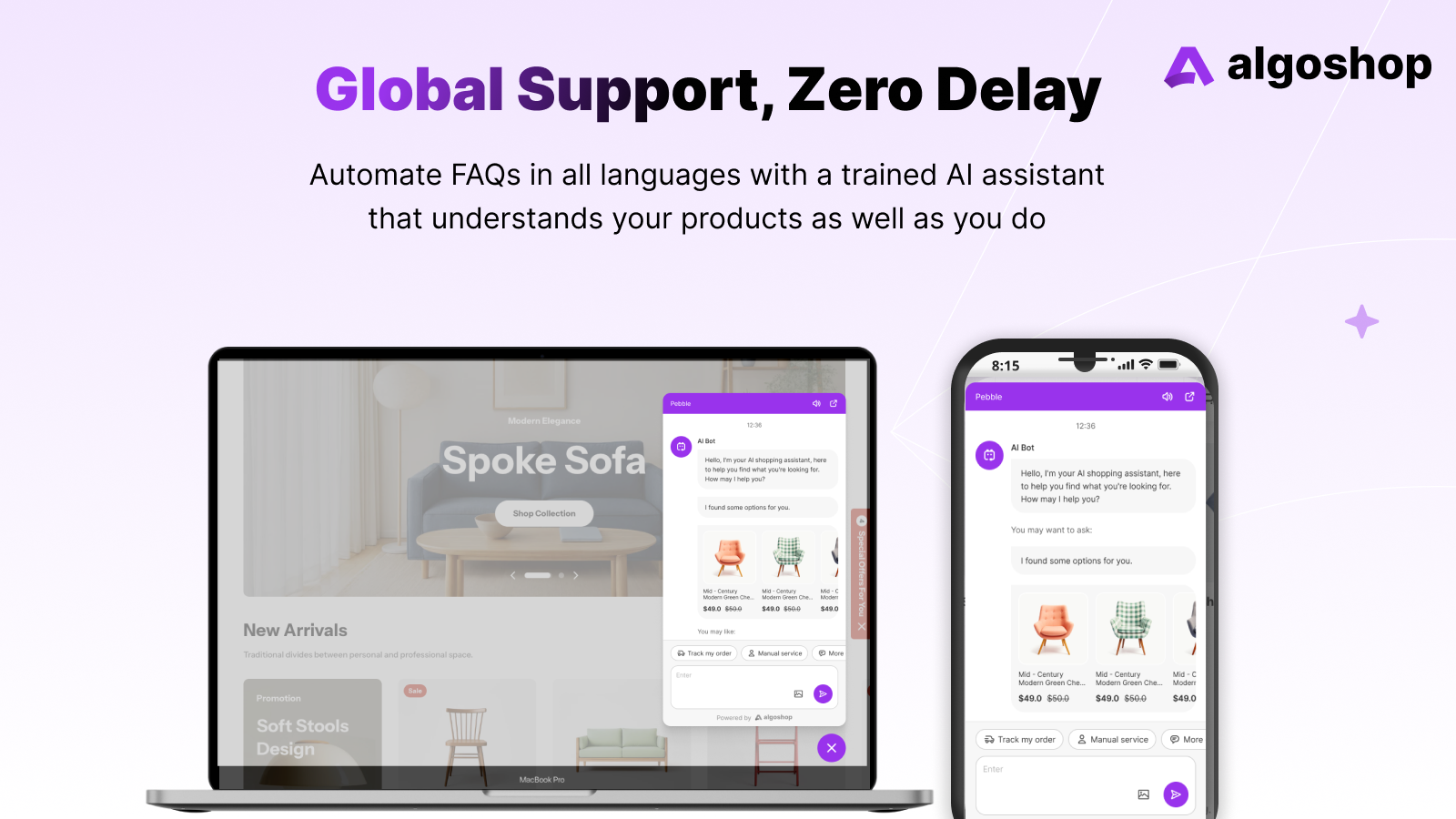
Algoshop product conversations on desktop and mobile. Official product imagery; interface examples are demonstration data.
A loyalty program asks customers to believe that today's purchase will count toward a future benefit. That belief depends on details: Which purchases earn points? When do points appear? What can a customer redeem, and where can they use the reward? A shopper who cannot find those answers may ignore the offer even when the underlying program is generous.
For a Shopify merchant, two jobs need different owners. A loyalty app defines and maintains the actual earning and redemption rules. Customer-facing support explains those rules and helps someone take the next step. Algoshop AI Sales Chatbot can answer shopper questions, recommend products, provide order-tracking assistance and route conversations to live chat. It should explain a loyalty policy only from information the merchant has approved—not make up a points balance, override a reward condition or grant a benefit on its own.
This guide shows how to make a loyalty offer understandable before and after purchase. It uses DGT Customer Rewards & Loyalty as a relevant example of a Shopify program that supports earning and redeeming points, including multi-store scenarios. It does not claim a direct technical integration between DGT and Algoshop.
Start with the questions a customer will actually ask
Merchants often write program pages in administrative language: “Earn, redeem, tier, expiration.” Customers ask in a different order. They want to know what they will receive for this purchase, why their account shows a particular balance, and whether a reward works on the item in their cart.
Swipe horizontally to read the full table.
| Customer moment | Typical question | Source that should own the answer |
|---|---|---|
| Before buying | “Will this order earn points?” | Published earning rules and eligible-product conditions |
| After buying | “When will my points show up?” | The configured program policy and actual account state |
| At redemption | “Can I use this reward with a sale item?” | Redemption and discount-combination rules |
| Across stores | “Can I use points earned at your other store here?” | The merchant's configured cross-store program scope |
The DGT listing describes points, discounts and incentives, plus centralized loyalty management across connected stores on applicable plans. It does not imply every merchant's rule is identical. A support answer must match the installed configuration, not merely the vendor's feature list.
Write a customer-readable rule sheet first
Before training or configuring an AI assistant, build a short rule sheet that a support agent could use without guessing. It should include how points are earned, when they become available, whether returns change the balance, how rewards are redeemed, whether they expire and what happens across stores. If a rule is not yet decided, mark it as unresolved rather than letting a chatbot fill the gap.
For example, an approved answer might say: “Eligible purchases earn points after your order reaches the status described in our rewards terms. Sign in to see your current balance.” That is only appropriate if the merchant's actual policy supports it. Do not insert a numeric earning rate or a timing promise from another store's program. If a customer asks for their exact balance, the assistant should use an authorized source of account data or hand the question to the team that can check it.
This is where loyalty software and AI chat complement each other conceptually. DGT manages the program; Algoshop can help explain approved policies and guide the conversation. The merchant remains responsible for configuring the rules and confirming what customer-specific data the support workflow can access.
Before purchase: connect reward information to product decisions
Points can influence a purchase only if the shopper understands the immediate choice. A visitor comparing two products may ask about material, size or suitability first, then ask whether a purchase qualifies for a reward. Product advice and loyalty eligibility are separate facts. A product recommendation should come from accurate catalog information; a rewards statement should come from the configured program terms.
Imagine a customer buying a refillable bottle as a gift. They ask, “Will I get points if I buy this with a discount?” A helpful flow is to explain the eligible-purchase policy, show where the program terms live and avoid promising a balance before the transaction is completed. If the discount interaction is complex or not stated in the published rules, the correct answer is a handoff for confirmation. This is an illustrative scenario, not a report of a live integration.
A gift purchase: answer the product question before the reward question
Here is a suggested conversation pattern for the bottle example, with the store's actual product and program details filled in before use:
Shopper: “I'm buying a bottle as a gift. Which one is easiest to carry?”
Helpful response: “Are they carrying it in a bag or using it mainly at a desk? That will help narrow the size and lid options.”
Shopper: “In a bag. And will I earn points with the sale code?”
Helpful next step: Explain the relevant lid and dimensions from the product information, link the suitable item, then answer the sale-code question from the rewards terms. If the terms do not cover that combination, pass that part to support rather than holding up the product comparison.
The example shows why product guidance and rewards support belong in the same customer journey but do not share the same source. A customer may need a recommendation now and an eligibility check next. Keeping the two answers distinct avoids losing the shopping task in a long explanation of loyalty administration.
After purchase: distinguish order status from points status
Post-purchase questions often arrive together: “Where is my order?” and “Where are my points?” They should not be collapsed into one generic response. The Algoshop listing describes self-service order tracking and live-chat support. The loyalty system, not the chat widget, decides when points post, adjust or expire.
A customer-facing help flow can separate the questions:
- Identify whether the shopper needs order-tracking information, a loyalty rule or an account-specific balance check.
- Give the approved general explanation if the rule is known.
- Do not expose or guess private account details in a generic answer.
- Route unresolved balance and exception cases to staff with the order context the store is permitted to use.
This separation is especially useful for a merchant with multiple storefronts. The DGT listing mentions centralized data synchronization across connected stores on relevant plans. A shopper still needs to know whether their specific program allows cross-store earning or redemption, and any timing or account conditions. The merchant should publish those terms in plain language.
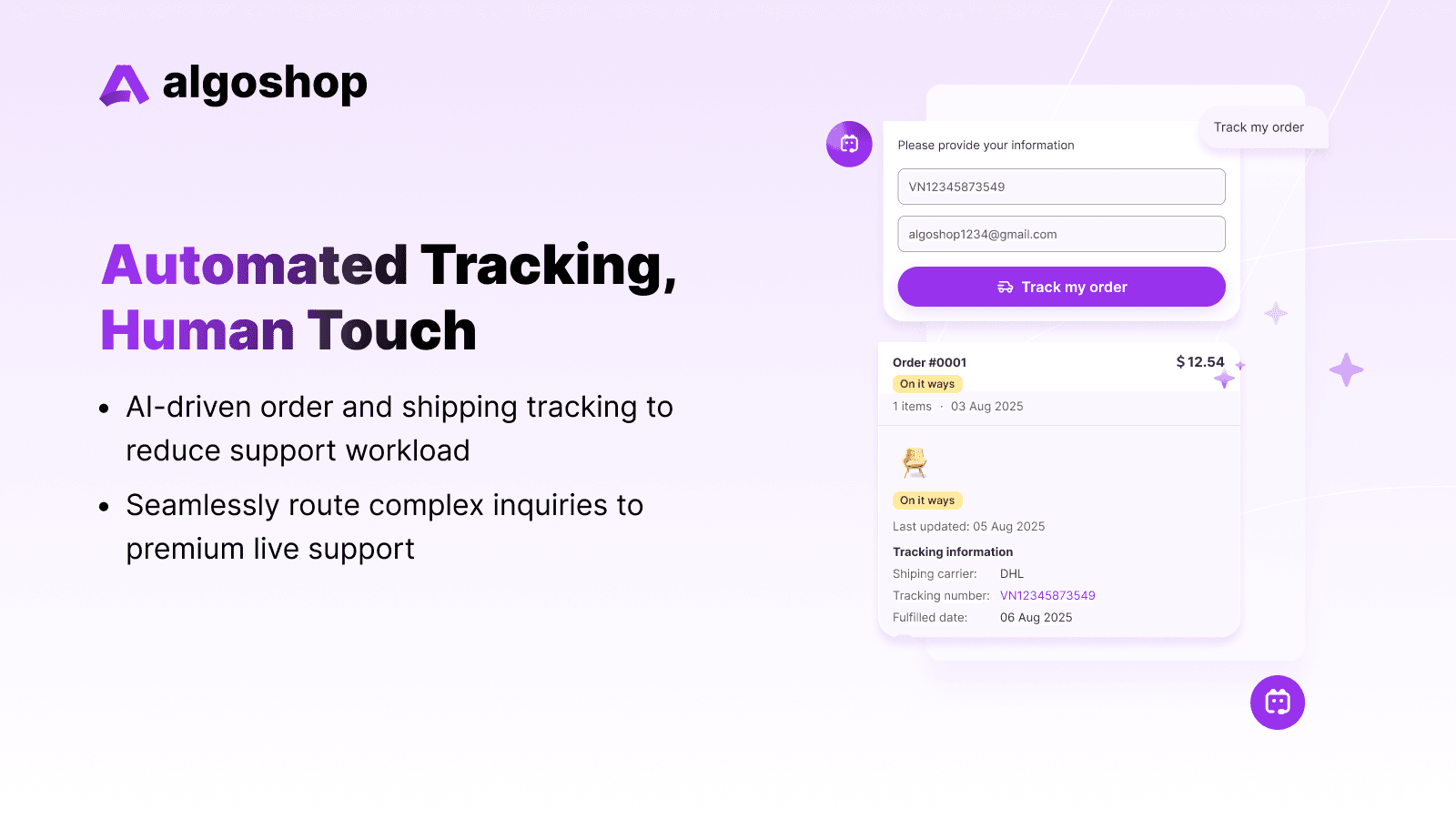
Order tracking helps answer the delivery question. A points balance remains a separate loyalty-account question, even when the customer asks both in one conversation.
Make a split answer feel like one helpful response
When a customer says, “My parcel is late and my points are missing,” begin with the delivery route, explain where the customer can check the order, and then address the points-posting rule. If staff need to investigate, the handoff should include the customer's two questions and the applicable program condition. Asking the shopper to start over in a second channel makes the store's internal separation feel like their problem.
For cross-store questions, name the participating store or program scope instead of replying “Yes, points work everywhere.” For a return, explain the published adjustment rule rather than treating parcel delivery as proof that a reward can no longer change. These details turn a generic chatbot answer into useful loyalty support without claiming an automatic DGT–Algoshop connection.
Keep reward promises consistent across channels
Follow one customer from the first purchase to the next
The following suggested journey makes the division of responsibilities practical. It uses no assumed earning rate or automatic account connection. Replace its policy references with the rules configured for your own program before using the answers.
A repeat-customer journey with clear answers
First purchase: understand the item
A shopper compares two bottles and asks which fits their bag. Product dimensions and lid information should drive the recommendation. Explain those details first; points should not substitute for a product that fits the customer's need.
Before checkout: understand eligibility
The shopper asks whether the sale code changes earning. Answer from the published program terms. If the combination is not covered, keep the product choice available and route the eligibility question to support rather than inventing a points total.
After checkout: understand the next checkpoint
The customer wants to know when points will appear. Explain the program's actual posting condition and where to check the balance. Order tracking is a separate route for the parcel; one status should not be offered as proof of the other.
Next visit: understand redemption
The customer returns with a reward and a different item in the cart. Explain the reward's eligible use and any relevant combination restrictions. For an account-specific discrepancy, carry the question to staff who can check the actual balance and transaction.
Each stage needs a short answer and a usable next step. Linking the complete terms is helpful, but replying only “See our policy” pushes the entire interpretation back onto the customer. Summarize the relevant condition accurately, then link the policy so the shopper can inspect it. If the condition depends on a current account state that the assistant cannot access, explain that limit once and give the route for checking it.
A support handoff that preserves the customer's question
Customer: “The bottle arrived, but I can't see the points. I also ordered through your other store.”
Suggested support response: “Let's check the rewards question separately from delivery. Which store was the purchase made through? Our team can compare it with the participating-store terms and your account record.”
Context for the team: The relevant storefront, the customer's original issue and the applicable published rule. Request order or account details only through the store's appropriate support process.
The response does not promise that every storefront participates or that delivered orders must already have points. It makes the next investigation understandable. For a return or cancellation, follow the same pattern: explain the actual adjustment policy and check the affected transaction rather than recycling the general earning answer.
This is the practical value of conversational support alongside a rewards program. Algoshop helps customers ask in their own words; the loyalty system and the merchant's policy remain the source of the reward decision. Repeated confusion is also useful feedback for the program page: fix the wording that generates the question, not just the response.
A policy can appear in a product-page widget, an FAQ, a campaign email, a chat answer and a support reply. If those surfaces contradict each other, customers are likely to remember the most favorable version. Assign one owner to approve the source policy and a regular check to update all customer-facing copies when the rule changes.
Swipe horizontally to read the full table.
| Policy change | Check the source | Then update |
|---|---|---|
| New earning rate | Loyalty configuration and published terms | Product-page copy, FAQ, campaigns and chat knowledge |
| Expiration rule | Applicable plan setting and merchant policy | Account help, reminder wording and escalation scripts |
| New store added | Connected-store scope | “Where can I use my points?” answer across all stores |
| Reward excluded from an offer | Actual discount and reward behavior | Promotional copy and checkout-support answers |
When a rule changes, update the short help answer as well as the formal terms. For example, a new participating store changes the answer to “Where can I spend points?” even if the earning rate stays the same. Reviewing that exact question is more useful than rereading every page of the program documentation.
A small rollout that earns trust
Start with five frequently asked questions rather than a giant, unreviewed knowledge base. Write approved answers for earning, posting, redemption, expiration and cross-store use. Test them with an ordinary purchase, a return or cancellation scenario and a case the policy does not cover. Then test how the assistant responds when it lacks an answer.
This process produces two improvements. The help experience becomes more accurate, and the merchant discovers which loyalty terms are still confusing. If people repeatedly ask “Why didn't this purchase count?”, the remedy may be clearer eligibility wording—not more chatbot persuasion.
For merchants evaluating the tools, see DGT Customer Rewards & Loyalty on Shopify for the current program features and plan scope, and Algoshop AI Sales Chatbot on Shopify for the current chat and order-support capabilities. Each app has its own responsibilities; neither product's public listing establishes a native integration between them.
Frequently asked questions
Can an AI chatbot decide how many loyalty points a customer gets?
The program's configured rules decide earning and redemption. A chatbot can explain approved rules and, where the installed workflow has authorized access, help with customer-specific questions. Otherwise it should direct the customer to an account view or a person who can verify the balance.
What should a merchant write before launching loyalty chat answers?
Write the actual earning, posting, redemption, expiration and cross-store rules. Include what happens for returns and excluded purchases. Test the answers against the configured program before putting them in a customer-facing assistant.
Why do shoppers still ask questions if a loyalty page exists?
The page may be hard to find, written in internal language or unclear at the moment of purchase. Repeated questions are useful editorial feedback: improve the page as well as the answer.
Loyalty works best when a reward is more than a banner. It is a promise the store can explain consistently, honor under its real rules and clarify when a shopper needs help. Good AI chat can make that explanation easier to reach; it cannot replace the rules behind it.