
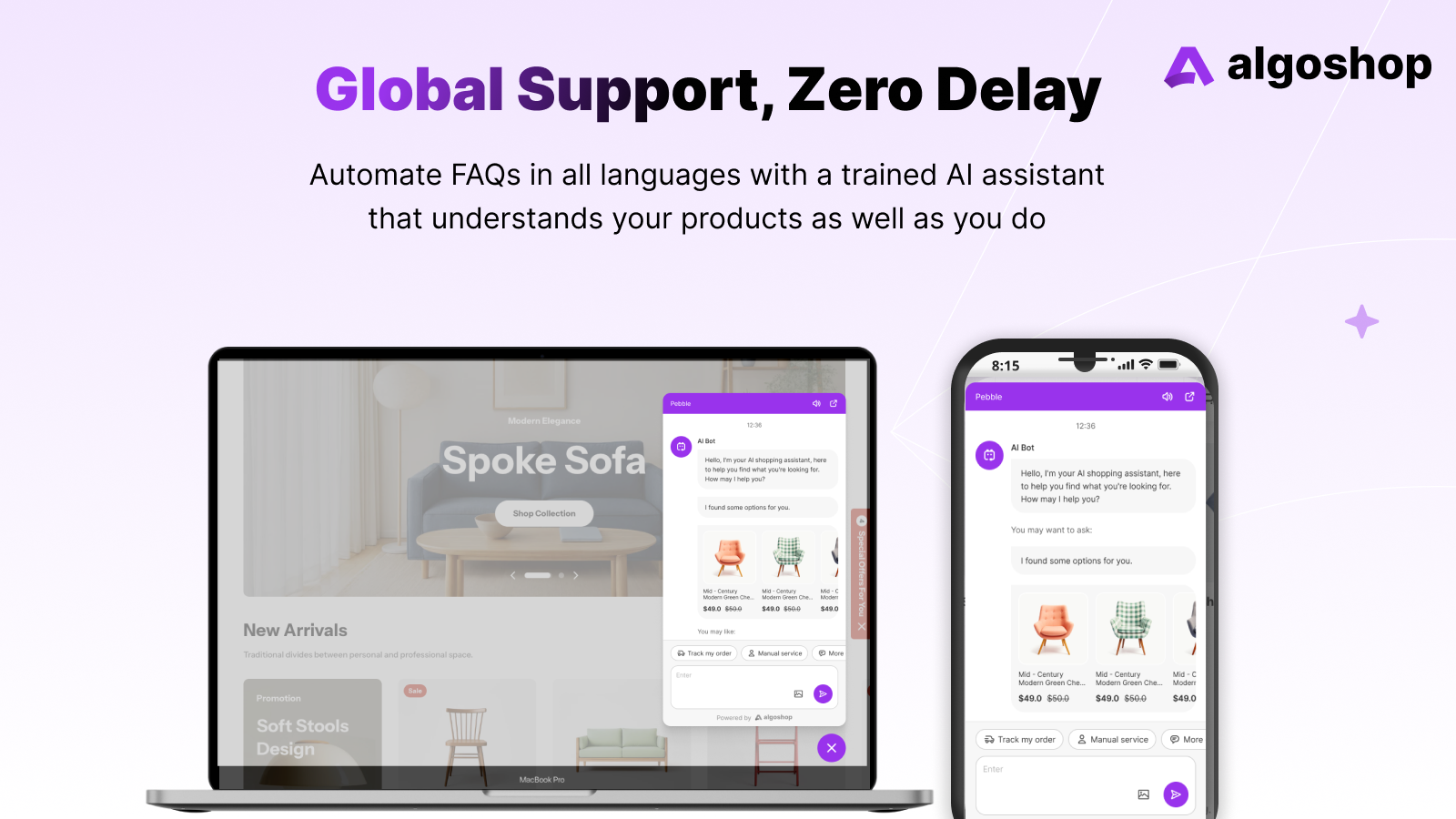
Algoshop product conversations on desktop and mobile. Official product imagery; interface examples are demonstration data.
A shopper who asks “Which one should I buy?” has not given a store much to work with. They might be choosing between sizes, buying a gift, replacing a product they already own or trying to stay within a budget. A useful shopping assistant does not treat that short message as permission to guess. It asks what matters, connects the answer to product information and makes the next step clear.
Algoshop AI Sales Chatbot is a Shopify app for AI-powered customer conversations, product recommendations, order-tracking assistance and live chat. Its listed capabilities can help a merchant guide customers through common buying questions. The quality of that guidance still depends on accurate catalog information, sensible questions and a human route for cases that the assistant cannot resolve.
This guide shows how to turn a broad request into a useful comparison: ask a focused question, explain the product match and keep the next step easy to follow.
Begin with the choice the customer is making
Many store messages sound like product searches but are really requests for decision support. “Is this good for a small apartment?” asks about dimensions and use. “Will this work with my camera?” asks about compatibility. “Can it arrive before Friday?” asks about fulfillment. The assistant should identify the type of decision before proposing an item.
Swipe horizontally to read the full table.
| Customer question | Information needed | Useful next step |
|---|---|---|
| “Which size should I get?” | Measurements, fit guide and the customer's relevant dimension | Explain the size guide; ask for the missing measurement if needed |
| “Is this compatible?” | Model number and approved compatibility list | Confirm the listed match or route an uncertain case to support |
| “What would make a good gift?” | Recipient's interests, occasion, price range and available options | Narrow to a few relevant products without assuming personal attributes |
| “Where is my order?” | Authorized order status and store support process | Provide the supported tracking path or hand off |
This distinction prevents a common failure: giving a polished recommendation that never answers the real question. A merchant should map recurring questions to the pages or policies that contain the actual answer, then repair those sources when they are incomplete.
Ask one useful follow-up question at a time
The best follow-up question removes the uncertainty that blocks a responsible answer. If a buyer wants a phone case, ask for the phone model. If they need a chair for a compact space, ask for the available dimensions. A chain of generic questions about preferences can feel like a survey rather than help.
Consider a shopper looking for a gift under $50. A relevant first question might be, “Is this for someone who likes cooking, home décor or outdoor activities?” The response can then lead to a small set of available options with the reason each fits the stated preference. Broader audience information can inform campaign planning, but a conversation gives the store something more specific: the customer's current occasion, budget and intended use.
The Algoshop Shopify listing describes product recommendations and proactive outreach cards. A merchant can use these features to make relevant options visible, but the message should remain tied to what the shopper has actually said and what the catalog supports. “You mentioned a compact space; this product is 40 cm wide” is actionable. “This is perfect for you” is not evidence.
Make the recommendation inspectable
A good product suggestion has three parts: the item, the reason and the remaining limitation. The assistant might explain that a jacket matches the shopper's stated size range and weather need, then link to the size chart so the buyer can check fit. If fabric or waterproof rating is not confirmed, it should not fill in the blank with a plausible-sounding claim.
Merchants can prepare for this by checking their product data before turning on broad conversational recommendations. Descriptions, variants, size charts, compatibility details, care instructions and stock status should agree. When two sources disagree, correct the source rather than asking the assistant to improvise around it.
A gift request, narrowed one decision at a time
Here is a suggested conversation, not a transcript from a customer store:
Shopper: “I need a gift under $50.”
Assistant: “What do they enjoy—cooking, home décor or spending time outdoors?”
Shopper: “Cooking, but they already have lots of equipment.”
Useful next question: “Would you prefer a consumable gift or a small item for serving?”
That second question changes the product search. Rather than listing every kitchen item in the price range, the store can compare actual food-gift options with suitable serving accessories. Explain the meaningful difference—contents, size, use or care—then link the item. If shipping before an occasion is the next concern, answer from the destination and current shipping policy rather than adding a confident date to make the recommendation more persuasive.
The same technique works in a replacement purchase. “I need another charger” first needs the device model. “I need a compact desk” first needs the space available. One discriminating question keeps the conversation short while making the recommendation more specific.

Keep the product selection close to the customer's question. Algoshop's storefront demonstration shows product cards in the chat experience.
Explain the match without overwhelming the shopper
A suggested response can use a simple order: “This item fits the use you described because [specific product detail]. Here is the product page. The remaining choice is [size, finish or other real option].” That gives the buyer the reason, the evidence and a manageable next decision.
Avoid turning the conversation into an intake form. If the customer has already given the budget and occasion, do not ask for them again. If two products differ only by finish, ask about finish rather than collecting unrelated personal information. Helpful personalization uses the information that changes the choice.
An editorial review set can include:
- A straightforward question with a documented answer.
- An ambiguous request that requires a clarifying question.
- A comparison between two similar variants.
- A question with no approved answer.
- A question involving an order or sensitive account information.
Read each answer as a customer would. Is the recommendation relevant? Can the stated reason be verified on the linked product page? Is the shopper told what to do if the answer is uncertain? These checks are more valuable than evaluating fluency alone.
Keep post-purchase help separate from product discovery
Before a purchase, the assistant may help compare products and answer policy questions. After a purchase, a shopper may need an order update, delivery change or return. These tasks use different information and may require different permissions. The Algoshop listing includes order-tracking and live-chat capabilities, but merchants should check their actual configuration before promising that the assistant can change an order, issue a refund or know the reason for a delay.
For a specific order, give a current authorized status or a clear handoff. If a shopper asks whether a return is allowed, distinguish the general published policy from a final decision about that order. A confident but invented status is worse than an honest escalation.
Design the human handoff before it is needed
Three shopping tasks need different conversations
Personalization becomes practical when the next question changes the recommendation. The following are suggested scenarios, not transcripts or tested Algoshop outcomes. They rely on the customer's stated needs and real catalog information rather than an assumed preference.
Choose the next question from the buying task
A gift with uncertain preferences
Ask what the recipient will use the item for, the approximate budget and any known constraint. If the shopper knows little, compare a few practical options with clear return or exchange information from the store's policy. Do not fill the missing preferences with a guess about the recipient's name.
An item for the customer's own routine
Ask about the use that matters: carrying a bag daily, fitting a lamp on a desk or choosing a bottle for a commute. Link dimensions, material and relevant features to that routine. A preference the shopper states explicitly can then narrow the options further.
A replacement that must be compatible
Start with the existing model, connector or required measurement. Confirm compatibility from the product information before proposing a replacement. If that detail is missing, send the question to support with the model information instead of presenting a merely similar-looking item.
A gift question: move from uncertainty to a useful comparison
Imagine someone asking for a work bag as a gift. A helpful first question is whether it needs to carry a laptop or mainly everyday essentials. If a laptop is involved, the relevant next detail is its size and the bag's documented compartment measurements. Only after that constraint is clear does it make sense to discuss appearance, color or extra pockets.
Explain the comparison in that order: the first option meets the size requirement and has the stated carrying feature; the second is smaller or has a different layout. Give the shopper the product links and the reason each option remains under consideration. If neither fits, stop calling them suitable. A smaller selection with an inspectable reason is easier to act on than a long list presented as universally ideal.
A replacement question: know when the missing detail is decisive
For a charger or accessory, a connector name or model identifier can determine whether the item is usable. Ask for that fact through the appropriate support route and compare it with the actual product specification. Do not substitute popularity, price or customer demographics for compatibility. A clear handoff should retain the requirement so the next person does not start the conversation over.
For an everyday desk purchase, the decisive fact may instead be available space. Ask which measurement matters, explain the product's actual dimensions and identify anything the store has not documented. These scenarios show why intent-first assistance is more than a friendly greeting: it makes each follow-up question relevant to the decision still unresolved.
The Algoshop listing describes product recommendations and customer conversations. The merchant's contribution is the usable information behind the recommendation. Keep that information current, make reasons understandable and let the customer correct the assistant's assumptions during the conversation.
A useful assistant knows when to stop. Requests about an undocumented product restriction, a disputed payment or a complex compatibility issue may require a person. Make the route visible and include enough context so the shopper does not need to repeat the entire conversation.
The handoff should answer three practical questions: who receives the case, what information they need and what the customer should expect next. If the store promises a specific response time, it must be one the support team can actually meet. Otherwise, state the contact channel without an invented deadline.
The same principle applies across languages. The Shopify listing describes multilingual support, but product terminology and policy exceptions still need review in the languages the merchant serves. A fluent translation of an incorrect warranty or sizing answer remains incorrect.
A small launch plan for merchants
Start with one product category. Collect ten real customer questions, verify the corresponding product and policy information, and write down the correct next step for each. Test the questions in the configured assistant. Include at least two cases where the answer should be “I need more information” or “let me connect you with support.”
Then review the public product pages. If customers repeatedly ask whether a cable is included, add the package contents to the page. If size advice depends on a missing measurement, improve the size guide. AI chat can make information easier to reach, but it should also reveal where the shopping experience itself needs clearer information.
As the store expands to other categories, keep a named owner for product facts and support policies. An assistant can scale a good answer, but it can also repeat a bad one. The responsible launch question is not “How many conversations can it handle?” It is “Can a shopper understand why this answer is trustworthy and what to do next?”
Frequently asked questions
Should a shopping assistant recommend a product immediately?
Only when the shopper has provided enough information and the recommendation can be explained with verified product facts. Otherwise, one focused follow-up question is more useful.
Can Algoshop handle questions after checkout?
The app listing includes order-tracking assistance and live chat. Merchants should verify their installed workflows and permissions before making store-specific promises.
What is the safest basis for a personalized suggestion?
Use needs the shopper states—such as intended use, dimensions, style or budget—together with current catalog information. Ask the one missing detail that would change the recommendation, rather than treating broad audience segments as a complete account of an individual buyer's needs.
For merchants exploring conversational product guidance, see the Algoshop Shopify App Store listing and partner media kit for current product details and approved assets.