
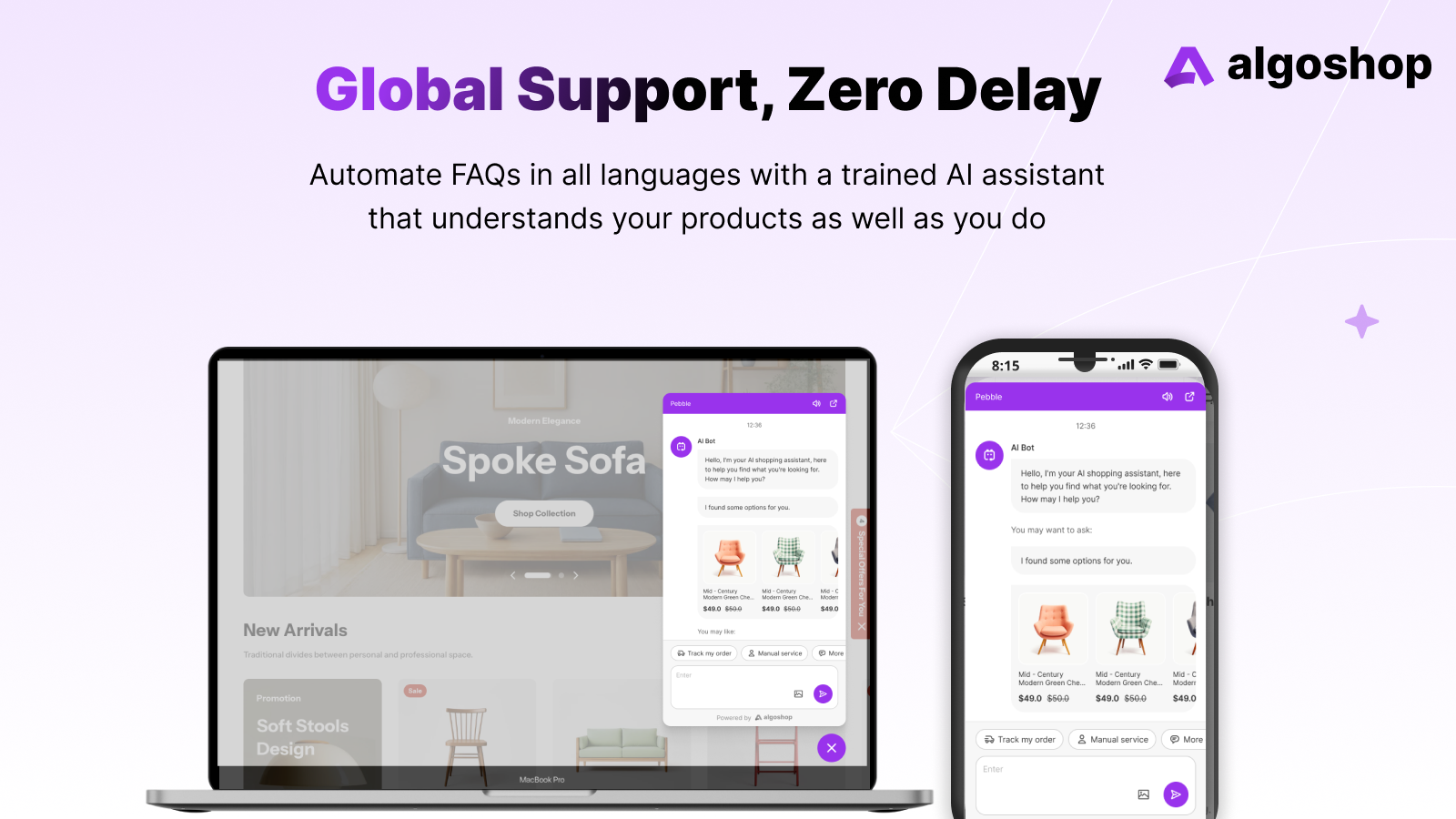
Algoshop product conversations on desktop and mobile. Official product imagery; interface examples are demonstration data.
A Shopify product page may contain every field the team was asked to fill in and still leave a buyer uncertain. “Will this size fit my room?” “Is the charger included?” “Can I use it outdoors?” A catalog record is written for the store; a buyer's question is about a decision. The work between them is to translate the right verified fact into an answer that fits the moment.
Algoshop AI Sales Chatbot is listed for AI-powered customer conversations, product recommendations, multilingual support, order tracking and live-chat assistance. Those capabilities are useful when shoppers need help before or after a purchase. They do not make an incomplete specification true. A helpful answer starts with merchant-approved data, distinguishes product facts from persuasive language and knows when to hand off.
This guide walks through the content workflow: turn catalog details into a clear answer, explain a relevant recommendation and help the buyer reach the next step. The examples are suggested merchant scenarios, not a direct integration with Simetrys's eCjenik app.
Start with the buyer decision, not the feature list
A product team may call a lamp “5W, 3000/4000/6000K, USB-powered.” A buyer may ask, “Can I use it without a plug?” The answer needs to use the electrical specification, the package contents and any battery information. Listing the numbers again without explaining their implication is technically dense but not useful.
For each product family, collect the top decisions a shopper is trying to make. These often fall into fit, compatibility, use, delivery, care and value. Map each question to the exact source the store maintains.
Swipe horizontally to read the full table.
| Buyer question | Approved source to check | Answer should help them decide |
|---|---|---|
| “Will it fit?” | Dimensions, sizing guide, variant measurements | Whether the relevant size or space requirement is met |
| “Is this included?” | Package contents | What arrives in the box and what must be supplied separately |
| “Can I use it for X?” | Approved intended-use description | Whether the stated use is supported, without inventing a capability |
| “When will it arrive?” | Current shipping and location policy | A realistic next step rather than an unsupported delivery promise |
| “What if it doesn't work for me?” | Current return and support policy | The actual conditions and contact route |
A customer answer should be short enough to act on, but complete enough to avoid a second, obvious question. If the needed fact is missing from the catalog, the answer owner should first fix the source. An AI assistant cannot infer a cable length, fabric composition or battery that the product brief does not specify.
Build a small approved answer set
Start with one product family rather than a storewide rollout. Choose five to ten questions drawn from support conversations, product reviews or the team's own sales knowledge. For each, record the source field, approved wording, exceptions and the person who owns updates. This gives the AI assistant usable context and gives human support a consistent reference.
Consider a hypothetical ceramic mug that comes in two capacities. “Is the large mug dishwasher safe?” is answerable only if the approved care information covers that specific variant. A weak answer says, “All our mugs are easy to clean.” A stronger one states the verified care instruction for the large mug and links to it. If the brief does not distinguish the variants, the assistant should say it needs confirmation. This example illustrates editorial judgment; it is not a demonstration of a live Algoshop store.
Work through the lamp question completely
For a suggested product brief, imagine the store specifies USB power, an included cable and no battery, with the power adapter sold separately. A customer asks, “Can I use it without a plug?” The most useful reply would explain: “This lamp needs a USB power source; it does not run on an internal battery. The cable is included, but the adapter is separate.” The answer has translated the specification into a decision without losing the package details.
If the shopper wanted a portable lamp, the next step is to compare an actual battery-powered option in the catalog—not to describe the USB lamp as portable because it is small. If the store sells no such option, say so and keep the explanation short. All facts in this sample brief are illustrative; replace them with the real product's power and contents information before using the response.
Swipe horizontally to read the full table.
| Stage | What the buyer needs | What the store prepares |
|---|---|---|
| Question | A plain answer about where the lamp can be used | Power source and battery information |
| Clarification | What is included and what else is needed | Package contents and adapter requirement |
| Recommendation | A suitable alternative, if one exists | Current product details and the reason for the match |
| Next step | A product page or staff contact | A usable link, not a generic “browse our store” reply |
This is where conversational product support adds value: it brings related facts together around the buyer's use, instead of making them assemble the answer from several fields.
Separate a recommendation from a promise
Product recommendations can narrow a customer's choices, but the explanation should make the reason legible. “This model has a wider base and fits the dimensions you mentioned” is more useful than “Our best-selling model is perfect for everyone.” The recommendation should point to product facts the customer can inspect, and availability should reflect the current catalog.
The Algoshop listing describes product recommendations and proactive outreach cards. A merchant can use those capabilities to put relevant options in front of shoppers. It should not turn a recommendation into an unsupported claim about performance, health, compatibility or guaranteed delivery.
A simple response pattern helps:
- Answer the stated question using an approved fact.
- Explain the implication for the buyer's use case in ordinary language.
- Offer the next step—a relevant product, policy page or human contact—without pretending the decision is already settled.
If a buyer asks for a recommendation but gives too little context, a focused follow-up question can be more helpful than a long list of products. “What size opening do you need to fit?” is a better step than guessing which accessory will work.

Product cards put a suggested item beside the conversation, so the buyer can move from a question to a product worth comparing. Source: Algoshop Partner Media Kit.
The important part of a recommendation is the connection between the reason and the item. If the buyer says their shelf is narrow, lead with the relevant dimensions. If they need a replacement accessory, lead with the compatible model. The same product may be a good suggestion for one need and a poor suggestion for another. A small, explained selection is more useful than a wall of links.
Treat order and policy questions differently
After purchase, a shopper may ask for order status, delivery changes, returns or a missing item. Those are not merely product-selection questions. The Shopify listing names self-service order tracking and live-chat support, but a store must verify the exact installed workflow and permissioned data before promising an account-specific action.
General policies can be answered from approved text. A specific delayed order may require a current record and human judgment. The assistant should make the difference clear. It can say what the normal process is and where the customer can check; it should not fabricate a tracking update or claim a refund has been issued when no authorized action occurred.
This is also a content-maintenance problem. A shipping-policy edit needs to reach the public policy page, reusable support responses and any AI knowledge source. Otherwise the store delivers different answers depending on channel.
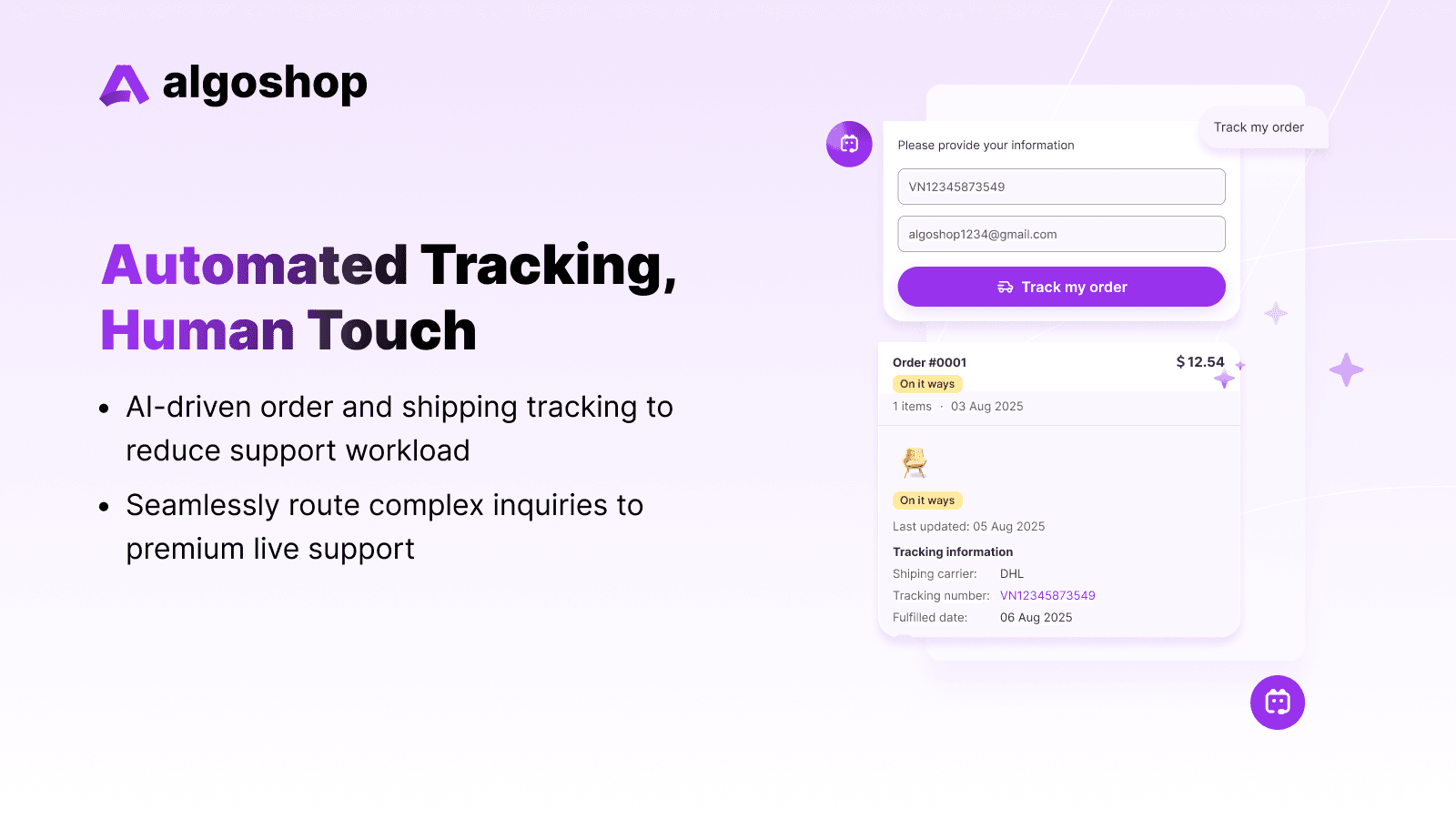
After purchase, switch from choosing a product to checking the order. Algoshop's tracking demonstration shows that different support task. Source: Algoshop Partner Media Kit.
Review the answers as a buyer would
Put the product brief beside the conversation
Use the lamp example as a complete editing exercise. The following sample brief is hypothetical, not a specification for a real product or an Algoshop-generated answer. Its purpose is to show which facts a merchant would need before offering a recommendation.
A sample product brief—not a live catalog record
Power and portability
USB-powered; no internal battery. The buyer needs a suitable power source during use. “Small” describes size; it does not establish cordless operation.
Package contents
Cable included; power adapter separate. Make this distinction visible before checkout so the customer can prepare what is needed.
Buying question
The shopper wants a light to move between rooms without plugging it in. That requirement may rule this item out even if its appearance, price and dimensions suit them.
A recommendation that changes when the requirement becomes clear
Caller: a first question
“Can I use this lamp without a plug?”
Agent: explain the relevant fact
“It needs a USB power source and has no internal battery. The cable is included, but the adapter is separate. Are you looking for cordless use, or a small lamp for a powered desk?”
Caller: clarify the task
“Cordless. I want to carry it from the bedroom to the balcony.”
Agent: keep the recommendation tied to the catalog
“Then this USB-powered model does not match that requirement. If the store has a battery-powered model, compare its documented use and charging details next. Outdoor suitability also needs its own product specification.”
The suggested answer has not lost the original item's useful details. It has explained them, discovered a decisive requirement and avoided treating a second requirement—outdoor use—as automatically satisfied. In a real store, link an actual suitable alternative only when one exists and its information supports the recommendation. If no item meets the request, a clear explanation is better than manufacturing a match.
Show why the alternative is relevant
For a different shopper using a powered desk, the same USB lamp may remain a sensible option. The explanation should connect the documented power source and included cable to that use, then identify any remaining question about the adapter, dimensions or controls. Product guidance is not simply ranking items; it is making the reason for the recommendation visible.
When preparing content for Algoshop's product-guidance workflow, collect the distinctions customers use to choose: what is included, what must be supplied separately, where the product can be used and which variants change those answers. Avoid replacing this detail with a longer list of adjectives. A complete brief makes both the human support answer and the AI-assisted conversation more useful.
Before publishing, test the assistant with questions that a real buyer might ask—not only the clean examples in a product brief. Include a typo, a comparison between variants, a question whose answer is missing, and a question that requires personal order information. Read the responses for accuracy, tone and next step.
Swipe horizontally to read the full table.
| Test case | Good behavior | Warning sign |
|---|---|---|
| Clear specification question | Gives the exact approved fact and context | Repeats marketing adjectives without answering |
| Ambiguous fit question | Asks for the missing measurement | Declares compatibility from a guess |
| Unsupported claim | States the limit and routes to review | Invents a benefit or certification |
| Order-specific request | Uses authorized status or support handoff | Creates a made-up delivery or refund event |
Then look at the source. If the same unanswered question keeps appearing, rewrite the product page or FAQ as well as the chat response. The best support system reduces confusion in the underlying shopping journey.
An editorial rollout for a busy merchant
One week can be enough to test the method without pretending to measure commercial impact. On day one, choose a product family and list frequent questions. On day two, verify the product facts and owner. On day three, draft short approved answers. On day four, test difficult cases and handoff. On day five, improve the public page where information was hard to find. Later reviews can look at whether customers ask different questions or still hit the same gap.
This sequence is intentionally small. It makes it possible to correct mistakes before they scale across a large catalog or many languages. For stores serving international shoppers, translate and review the underlying facts as carefully as the answer style; a fluent translation of an incorrect claim is still incorrect.
Frequently asked questions
Does an AI chatbot replace product content work?
No. It makes approved information easier to use in conversation. The product facts, policies and exceptions still need an owner and regular review.
What if the buyer asks something the store has never documented?
Ask a clarifying question or pass the issue to a person who can verify it. Use the recurring question as evidence that the product page or support material needs improvement.
Can Algoshop answer in multiple languages?
The current Shopify listing describes multilingual AI support. The merchant should still check key product terminology, policy wording and the experience in the languages their shoppers use.
Helpful buyer answers are built from a chain the merchant can inspect: question → approved fact → clear explanation → next step. Algoshop AI Sales Chatbot can help deliver that explanation in the shopping conversation; the quality of the chain remains the store's responsibility.